








Oracle reported good news and not-so-good news in its Q3 2016 financial results March 15; then, its executives spent time on the earnings call claiming that it has conquered competitors Workday and Salesforce in the marketplace.
Of course, slamming the competition publicly has been the modus operandi for years at the Redwood City, Calif.-based enterprise database and software provider, so no surprises there.
Oracle reported that its revenues were down in the quarter, largely due to a prolonged slowdown of sales of its on-premises database and supporting software. Revenue dipped 3 percent to $9.01 billion, missing Wall Street projections of $9.12 billion.
Profit retreated 14 percent during the quarter to $2.1 billion. This remains a healthy net gain, however, thanks largely to a whopping 51 percent gross margin and steady control of corporate costs.
On-Premises Software Slipping, Cloud Not Catching Up
Oracle’s on-premises software sales fell 4 percent during the quarter, and this has been a continuing trend. Total services revenues were $793 million, down by 7 percent.
Total hardware revenues were $1.1 billion, down 13 percent; this, too, has been a trend since 2010, after the company bought Sun Microsystems.
On the positive side, Oracle is selling cloud software and services like it never has before, which the company claims is causing a lot of its customers to switch over from conventional Oracle on-premises systems–and from systems made by Salesforce and Workday.
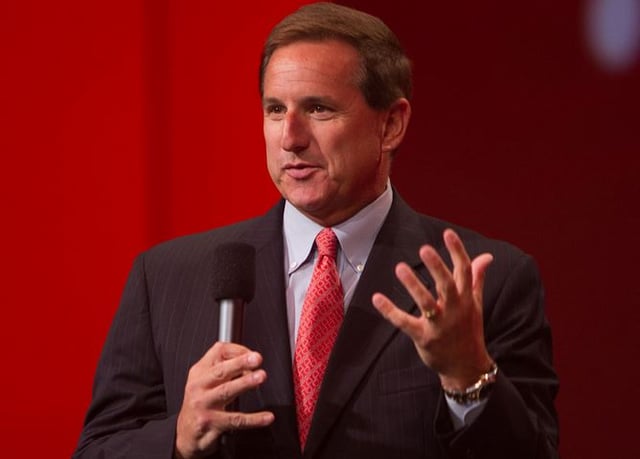
“About Workday: We’re 10X bigger than they are (in ERP, enterprise resource planning),” co-CEO Mark Hurd (pictured; credit Wikipedia) said on the conference call to analysts, investors and journalists. “Southwestern Energy had Workday and stopped their Workday implementation to use Oracle. Fannie Mae used Workday, no longer does, now uses Oracle. Moneygram started off implementing Workday, it didn’t go well, reevaluated, and now has Oracle ACM Cloud as their core app for their enterprise.”
Has Oracle Passed Salesforce in SaaS and PaaS?
Chairman, co-founder and CTO Larry Ellison weighed in on Salesforce, which is CEO’d by a former employee, Marc Benioff.
“Oracle is now selling more new SaaS and PaaS annually recurring cloud revenue than any other company in the world, including Salesforce.com,” Ellison said on the call. “We’re growing much faster than Salesforce.com–more than twice as fast–because we sell into a lot more SaaS and PaaS markets than they do. We compete directly with Salesforce.com in every segment of the vast customer-experience market–including sales, service and market.
“Oracle also competes in huge SaaS markets where Salesforce does not compete at all, such as ERB (educational records bureau) and HVM (high-volume manufacturing).”
Co-CEO Safra Catz said cloud services and software sales grew 40 percent overall in the quarter, led by SaaS (software as a service) and PaaS (platform as a service).
“Our cloud business is now in a hyper-growth phase,” Catz said.
Asked if Oracle is cannibalizing its own customers by moving them to cloud in replacing current on-premises software deployments, Hurd agreed–without using the term “cannibalize.”
“We’re making that trade every day. If we can trade license for cloud, that’s what we’re doing,” Hurd said on the conference call. “Yeah, we’re seeing more momentum in cloud (sales), and we look at that as great.
“Let me look at this one more time: If we get a dollar (per) booking in cloud and a dollar (per) booking in license, the next year we get the support on the license. The next year, that dollar we get as a booking — we get another dollar of revenue. The fact that you see those dollars shift, that is an absolute good thing for us,” Hurd said on the call.
That was his explanation, word for word. Hurd did not elaborate on his statement, which undoubtedly left some listeners scratching their heads.