








- Data Governance: 10 Steps to Establishing Effective Policies
- Recognizing Data Governance-Related Critical Business Issues
- Determine What Is Causing or Continuing These Issues
- Explore the Impact of a DG Program
- Establish a Vision for Effective Enterprise Data Utilization
- Identify Cross-Functional Stakeholders, Decision Makers
- Determine and Document DG Impact and Benefits
- Define How a Successful DG Deployment Will Be Measured
- Develop an Enterprise Information Map
- Determine What Existing IT Can Be Repurposed for DG
- Share Quick Wins of Data Governance Throughout the Enterprise
Data Governance: 10 Steps to Establishing Effective Policies
By Chris Preimesberger
Recognizing Data Governance-Related Critical Business Issues
Data governance is most commonly associated with regulatory compliance. But data quality and comprehension exist at the heart of data governance. The ability to more completely use rapidly growing volumes of enterprise data, as a competitive advantage, is also a recognized goal of a data governance strategy. Achieving this in a manner that ensures only the right people see the right data at the right time gives organizations a realistic path to follow for on-ramping data governance.
Determine What Is Causing or Continuing These Issues
The sheer volume of data that is captured and stored by organizations is stressing existing data management capabilities. Data quality suffers as efforts to accurately comprehend data context are impacted by resource and technology constraints. At the same time, minimizing security risks becomes more complicated; categorizing data by security level and tracking data movements and transformations can be labor-intensive and very costly.
Explore the Impact of a DG Program
Ignoring data governance can lead to significant risks when making important business decisions. These include heavy fines, and even executive incarceration in the case of data breaches and theft. The upside: Data governance can help organizations make more accurate, higher-value business decisions, and respond faster to market trends and customer demands.
Establish a Vision for Effective Enterprise Data Utilization
Ease of use by technical and nontechnical staff should be a prerequisite. Technical users should have access to detailed data insights that help accelerate measurable data governance success. Building data governance tasks and processes into automated technical operations for business users will encourage faster adoption and more sustained engagement.
Identify Cross-Functional Stakeholders, Decision Makers
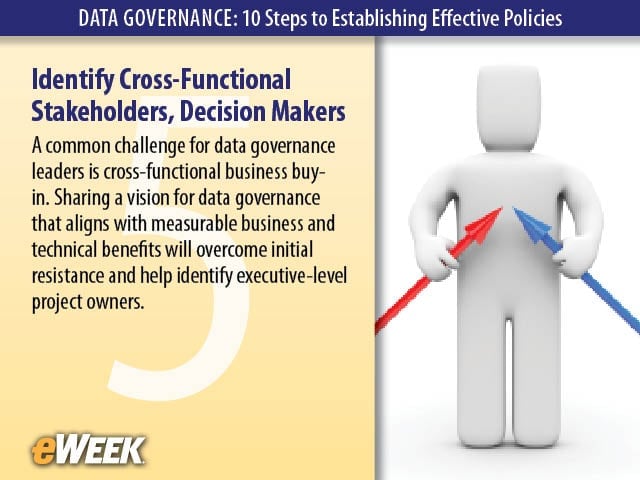
A common challenge for data governance leaders is cross-functional business buy-in. Sharing a vision for data governance that aligns with measurable business and technical benefits will overcome initial resistance and help identify executive-level project owners.
Determine and Document DG Impact and Benefits
Segmenting those who will be impacted by a data governance program allows an organization to more clearly understand how to motivate involvement at a tactical level. Individual benefits must be made obvious and should apply to daily tasks and responsibilities.
Define How a Successful DG Deployment Will Be Measured
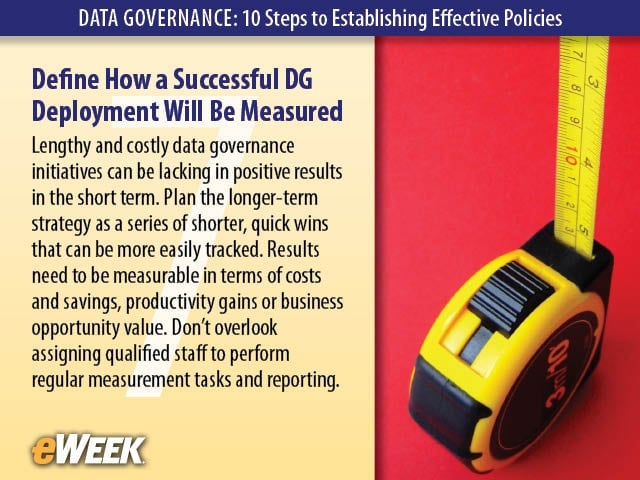
Lengthy and costly data governance initiatives can be lacking in positive results in the short term. Plan the longer-term strategy as a series of shorter, quick wins that can be more easily tracked. Results need to be measurable in terms of costs and savings, productivity gains or business opportunity value. Don’t overlook assigning qualified staff to perform regular measurement tasks and reporting.
Develop an Enterprise Information Map
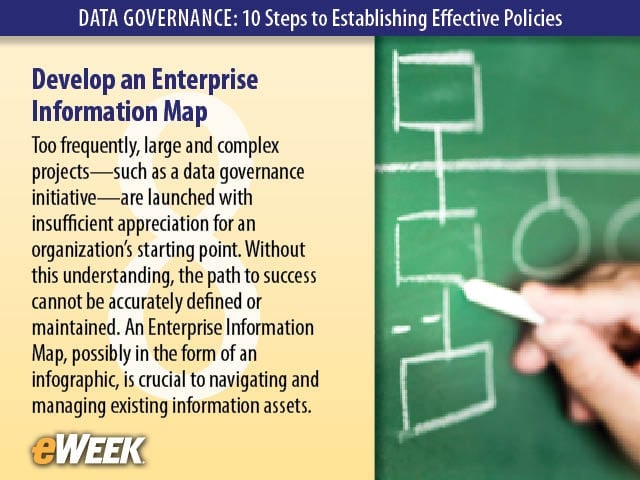
Too frequently, large and complex projects—such as a data governance initiative—are launched with insufficient appreciation for an organization’s starting point. Without this understanding, the path to success cannot be accurately defined or maintained. An Enterprise Information Map, possibly in the form of an infographic, is crucial to navigating and managing existing information assets.
Determine What Existing IT Can Be Repurposed for DG
A frequent obstacle to meaningful progress is the belief that an expensive new system must be acquired. This is not the case. Many organizations are already using some essential tools that will allow data professionals to manage and model data based on a detailed understanding of business and governance needs. First, learn how existing systems can be applied or repurposed before committing to new technology.
Share Quick Wins of Data Governance Throughout the Enterprise
Identifying and sharing quick wins helps promote interest, buy-in and the broader adoption of data governance benefits. Develop an environment of shared celebration based on positive data governance metrics.