






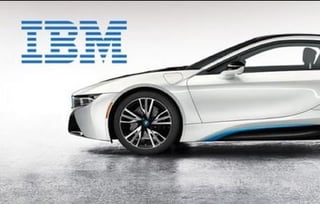

A couple of companies with pretty well-known three-letter names, BMW and IBM, revealed Dec. 15 that they are working together in utilizing Watson cognitive computing to design and build cars of the future.
A key part of the agreement entails the BMW Group moving a team of researchers to IBM’s global headquarters for Watson Internet of Things in Munich. The companies will work together to explore how to improve intelligent assistant functions for drivers.
To further its automotive research and demonstrate the possibilities of Watson IoT technologies to clients, IBM will locate 4 BMW i8 hybrid sports cars at its Munich Watson IoT HQ. Prototype solutions which will run on IBM’s Bluemix cloud platform will help demonstrate how Watson can enable new conversational interfaces between cars and drivers.
Watson Will Learn Driver Preferences for Design Purposes
Watson’s machine learning capabilities offer new opportunities for vehicles to learn about the preferences, needs and driving habits of their drivers over time, customizing the driving experience accordingly and improving levels of comfort and safety, IBM said.
The car’s manual will be ingested into Watson so that drivers can ask questions about the vehicle in natural language while still being able to focus on the road. The aim is for the solution to also incorporate data from the Weather Company (an IBM business) as well as real-time, contextual updates about route, traffic and vehicle status in order to enrich the driving experience and make recommendations to the driver.
IBM recently pledged to invest $200 million to make its new Munich center one of the world’s most advanced facilities for collaborative innovation as part of a global investment of $3 billion to bring Watson cognitive computing to the Internet of Things.
Big Blue opened its Watson center in Munich exactly a year ago. So far, more than 6,000 customers globally are using IoT solutions and services—up from 4,000 just nine months ago, IBM said.
‘Collaboratories’ in Play Here
BMW, which also has its company headquarters in Bavaria’s capital, is one of the first companies to sign up to be collocated inside IBM’s building within one of the so-called industry “collaboratories.” A team of BMW Group engineers will work alongside IBM’s own team of technologists, developers and consultants, the two companies said.
According to IBM’s studies, cars are increasingly becoming:
—Self-healing: Vehicles that are able to diagnose and fix themselves and even fix other vehicles with issues without human help.
—Self-socializing: Vehicles that connect with other vehicles and the world around them.
—Self-learning: Vehicles with cognitive capability to continuously learn and give advice based on the behavior of the driver, passengers, and other vehicles.
—Self-driving: Vehicles are moving from limited automation to becoming fully autonomous.
—Self-configuring: Vehicles adapt themselves to a driver’s personal preferences—everything from seat height and position to their drivers’ favorite destinations.
—Self-integrating: Like other smart devices, these vehicles will be integrated parts of the IoT, connecting traffic, weather, and mobility events as they move around.
“Watson is transforming how people interact with the physical world—helping to create safer, more efficient and personal experiences at home, at work and on the road,” said Harriet Green, Global Head of IBM’s Watson IoT business.
“With this agreement, our companies will work together to lay the foundations so that drivers can benefit from Watson’s conversational and machine learning capabilities. Our insight shows that while the car will remain a fixture in personal transportation, the driving experience will change more over the next decade than at any other time of the automobile’s existence.”