






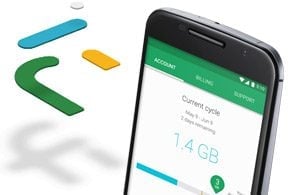

Customers of Google’s project Fi high-speed wireless service now have the equivalent of an unlimited data plan.
Google this week introduced a new Project Fi feature called Bill Protection that caps data usage charges at certain levels regardless of how much data is actually used.
For example, for a single user, Google will continue to charge $20 per month for unlimited voice calling and text messaging and $10 per gigabyte of data used. As usual, Google will only charge for data that is actually used. For instance, an individual that pays for 2GBs of data but only uses 1.5GB in a particular month pays only $15 and gets a credit for the remaining amount.
But under the new plan, the data charges will top off at 6GB. In other words, an individual user will continue to pay as usual until the 6GB mark. Any data usage after that will be completely free and available at the same speed, according to Google. So, a Project Fi subscriber using 6GB per month will pay $80 per month plus taxes as will an individual that uses 12GB per month.
Bill Protection will apply both for data used in the United Sates and overseas.
It is only when users start using more than 15GB of data per month that they will start experiencing slower speeds, Project Fi product manager Marcia Jung said in a Jan. 17 blog post. “Bill Protection gives you the peace of mind to use extra data when you need it,” Jung said. “Bill Protection kicks in at different usage points based on the number of people on your plan,” she said.
For example, unlimited calls and text for two people will continue to be available for $35 per month. But Bill Protection will kick in at 10 GB per month—any data usage that exceeds 10 GB will be free. Similarly, for four people, Bill Protection is available at 14 GB and for six people data usage charges stop after 18 GB.
Google’s Project Fi is a wireless service that uses a combination of WiFi and 4G LTE networks belonging to various carriers to provide wireless coverage in the U.S. and internationally. In the United States, Google has partnerships with three cellular network providers—Sprint, T-Mobile and U.S. Cellular—to provide the service.
The service works by constantly moving users between WiFi and cellular networks based on their availability and speed. When multiple carrier networks are available in a single area Project Fi will automatically use the fastest service in that location.
Since the service requires phones that are capable of working across multiple carrier networks, Project Fi is currently available for only a handful of devices equipped with a special SIM card and a cellular radio optimized to work across different networks, according to Google.
Among the currently available Project Fi-friendly phones are Google’s Pixel 2 and Pixel 2 XL starting at around $650 and the Pixel XL, which sells for around $550. The service is also available with the Android One Moto X4, Nexus 6P and Nexus 5X.
Bill Protection is available to Project Fi individual subscribers and those on group plans, starting this week. Google is offering a $120 discount on some of its Fi-ready phones for those interested in signing up for the plans.