








How Internet of Things Will Shape Intelligent Enterprises
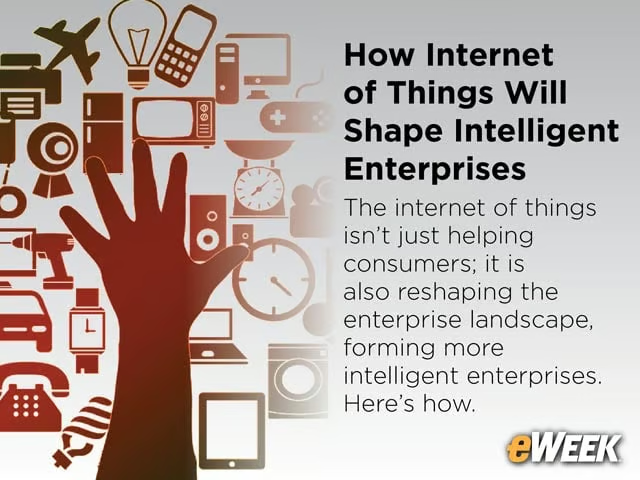
People are more than ready for the internet of things because they’ve been reading about its possibilities for a few years. They are beginning to buy smart connected products, such as thermostats, washing machines and refrigerators. Similarly, the IoT is quickly impacting and reshaping the enterprise landscape, forming more intelligent enterprises across industries. The convergence of IoT, mobility and cloud computing has led to a new operational paradigm known as the intelligent enterprise which allows businesses to be more efficient and make informed decisions with improved real-time visibility. This eWEEK slide show, using industry information from Tom Bianculli, CTO of Zebra Technologies, provides insights into the intelligent enterprise.
The Promise of the Intelligent Enterprise

Businesses around the world will be dynamically streaming data to their workforces in real time. They will be able to run their operations at the speed they can collect data. They will be able to make decisions in real time. They will have visibility into what is actually happening as it happens, and react in real time. The new reality is that access to real-time data—from people, processes and devices through sensors connected to the internet—will revolutionize the way we interact with each other and our world.
Retail

On average, only 65 percent of inventory reported through retailers’ inventory management software is correct. Technological advancements in areas such as machine vision, RFID (radio-frequency identification) and machine learning are enabling more advanced tracking by allowing inventory to be “seen” and connected, rather than only manually scanned. Thanks to IoT solutions, we may soon see the day when a customer picks up a sweater from a shelf and buys it right there with his or her smartphone, without the need to wait in line at checkout.
Transportation and Logistics
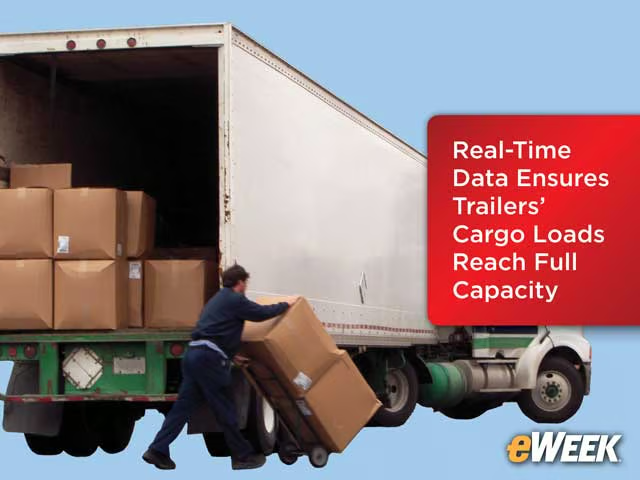
Research shows the average floor-loaded trailer could carry 30 percent more cargo than they currently do. Using data collected right at the dock door together with mobile devices and trailer load analytics software, warehouses and dock managers are now receiving a real-time view of each trailer to ensure their cargo loads reach their full potential to optimize deliveries.
Manufacturing
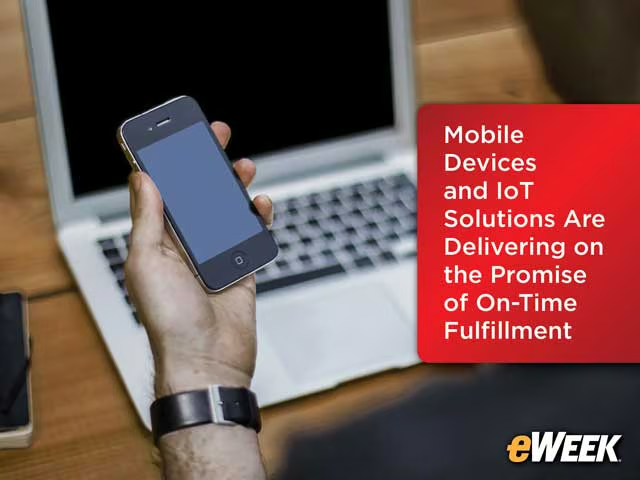
In this on-demand world, consumers expect shorter delivery times and simultaneously the number of shipments increasing. Mobile devices and IoT solutions are enabling warehouses to deliver on the promise of flawless, more efficient and on-time fulfillment. And with the rise of 3D printers, we’ll soon live in a world where a customer can order an item, and the delivery truck prints that item as it’s driving to his or her home.
Health Care

In health care, wearables and sensors that automatically transmit health data directly to doctors will eliminate the need to manually enter the information into a system. This decreases the number of face-to-face doctor visits and frees up physicians to spend more quality time with each patient. Providing timely treatment for patients has long been a challenge, but with smart, noninvasive technology, health care facilities now have access to accurate, real-time tracking of patients to provide faster, better care.
Entertainment

The NFL is placing sensors in each player’s shoulder pads to track movement and generate real-time player stats. The result: real-time analysis of the speed, angle, acceleration and deceleration of the game—data never before seen in this game played since the mid-19th century.
The Power of Partnerships

To stay on top of the present and prepare for the future, enterprises must determine how to best connect and manage these devices while using them to benefit their business processes and create new experiences for their employees, customers, partners and all stakeholders. Partnerships—among value-chain providers and industry groups, for starters—are a good part of the answer. But those need to be developed in order for the enterprise to continue to grow.
Partnerships Will Need to Connect Across Industries
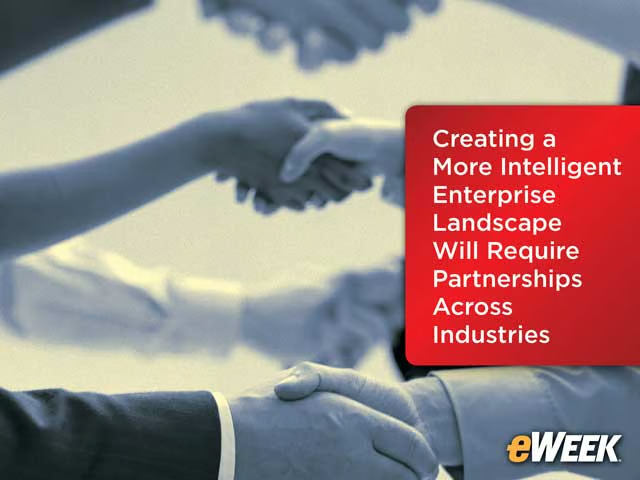
Despite the potential that the IoT presents, creating a more intelligent enterprise landscape cannot be accomplished by one or even a handful of innovators. It will require businesses across industry sectors and market sizes to convene and partner with vendors, government, customers and academic institutions to establish agreed-upon standard practices and guidelines so that all enterprises can connect and become more intelligent. Through the power of partnerships, we can build smart infrastructure for cities, individuals and businesses. Standing still is not an option.