






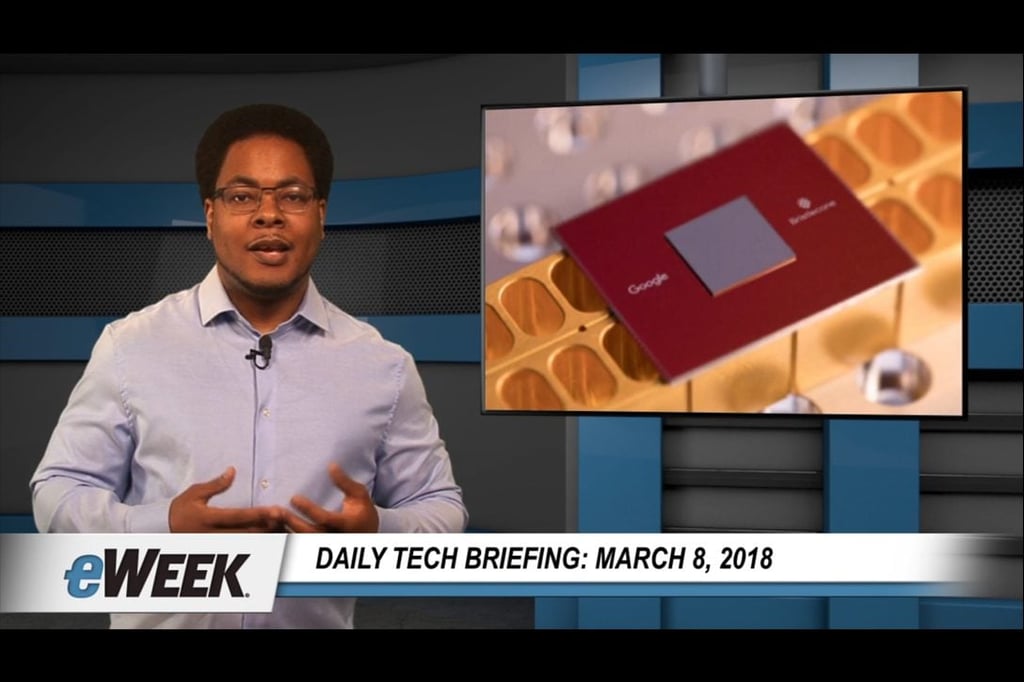


Today’s topics include Google previewing the largest quantum computing processor to date; the DDoS record broken again as a memcached attack hits 1.7 Tbps; Microsoft revamping the setup experience for Windows 10; and hyperconverged infrastructure systems as one of the hottest IT markets of 2018.
Google this week previewed Bristlecone, a 72-qubit quantum processor that surpasses the previous record 50-qubit system IBM announced last November.
Google’s announcement, at the American Physical Society meeting March 5 in Los Angeles, takes the company one step closer to its goal of demonstrating “quantum supremacy,” where a quantum computer can perform a task that a classical computer cannot. Google thinks quantum supremacy can be easily demonstrated with a 49-qubit processor so long as certain other technical conditions are also achieved.
Julian Kelly, research scientist at Google’s Quantum AI Lab, said, “We believe the experimental demonstration of a quantum processor outperforming a supercomputer would be a watershed moment for our field. [It] remains one of our key objectives.”
Netscout Arbor on March 5 reported the largest ever distributed denial-of-service attack to date at 1.7 terabits per second, just four days after the previous largest DDoS attack at 1.35 Tbps against GitHub was reported. Both attacks involved improperly configured memcached servers that reflected attack traffic, amplifying the total volume.
At this point in time, it’s not clear who is behind the memcached DDoS attacks, though indicators show where the traffic is coming from.
Carlos Morales, vice president of Arbor’s Security Engineering and Response Team, noted, “The top source country was the United States at nearly 50 percent of the traffic at peak. The other sources in the top 5 included France, Netherlands, UK and Australia.”
Microsoft on March 6 released Windows 10 test build 17115 for PC members of the Windows Insider early-access program. The new build features a revamped set of controls that greet users when they first run the operating system. Included is a new setup experience offering users control over how their data is shared with the company.
Marisa Rogers, Windows and Devices Group Privacy Officer at Microsoft, said, “This new design conveys focused information to help our customers make focused choices about their privacy and offers two new settings for Inking & Typing and Find my device.”
Those new settings may show up in a single-screen layout or as separate screens for some users so that the company’s developers can gauge which approach is most effective. On separate screens, Microsoft will highlight its privacy recommendation by framing it with a dotted line. Some users may be presented with up to seven individual screens.
Hyperconverged infrastructure systems are all the rage, with HP, Dell EMC, Cisco Systems, Lenovo, Nutanix, Pivot3, Cohesity, HyperGrid, Maxta and others all crowding the space. “Hyperconverged” refers to platform offerings that share computing and storage resources, based on software-defined storage, software-defined computing, commodity hardware and a unified management interface.
Hyperconverged systems deliver their main value through software tools, commoditizing the underlying hardware. The market surpassed $2.2 billion in global revenue in 2016, up 110 percent compared to 2015, and was at $2.9 billion after three quarters in 2017.
Pivot3 CEO Ron Nash said, “Hyperconverged is in a ‘crossing-the-chasm’ situation right now. … Once [everybody] bought the hyperconverged system for one purpose, they started to run other things on it. They saw that it stayed up, did not lose data, was easy to operate and was less expensive than buying traditional legacy gear.”