








- Next-Gen Object Storage: 10 Key Data Points From Industry Summit
- Defining Object Storage
- Enables Massive Scalability
- Much Easier, Faster Search Through Metadata
- A Growing Number of Major Providers Offer Object Storage
- Amazon’s Five Storage Options
- NetFlix: 100 Percent of Its Video Service Runs on Amazon
- Aligns With the Cost of Data
- Big Data Is Changing Traditional Role of Storage
- Cloud Computing Is a Natural for Object Storage
- Object Storage Saves Costs Over Time
Next-Gen Object Storage: 10 Key Data Points From Industry Summit

by Chris Preimesberger
Defining Object Storage
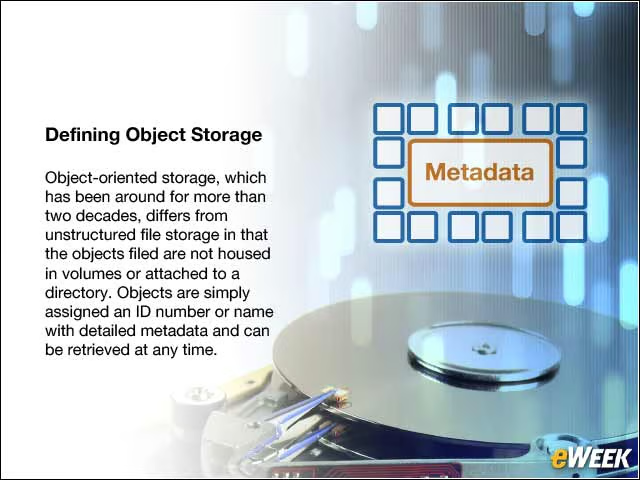
Object-oriented storage, which has been around for more than two decades, differs from unstructured file storage in that the objects filed are not housed in volumes or attached to a directory. Objects are simply assigned an ID number or name with detailed metadata and can be retrieved at any time.
Enables Massive Scalability
The world’s largest online object storage providers, Microsoft Azure Storage (5 trillion objects) and Amazon (2 trillion objects), prove that there is virtually no limit to storage in object-oriented systems.
Much Easier, Faster Search Through Metadata
Object storage systems can easily search for data without knowing specific file names, dates or traditional file designations. They can also use the metadata to apply service-level agreements (SLAs), policies for routing, distribution and disaster recovery, retention and deletion, as well as to automate storage management. These are functions that file systems just cannot address.
A Growing Number of Major Providers Offer Object Storage
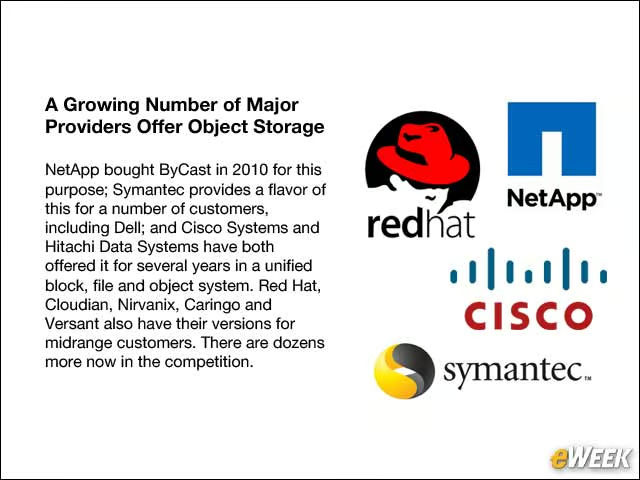
NetApp bought ByCast in 2010 for this purpose; Symantec provides a flavor of this for a number of customers, including Dell; and Cisco Systems and Hitachi Data Systems have both offered it for several years in a unified block, file and object system. Red Hat, Cloudian, Nirvanix, Caringo and Versant also have their versions for midrange customers. There are dozens more now in the competition.
Amazon’s Five Storage Options
Amazon, which came out with its cloud storage service in 2006 and has led the market since that time, has five types of storage available at this time. They are the frontline Amazon S3 (Simple Storage Service); a separate redundant high-scale object store for enterprises; Amazon Glacier for archiving, a low-cost archive in the cloud; Reduced Redundancy Storage, a lower-redundancy object storage option; the Amazon Web Service (AWS) Storage Gateway, which enables access to S3 for file sharing, data copies and backup; and AWS Elastic Block store, which offers block storage for Elastic Compute Cloud (EC3).
NetFlix: 100 Percent of Its Video Service Runs on Amazon
Netflix and YouTube have more video stored in the cloud than any other companies in the world.
Aligns With the Cost of Data
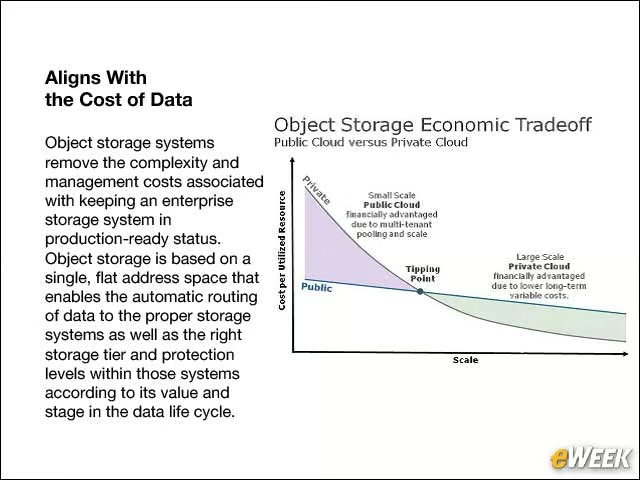
Object storage systems remove the complexity and management costs associated with keeping an enterprise storage system in production-ready status. Object storage is based on a single, flat address space that enables the automatic routing of data to the proper storage systems as well as the right storage tier and protection levels within those systems according to its value and stage in the data life cycle.
Big Data Is Changing Traditional Role of Storage
Historically, the databases were used to store highly structured business data, which fit well into spreadsheet form and was good at answering relatively simple questions. In combination, this solved some moderately interesting use cases. Today, data is found in numerous forms, from machine-generated processes to spreadsheets, PDFs, Web logs, photos, video and so on. All that data conforms to domain-specific information models that often involve complex structures. Object storage dismisses all of this and puts it all in pools of storage.
Cloud Computing Is a Natural for Object Storage
The cloud is founded on the utility of computing and the “self-healing of infrastructure.” These tenets lend themselves well to secondary problems confronting data management on the big data frontier. Big data load problems are solved through distributed software architecture and parallel processing. Cloud computing inherently delivers a distributed infrastructure suitable for distributed software architectures. The ability to spread data across multiple machines and to move processes to various machines to provide efficiency is how data is best processed, and the scalability object storage brings is a key element in this.
Object Storage Saves Costs Over Time
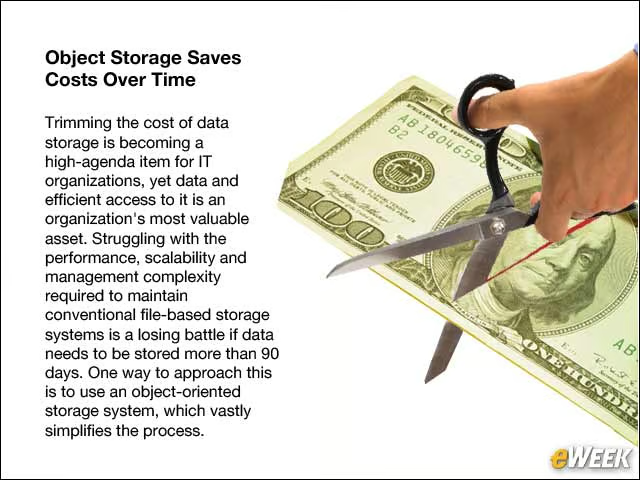
Trimming the cost of data storage is becoming a high-agenda item for IT organizations, yet data and efficient access to it is an organization’s most valuable asset. Struggling with the performance, scalability and management complexity required to maintain conventional file-based storage systems is a losing battle if data needs to be stored more than 90 days. One way to approach this is to use an object-oriented storage system, which vastly simplifies the process.