







BARCELONA, Spain—The DockerCon EU conference kicked off here today, with both the devoted and the curious assembled to learn about one of the most talked-about technologies today—Docker. It’s no longer just a small project run by a single company; it’s a community that has the biggest names in IT—including Hewlett Packard Enterprise and IBM—supporting it.
But why is Docker so popular? What makes it the new technology that organizations big and small are racing to embrace?
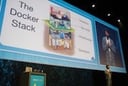
That’s a question that Docker Inc.’s founder Solomon Hykes (pictured) and CEO Ben Golub answered during a two-and-half-hour keynote where they detailed the vision and the model that defines Docker’s progress.
First the numbers.
According to Golub, there are now 240,000 Dockerized applications. Those applications are not just idly sitting in the Docker Hub repository. Since January, there have been 1.3 billion Docker Hub application downloads (referred to as “pulls”), which translates to approximately 65 Docker Hub pulls per second, Golub said.
Docker is no longer just an application virtualization engine. The broader Docker project portfolio now also includes the Docker Compose and Swarm efforts first announced in February. Docker Swarm provides container clustering capabilities, and Docker Compose enables multiple containers to be pulled together to run a single logical application.
Containers are also now a broader open specification, thanks to the Open Container Initiative project at the Linux Foundation, which Docker helped create. More than 35 members are now participating in that organization, Golub said.
Perhaps the most important statistic of all, though, is the fact that, according to Golub, 40 percent of organizations that are using Docker are now using it in production.
Why are so many people embracing Docker? Hykes said that it has a lot to do with Docker executing on its mission.
“Our mission is to build tools of mass innovation,” Hykes said.
Hykes explained that all around the world there are enormous numbers of creative people and then there are lots of pieces of incredible technology that could enable many people to invent new things—if only the creative people could more easily use the incredible technology.
Docker builds and delivers tools that can make hard technology easier to use, which in turn, Hykes hopes, can lead to the mass innovation that is Docker’s mission. Simply making tools available, however, isn’t enough, the tools need to have a high degree of quality too—a point that Hykes emphasized at great length.
“We will always put quality first,” Hykes said. “Quality is a journey not a destination; either you are focused on quality or you’re not.”
In order to fulfill the mission of building tools of mass innovation, Hykes is certain that reliable tools are needed, and part of reliability is enforcing a high degree of quality.
“Our hope is that whenever you come up with the next breakthrough in whatever it is you’re going to build, ship and deploy, we want to be the ones to help you get there,” Hykes said.
Sean Michael Kerner is a senior editor at eWEEK and InternetNews.com. Follow him on Twitter @TechJournalist.