








The companies building the future of artificial intelligence are now trying to build something less glamorous but just as essential: their own labor supply.
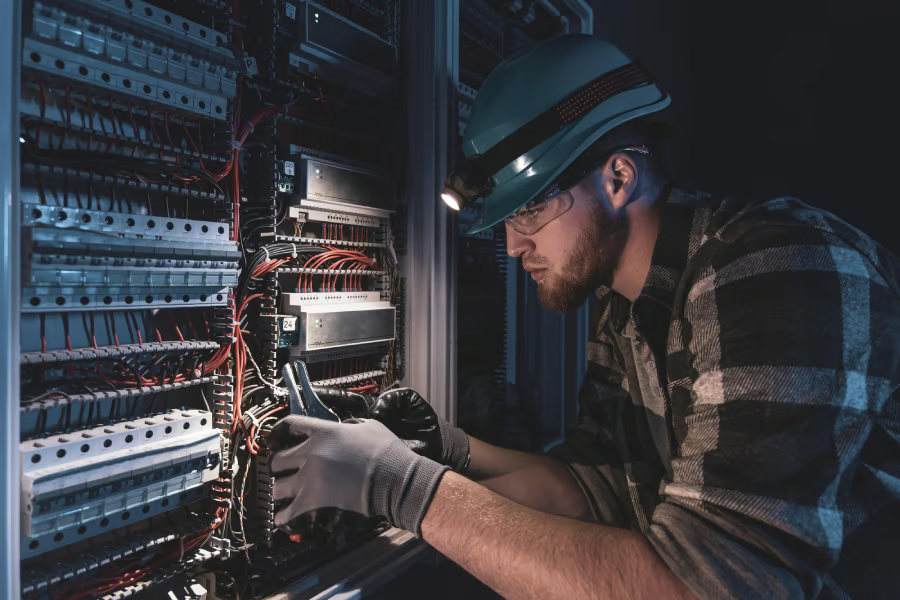
Several outlets have reported that technology companies have begun funding programs to recruit and train electricians, carpenters, and other workers needed to construct and operate data centers. The move reflects a shift in corporate strategy, as companies that once competed mainly for engineers and researchers are now increasingly competing for blue-collar workers who can install power, cooling, and communications systems.
As AI infrastructure spending accelerates, access to skilled electricians is becoming as strategically important as access to Nvidia GPUs. Without enough workers, billion-dollar data center projects risk delays regardless of available capital.
Meta and Google are investing a combined $165 million in workforce training programs, according to Quartz. Meta has committed $115 million to fund a one-year initiative, while Google is investing $50 million over three years to expand training for electricians and other skilled trades needed to support AI data center construction.
Apprentices enrolled in Meta’s one-month program will get transportation and housing covered, as the company is aggressively pushing to start with 5,000 trainees. Google, on the other hand, is taking a similar but less aggressive push. The company aims to increase annual apprenticeship intake from 19,500 to 30,000 over the next three years.
In Texas, BlackRock is also betting $100 million for the same purpose, Quartz reports. The move reinforces a growing reality across the AI industry: building the next generation of data centers now depends as much on securing skilled labor as it does on financing, land, or advanced chips.
Citing an Indeed analysis reported by The New York Times, Quartz notes that trained electricians working in data centers earn 42% more than those working elsewhere, underscoring the high demand for these roles.
Physical infrastructure is becoming an increasing bottleneck
The expansion of artificial intelligence is creating a bottleneck between the pace of AI investment and the pace at which infrastructure can be built. Companies may have the capital to buy GPUs and acquire land, but projects can still stall because of limited grid capacity, equipment shortages, permitting delays, and a lack of skilled workers.
Electrical work is particularly critical because AI data centers place heavy demands on power-distribution systems. Workers must install transformers, switchgear, generators, uninterruptible power supplies, busways, and server-rack connections, while cooling specialists manage the heat produced by dense computing equipment.
As a result, the AI race is becoming, in part, a competition for physical capacity. Companies are competing not only for chips, engineers, and computing power, but also for the underlying infrastructure of these data centers.
An employment irony
While AI is being blamed for eliminating thousands of jobs, events like this suggest it is also creating new ones.
The contrast echoes advice from Geoffrey Hinton, one of the pioneers of modern AI. Speaking on The Diary of a CEO podcast, Hinton said, “It’s going to be a long time before it’s as good at physical manipulation as us,” before adding that being a plumber would be a good bet against AI job displacements.
Hinton’s point was that AI can perform many forms of mind work more easily than it can navigate unpredictable physical environments. Plumbing, electrical work, and similar trades require moving through cramped spaces, handling irregular materials, adapting to on-site conditions, and making real-time judgments — tasks that remain difficult even with embodied AI.
The AI boom is reshaping the labor market in unexpected ways. While automation threatens some office jobs, the industry's expansion is making electricians, pipefitters, HVAC specialists, and other skilled trades increasingly indispensable to building the infrastructure AI depends on.
For an industry often defined by breakthroughs in software, the next phase of the AI race may depend just as much on the people wiring the data centers as the engineers designing the models.
Other news: OpenAI has also launched a program offering 100,000 academic researchers free access to ChatGPT through 2027.