






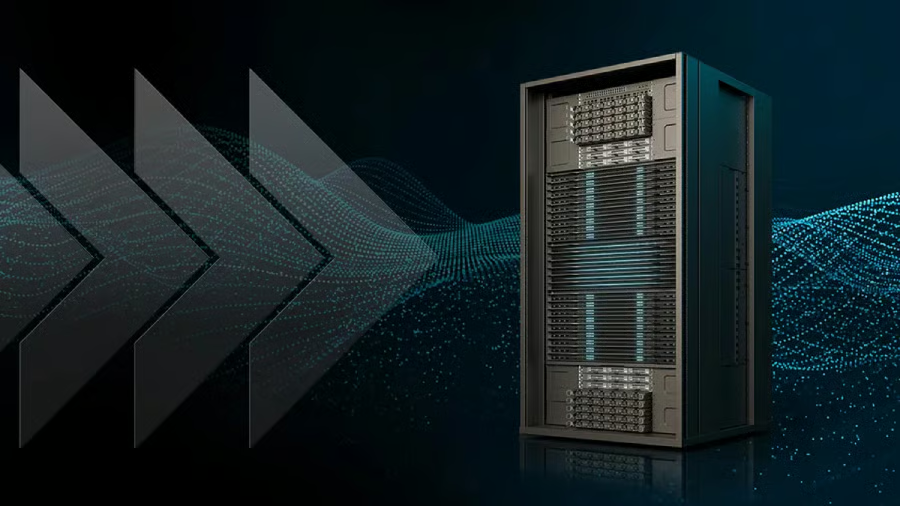


AMD is making its boldest push yet into the AI infrastructure race with Helios, its first rack-scale AI system, and Microsoft is already lining up as one of its first major customers.
The chipmaker said it will begin shipping Helios later this year, positioning the platform as a direct competitor to Nvidia's Grace Blackwell and upcoming Vera Rubin AI systems.
Microsoft joins OpenAI, Meta, Oracle, and Tata Consultancy Services among the companies planning to deploy the new platform as demand for AI computing continues to surge.
"We are expanding the Azure infrastructure portfolio with AMD Helios to give customers the performance, scale and choice they need to build and run the next generation of AI applications," Microsoft CEO Satya Nadella said in an AMD press release.
Microsoft said Helios will support frontier AI model inference, Azure AI services and customer workloads. The company will also introduce new Azure compute instances powered by AMD's sixth-generation EPYC Venice processors for agentic AI, data pipelines and semiconductor design.
A full-stack AI platform
Helios marks AMD's first fully integrated rack-scale AI system, combining the company's Instinct GPUs, EPYC CPUs, Pensando networking technology and ROCm software stack in a single platform.
The liquid-cooled system features 18 compute trays, each equipped with four Instinct GPUs and one EPYC processor. AMD says the design is built to improve AI inference performance while lowering the total cost of running large AI models.
"We're very focused on providing the best total cost of ownership, the lowest cost per token, all in," Forrest Norrod, AMD's head of data center solutions, told CNBC. "And our customers are telling us that we're achieving that."
Industry estimates from Futurum Group place the price of a Helios rack between $5 million and $5.5 million, although AMD has not confirmed pricing.
Challenging Nvidia's lead
Helios arrives as Nvidia continues to dominate the AI accelerator market with more than a 95% share of the data center GPU market, according to Futurum Group. AMD currently holds about 4.5%.
Even so, AMD's customer list has continued to grow. The company says eight of the world's 10 largest AI companies already use its Instinct GPUs.
Meta previously announced plans to deploy up to 6 gigawatts of AMD GPUs, with shipments supporting the first gigawatt of Helios systems expected to begin in the second half of 2026, while OpenAI and Oracle have also committed to using the platform.
AMD said its data center business grew 57% year over year during the first quarter of 2026 and expects data center AI revenue to reach tens of billions of dollars beginning in 2027, with Helios contributing the largest share.
The software hurdle remains
While AMD believes its hardware can compete with Nvidia, analysts say software remains the company's biggest challenge. Counterpoint Research analyst Neil Shah told CNBC that AMD's chips are "on par" with Nvidia's hardware, but added that "the secret sauce is in the software and optimization."
"With CUDA, I think Nvidia has a bigger ecosystem, and it's quite ahead versus AMD," Shah said.
What Helios changes for AI buyers
Helios gives cloud providers and AI developers another high-end option at a time when demand for AI infrastructure continues to outpace supply. For large customers such as Microsoft, adding another supplier could reduce dependence on Nvidia while expanding available computing capacity.
Still, winning market share will require more than competitive hardware. AMD must prove Helios performs reliably at scale and continue strengthening its ROCm software ecosystem if it hopes to convince more AI developers to move workloads away from Nvidia's mature CUDA platform.
Early customer deployments later this year will likely determine whether Helios becomes a meaningful challenger or simply another alternative in a market Nvidia still overwhelmingly controls.
Also read: Meta’s Louisiana AI data center could cost more than $250 billion once chips and equipment are included, showing the scale behind its infrastructure expansion.