







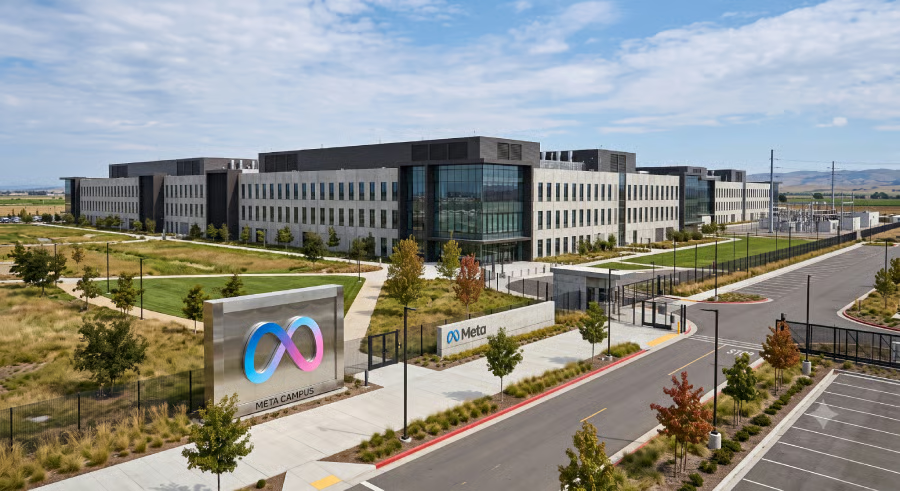
Meta’s largest data center is turning into a city-sized test of how much the AI race can cost.
The company has committed more than $50 billion to expand its Hyperion complex in Richland Parish, Louisiana, into a 5-gigawatt AI computing hub. Bloomberg estimates that chips and other equipment could eventually push the project’s total cost beyond $250 billion, although Meta has not confirmed spending above its announced investment.
Hyperion could give Meta vastly more computing power for advanced AI models. It also raises a harder question for the industry: How do companies finance, power, and earn a return on infrastructure that may cost hundreds of billions of dollars?
Meta raises Hyperion investment above $50 billion
Meta said Hyperion will expand from its original target of more than 2 gigawatts to 5 gigawatts of compute capacity, with the company’s disclosed investment in the Richland Parish data center now topping $50 billion, Reuters reported.
A Meta spokesperson told CNBC that the project should reach 2 gigawatts by 2030. The full 5-gigawatt data center is expected to be completed around 2032.
The publicly disclosed cost has risen sharply. Hyperion was initially presented as a $10 billion project, while a joint venture announced with Blue Owl Capital in October valued the development at about $27 billion.
“With this expansion, we will be investing over $1 billion in local infrastructure improvements, including roads, water and wastewater systems,” Meta said, according to CNBC.
Louisiana businesses have received more than $1.6 billion in contracts since construction began in December 2024. Meta also doubled its estimate for permanent jobs at the completed data center to 1,000.
Why the total cost could exceed $250 billion
Bloomberg reported that Meta’s latest $40 billion expansion brought the publicly disclosed project investment above $50 billion. The company could spend roughly $200 billion more, largely on the computing chips and other equipment installed across the nearly 4,000-acre site.
A person familiar with the financing estimated that Hyperion’s total cost would reach at least $250 billion. Meta has not publicly confirmed any expenses beyond the announced $50 billion, so the larger figure is an estimate rather than an official company commitment.
Blue Owl owns an 80% stake in the project and has sought billions of dollars from Wall Street to fund construction. The involvement of outside investors and lenders shows how AI developments at this scale increasingly depend on complex financing partnerships.
Power demand brings costs and tradeoffs
Entergy Louisiana plans to build 10 gas-fired power plants to supply the data center, according to Bloomberg. The site is planned to provide 5 gigawatts of computing capacity, while more than 2 gigawatts of electricity will serve its broader power requirements.
Meta said it would pay the full cost of the energy, water, and infrastructure used by the facility so utility customers would not have to cover those expenses.
Environmental and consumer groups have continued to question whether financing arrangements could leave ratepayers exposed if the project changes or Meta withdraws before utilities recover their investments.
Louisiana has supported the development with a 20-year sales tax exemption for qualifying data centers built before 2029. The arrangement could deliver contracts, tax revenue, and jobs, although the state is also committing public incentives and utility resources to a project whose long-term returns remain uncertain.
Hyperion illustrates how AI competition now depends on more than better models.
Companies must secure chips, electricity, financing, and local government support while proving that infrastructure costing tens or even hundreds of billions of dollars can eventually pay for itself.
Read how Meta’s largest data center project is bringing in 72-ton robots to support construction at the massive Louisiana site.