






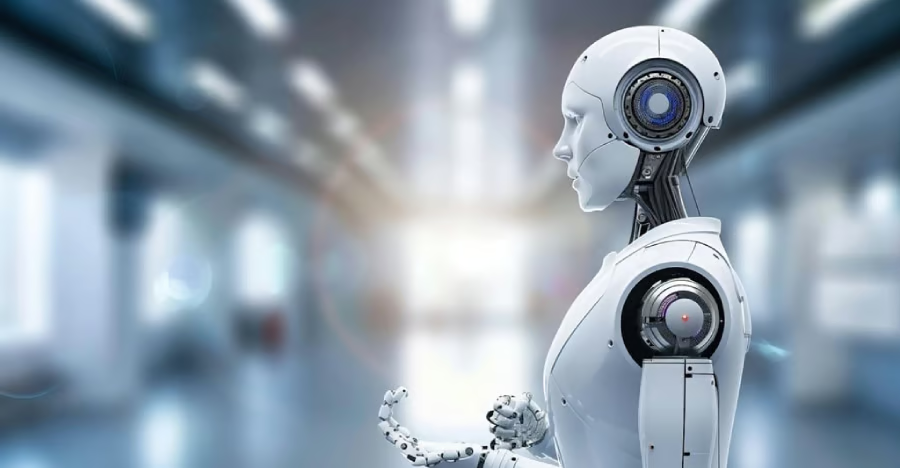


China's race to build useful humanoid robots is increasingly focused on one difficult challenge: giving them hands that work like ours.
While humanoid robots have become a regular feature at public demonstrations in China, industry leaders say the biggest obstacle is no longer getting robots to walk; it's teaching them to handle objects with the precision of human hands.
That challenge has fueled a growing market for robotic hands as China pushes its embodied AI strategy, which combines artificial intelligence with machines capable of physically interacting with the world. The country's leaders see robotics as a way to offset labor shortages caused by an aging population while creating new high-value industries.
Although China installs more industrial robots than any other country, truly general-purpose humanoid robots remain years away.
The International Federation of Robotics concluded last year that "true multipurpose humanoids are far off yet," highlighting how difficult real-world manipulation remains, according to The Guardian.
Why hands are a challenge
Experts say building robotic hands involves both hardware and software challenges.
"The challenge of making these hands is getting solved now," Nathan Lepora, a professor of robotics and AI at the University of Bristol, told The Guardian. "Controlling them, now that's a whole different game … nobody knows how to do that."
Robotic hands require compact motors, sensors, and joints packed into a human-sized form while remaining strong enough to perform delicate tasks such as gripping tools, folding laundry, or handling fragile objects.
LinkerBot founder Zhou Yong described the engineering challenge to The Guardian, saying making a robotic hand is "one hundred times more difficult" than building a humanoid robot because of the hand's complexity and limited space.
A new market takes shape
Among the companies chasing the opportunity is Chinese startup LinkerBot, founded in 2023.
According to WIRED, the company manufactures robotic hands with five fingers and at least 11 joints, selling some models in China for as low as $600. LinkerBot says it shipped 10,000 robotic hands last year and is now pursuing a $6 billion valuation after multiple funding rounds.
Rather than building complete humanoid robots, the company focuses exclusively on hands. Successful companies, Zhou told WIRED, succeed by specializing, an approach that allows LinkerBot to supply manufacturers instead of competing directly with robot makers.
China's manufacturing ecosystem also gives companies a significant advantage. Local suppliers already produce batteries, motors, and other components at scale thanks to the country's electric vehicle industry, making it easier and cheaper to manufacture robotic hardware than in many other regions.
Software remains the biggest hurdle
Even if the hardware improves, robots still need enormous amounts of real-world training data before they can reliably manipulate everyday objects.
Companies are collecting that data through teleoperation systems and wearable devices that record how humans move their hands, apply pressure, and interact with objects. Those datasets are intended to train AI models that can eventually perform similar tasks autonomously.
Pan Yunzhe, founder of Wuji Technology, told The Guardian that collecting both movement and touch information remains "super complicated and not solved yet."
The next test for humanoids
China's investment suggests the next competition in AI may extend beyond chatbots and language models into machines that can physically perform work.
If companies solve dexterous manipulation, humanoid robots could move beyond demonstrations into manufacturing, logistics, healthcare, and eventually household assistance. Lower-cost robotic hands could also reduce the price of advanced prosthetics, an area LinkerBot says it hopes to address.
However, the industry's biggest challenge remains software. Until robots can reliably understand and manipulate unpredictable real-world environments, human-like hands alone will not be enough to make humanoid robots commonplace.
Also read: Humanoid robot Atlas stepped onto the FIFA World Cup stage in a Hyundai showcase that tested robotics beyond controlled lab settings.