






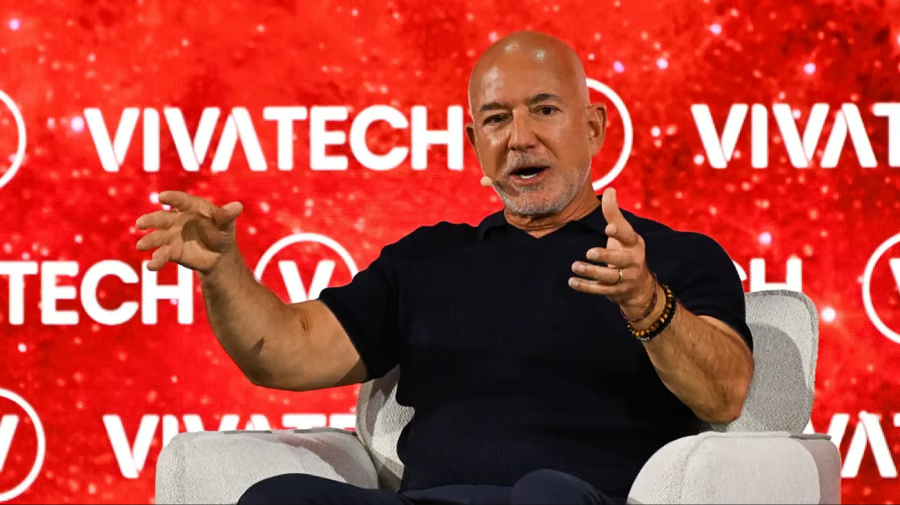


AI may be coming for the workplace, but Jeff Bezos does not think it is coming for everyone’s job.
The Amazon founder said at VivaTech in Paris that he disagrees with fears that AI will make humans redundant. “I totally disagree with this point of view,” Bezos said. “And I think, in fact, AI is going to create a labor shortage.”
His comments frame AI less as a headcount-cutting tool and more as a force that could reshape workforce planning, hiring demand, and industrial productivity.
Bezos made the case at a moment when AI’s labor impact is already showing up in hiring plans, layoff notices, and worker anxiety. Companies are investing heavily in AI, workers are watching automation move into more tasks, and some employers are tying job cuts to efficiency gains.
Bezos sees AI as a builder’s tool
Reuters reported that Bezos spoke on Wednesday at the VivaTech technology conference in Paris, where he discussed AI, Blue Origin, and his new AI startup, Prometheus, which focuses on accelerating physical manufacturing.
Bezos argued that people are not short on ideas. They are short on the tools, time, and capacity needed to turn those ideas into real products.
“We have an endless set of things to invent. We are limited not by our imaginations but by what we can actually do,” Bezos said, according to Business Insider.
His point was not just philosophical.
Prometheus is aimed at physical manufacturing, a field where AI could extend beyond chatbots and software assistants to encompass factories, robotics, materials, and industrial systems.
For businesses, that shift could change where workforce pressure lands.
If AI makes it easier to design, prototype, and manufacture products, companies may need more people who can operate, supervise, integrate, and scale those systems.
The optimism meets an anxious labor market
Bezos’ view contrasts with the anxiety among workers, economists, unions, and some political figures who worry that AI could displace large numbers of people.
Reuters, citing Challenger, Gray & Christmas Inc., said US-based employers announced 97,006 job cuts in May, with AI linked to 40% of the layoffs. A Reuters/Ipsos poll also found that about half of Americans fear AI could put them or someone in their household out of work.
The BBC noted that the UK’s Trades Union Congress warned AI could repeat “the disaster of deindustrialisation” if productivity gains enrich shareholders while jobs are degraded or displaced.
The tension matters because both ideas can be true at once.
AI may create new demand in some fields while reducing demand in others. The result may not be simple mass unemployment or simple job creation, but a faster mismatch between the work companies need and the skills workers have.
Why the workforce question matters
For enterprise leaders, Bezos’ comments raise a bigger question about what kind of labor AI may increase.
If AI accelerates manufacturing, product development, robotics, and infrastructure, companies may need more people to operate, supervise, and govern these systems. These types of jobs require technicians, AI supervisors, compliance staff, and domain experts who can transform automated output into business results.
The risk is treating AI only as a headcount-cutting tool. More automation can also create new work around training, safety, vendor management, governance, and human review.
His argument may be contested, but the takeaway for the workforce is clear. Companies must plan for the roles and skills AI creates, not just what it replaces.
AI is moving from boardroom strategy to layoff notices, making its workforce impact harder for companies to ignore.