






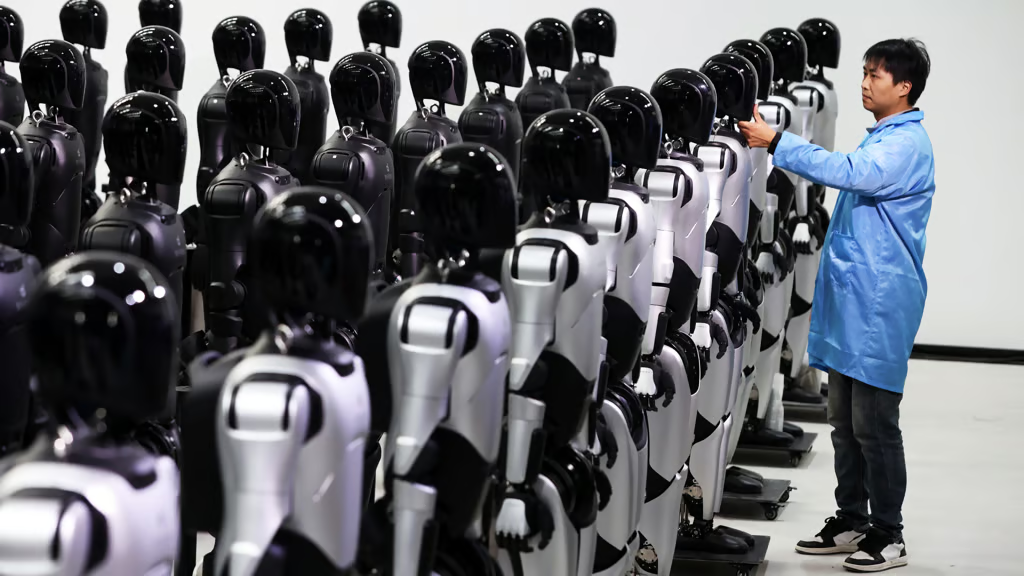


Across China, humanoid robots are now being sent to specialized training facilities designed to prepare them for real-world work at scale.
In Shanghai’s Zhangjiang tech hub, a major 5,000-square-meter center is bringing together more than 100 robots from different companies to train side by side. The idea is simple but ambitious: teach machines how to operate in human environments by exposing them to repeated, structured practice of everyday tasks.
These facilities are part of a broader national push to build a unified robotics ecosystem rather than isolated development efforts. The curriculum is also practical. Robots are being trained to master about 45 core skills, including folding clothes, organizing shelves, cleaning surfaces, and handling objects with precision.
According to a Futura report, these tasks are repeated hundreds of times per day, with some actions performed up to 600 times daily under supervision. The goal is to refine motion control and decision-making through repetition and correction.
At the same time, robots are being deployed in a wide range of environments, including domestic spaces, industrial settings, and service scenarios, enabling them to eventually operate in fields such as manufacturing, healthcare, agriculture, and logistics.
Learning by repetition, not reading
Inside these training centers, there are no textbooks or exams. Instead, robots learn by copying human movements again and again.
At some facilities, trainers wear motion-capture gear or VR headsets while robots mirror their actions in real time. In one example, a trainer described how the system works:
“We wear VR (virtual reality) glasses and have controllers in hand. Our left and right hands are like the robot’s left and right arms. It will learn our postures by moving them. The data will be uploaded to the cloud. Once the data is approved (forming a dataset), it will be uploaded to the robot, and it will learn from it,” Qu Qiongbin, an AI robot trainer, told Euronews, as eWeek previously reported.
The robots then repeat the same actions thousands of times — grasping, placing, wiping, or folding — until the motion becomes reliable.
While robots can solve complex equations instantly, physical tasks like folding clothes or handling soft objects remain surprisingly difficult. Fabric is especially challenging because they change shape and lacks a fixed structure. To overcome this, engineers rely on brute repetition, sometimes running the same motion thousands of times across hundreds of machines.
Toward a ‘super brain’ for robots
Beyond training individual machines, the bigger ambition is to merge all collected data into a shared intelligence system.
Futura reports that the long-term vision is to create a centralized “super brain” that consolidates learning across different robot models and manufacturers. This would allow new robots to inherit skills immediately, rather than learning from scratch.
China’s push into humanoid robotics is also tied to industrial strategy. Reports suggest the country is aiming for large-scale production, with expectations of up to 100,000 humanoid robots annually in the coming years, according to Futura.
These robots are expected to work across industries, including manufacturing, healthcare, agriculture, and services.
If China can turn repeated robot training into reusable shared intelligence, humanoid development could start to look less like isolated lab work and more like industrial infrastructure. The remaining question is whether these machines can handle the messy, unpredictable reality of human spaces as reliably as they perform choreographed tasks in training centers.
Also read: UBTECH has opened preorders for UWORLD U1 household humanoid robots, with shipments expected in September.