






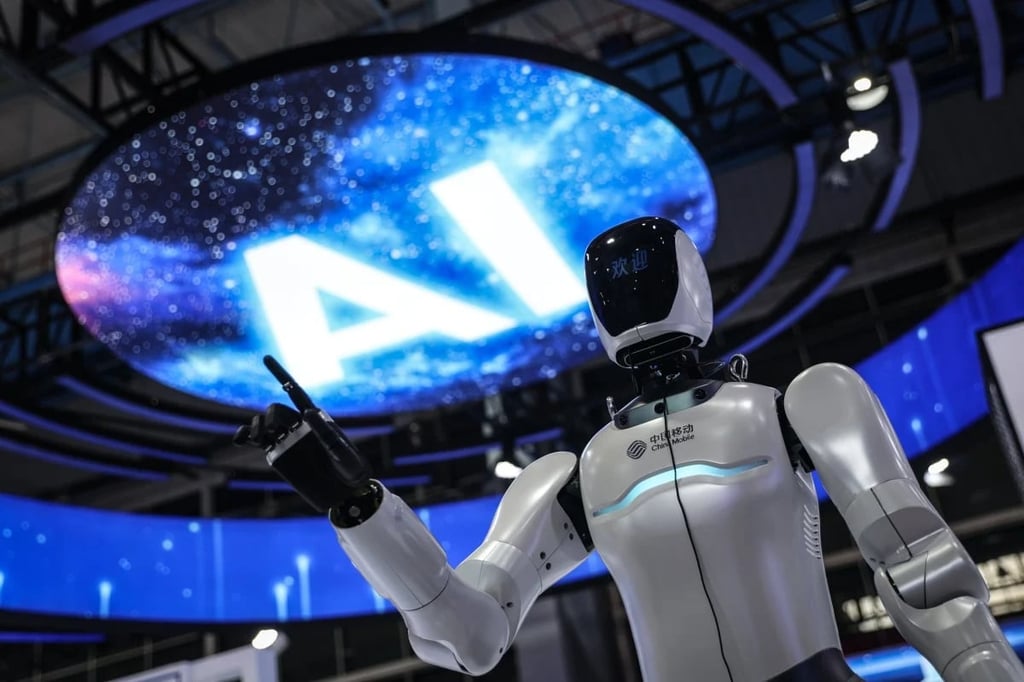


A new wave of Chinese humanoid robots is quietly closing in on the US market.
A growing number of startups from Shenzhen, often called China’s “Silicon Valley,” are stepping onto the global stage, hoping to expand overseas before Tesla’s Optimus robot is even available to the public.
One of the most closely watched names is LimX Dynamics, a company that has moved quickly from a small operation into an ambitious player with international plans, according to CNBC’s The China Connection newsletter.
LimX founder Will Zhang told CNBC the company is now exploring business collaborations in the US. The comments came just days after LimX showed off its humanoid robot at the Consumer Electronics Show (CES) in Las Vegas this month.
The company’s push into new markets is part of a broader strategy of expanding globally through partnerships rather than going it alone. “More than money, I’m focused on local partnerships,” Zhang said in an interview with CNBC.
Middle East comes first
Before a full US entry, LimX is prioritizing the Middle East. Zhang said the startup has already secured its first foreign backer from the region and expects to begin shipping humanoid robots there this year.
Details of the investor and funding size have not been disclosed because the financing round is still underway. PitchBook data cited by CNBC shows LimX has raised $69.31 million as of July 2025, with support from major Chinese firms including Alibaba, JD.com, and Lenovo.
A growing challenge for Tesla’s Optimus
LimX is not the only Chinese robotics company looking outward. Other firms, such as Unitree, also appeared at CES, highlighting how quickly China’s humanoid sector is moving.
This global momentum is increasing pressure on Tesla’s humanoid ambitions. Elon Musk said last week at Davos that Optimus would not be sold to the public until 2027.
Meanwhile, Chinese companies are already shipping robots. As noted by CNBC, research firm Omdia estimates that around 13,000 humanoid robots were shipped worldwide last year, with Chinese makers leading the market.
The outlook for China’s humanoid market is becoming more bullish, and Wall Street is taking notice of the speed at which China is scaling up.
Morgan Stanley recently doubled its forecast for China’s humanoid robot sales this year to 28,000 units, up from an earlier estimate of 14,000. “We expect sales to businesses to be the key driver this year, taking over from government, R&D and entertainment-related sales last year,” equity analyst Shen Zhong wrote in the report, as quoted by CNBC.
The bank also projects that by 2050, China’s humanoid market could reach annual sales of 54 million units.
LimX’s Oli robot and the race for innovation
LimX has already begun delivering its humanoid robot, called Oli, according to Zhang.
The base version costs 158,000 yuan (about $22,660, as of January 2026), while a developer-focused model that allows custom integrations costs nearly twice as much.
Zhang says LimX wants to lead in core technology, not simply follow existing trends. “We don’t think it has to be that the US leads and China follows,” he told CNBC.
A major hurdle for robots has always been the “remote control” factor; humans are still piloting most demos you see. LimX is trying to change that with a new AI operating system called COSA.
Launched earlier this month, COSA is designed to let robots make autonomous decisions. Instead of following a script, a COSA-powered robot could theoretically “think” through a task like picking up tennis balls or navigating a cluttered office in real time. Zhang’s goal for 2026 is to perfect voice commands so that robots can ditch the controllers entirely.
A shifting competitive landscape
The surge of Chinese humanoid robotics companies exploring international markets adds pressure not just on Tesla, but on American competitors like Figure AI. Multiple Chinese consumer electronics firms are using events like CES to gauge US market receptiveness and establish partnerships before larger-scale launches.
For now, Chinese manufacturers hold the production advantage while American companies refine their technology. Whether that gap narrows when Optimus finally reaches consumers in 2027 may depend on how much ground Chinese competitors gain in the interim and whether local partnerships can help them navigate potential trade restrictions and geopolitical tensions.
Also read: Unitree’s H2 humanoid shows how quickly Chinese firms are iterating on price and capability ahead of US expansion.