








Elon Musk’s AI ambitions now stretch from chatbots and social feeds to robotaxis, brain implants, humanoid robots, and spacecraft.
At the center is xAI, the company behind Grok. Around it sit X, Tesla, Neuralink, and SpaceX: separate businesses with very different products, but increasingly overlapping needs for data, compute, robotics, autonomy, and real-time decision-making.
The result is an AI ecosystem that spans digital platforms, physical machines, and communication networks. While most AI companies focus on models and software, Musk's portfolio extends into transportation, robotics, neuroscience, and aerospace. The bigger question is whether those ventures can reinforce one another, creating advantages that competitors struggle to match.
- xAI is becoming the center of gravity
- X gives Musk a distribution engine and a data stream
- Tesla turns AI into something physical
- Neuralink pushes the interface closer to the brain
- SpaceX shows how autonomy works at extreme scale
- The real strategy is vertical integration
- The risks are as large as the ambition
xAI is becoming the center of gravity
Musk launched xAI in 2023 as a direct challenge to OpenAI, the company he helped co-found and later criticized. Its flagship product, Grok, is now positioned as a general-purpose AI assistant for consumers, developers, and enterprise users.
The company’s pitch is not subtle. xAI describes its models as capable of reasoning, coding, voice, images, and video, and says they are trained on what it calls one of the world’s largest AI supercomputing clusters. That infrastructure claim matters because the AI race is increasingly a compute race. Better models require more chips, more power, more data, and more engineering talent.
Grok also gives Musk something his other companies lacked: a consumer-facing AI layer that can be integrated into multiple products. On X, Grok can serve as a search, summarization, and engagement tool. For developers, xAI offers API access. For Musk’s broader portfolio, the AI chatbot could serve as the connective tissue among software, hardware, and user-facing AI.
X gives Musk a distribution engine and a data stream
The most obvious advantage in Musk’s AI ecosystem is X.
In 2025, xAI acquired X in an all-stock deal that valued the social media platform at $33 billion, according to the Associated Press. The merger formally aligned Musk’s AI company with the platform formerly known as Twitter, giving xAI direct access to a large social network and a built-in distribution channel.
That deal matters for two reasons. First, X gives Grok instant distribution. Rather than competing only through a standalone chatbot interface, xAI can place its AI tools directly into a social platform used by millions of people.
Second, X provides access to a constant stream of real-time public conversation. Trending topics, breaking news, user interactions, and public debates can help AI systems remain current and responsive in ways that static training datasets cannot.
That advantage comes with obvious risks. Training or grounding AI systems on social platform data raises questions about moderation, accuracy, privacy, bias, and consent. Grok’s personality-driven positioning may help it stand out, but it also increases the chance that mistakes become highly visible controversies.
Tesla turns AI into something physical
Tesla may be the most important piece of Musk’s AI story because it moves AI out of the chat window and into the physical world.
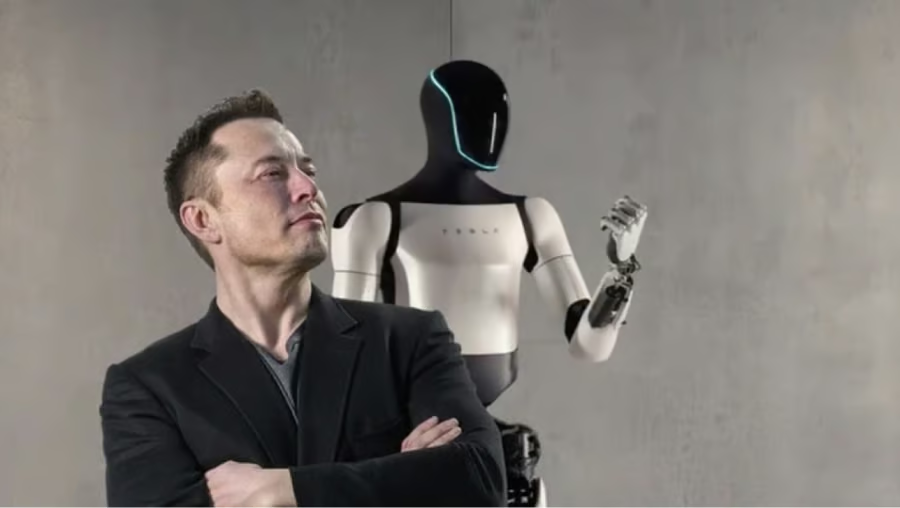
The company says its AI and robotics efforts are focused on autonomy at scale across vehicles, robots, and future products. That includes Full Self-Driving technology, custom AI chips, neural networks, simulation systems, and the Optimus humanoid robot project.
Tesla’s advantage is its fleet. The company claims that millions of vehicles generate real-world driving data that can help train and refine AI systems. Few competitors have access to that volume of operational data collected from physical environments.
Optimus extends that strategy beyond transportation. The humanoid robot is still in development, but its long-term purpose is clear: apply Tesla’s advances in perception, navigation, motion planning, and real-world interaction to a general-purpose machine that can operate in human environments.
That is where the ecosystem becomes more interesting. Tesla’s vehicles and robots both need AI that can understand the physical world, make decisions under uncertainty, and operate safely around people. If xAI provides the reasoning layer, Tesla provides the embodiment.
Neuralink pushes the interface closer to the brain
Neuralink sits at the farthest edge of Musk’s AI map.
The company is developing brain-computer interfaces that enable people to control digital devices with neural signals. Its first human clinical studies have focused on helping individuals with paralysis regain independence through direct interaction with computers.
For now, Neuralink is primarily a medical technology company rather than a conventional AI business. But strategically, it points to a future in which the interface between humans and computers becomes significantly more direct.
That makes Neuralink relevant to Musk’s broader AI ambitions, even if the timelines are much longer and the regulatory hurdles much higher. Brain-computer interfaces require advanced signal processing, robotics, software, and eventually AI-assisted interpretation of neural activity.
The caution is just as important as the ambition. Brain implants involve clinical trials, patient safety, medical oversight, and ethical scrutiny. Neuralink may be the most futuristic part of Musk’s AI portfolio, but it is also the one operating under the strictest constraints.
SpaceX shows how autonomy works at extreme scale
SpaceX is not typically viewed as an AI company, but its operations rely heavily on automation, robotics, simulation, and autonomous control systems.
From autonomous spacecraft docking procedures to the management of the Starlink satellite network, SpaceX has spent years developing systems capable of operating with limited human intervention in high-risk environments.
The company also contributes to infrastructure. Starlink has evolved into a global communications platform that could support future AI applications across vehicles, robots, industrial systems, and remote environments.
The connection to AI is not that SpaceX needs a chatbot. It is that SpaceX has extensive experience building autonomous systems where software failures can have significant consequences. Those lessons become increasingly relevant as AI expands into transportation, robotics, manufacturing, and critical infrastructure.
The real strategy is vertical integration
Musk’s AI ventures are often discussed independently: xAI versus OpenAI, Tesla versus Waymo, Neuralink versus competing brain-computer interface companies, and SpaceX versus traditional aerospace firms.
The bigger story is how these companies potentially fit together.
xAI supplies models. X provides users with engagement and real-time information. Tesla supplies embodied AI through vehicles and robots. Neuralink explores future human-machine interfaces. SpaceX contributes expertise in autonomous systems and communications infrastructure.
This does not mean the companies function as a single organization. They face different technical challenges, regulatory environments, and business objectives. Yet together they point toward a vision in which AI systems can understand information, interact with the physical world, communicate across networks, and eventually engage with humans through increasingly natural interfaces.
The risks are as large as the ambition
The same overlap that creates opportunities also creates risks.
Data sharing between social platforms and AI systems can raise privacy concerns, particularly as tech companies increasingly use user-generated content to train AI models. For example, Meta faced regulatory scrutiny and public backlash over plans to use data from Facebook and Instagram users for AI training.
There is also the Musk factor. His companies move quickly, attract constant attention, and often operate at the center of public debate. That visibility can accelerate innovation and adoption, but it can also magnify failures.
For readers watching the AI industry, the key takeaway is not simply that Musk owns several companies with AI ambitions. It appears he is building an interconnected ecosystem designed to compete across multiple layers of the AI stack.
If that strategy succeeds, Musk will not just be competing in the chatbot race. He will be competing across software, robotics, transportation, communications, and potentially the future of human-computer interaction itself.
Related reading: That broader vision extends beyond technology alone, with Musk recently outlining how AI could one day support a form of universal high income.