






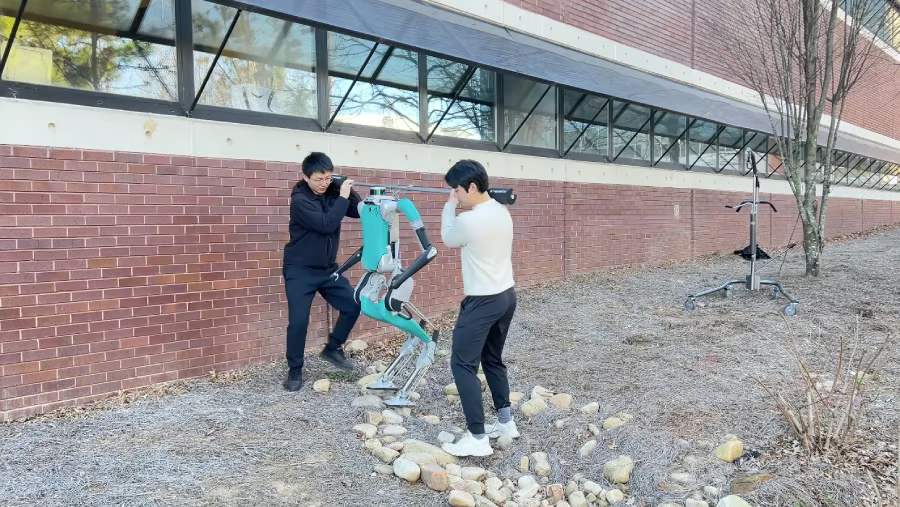


Sand, loose gravel, wet grass, and steep slopes can quickly expose the limits of a humanoid robot’s balance.
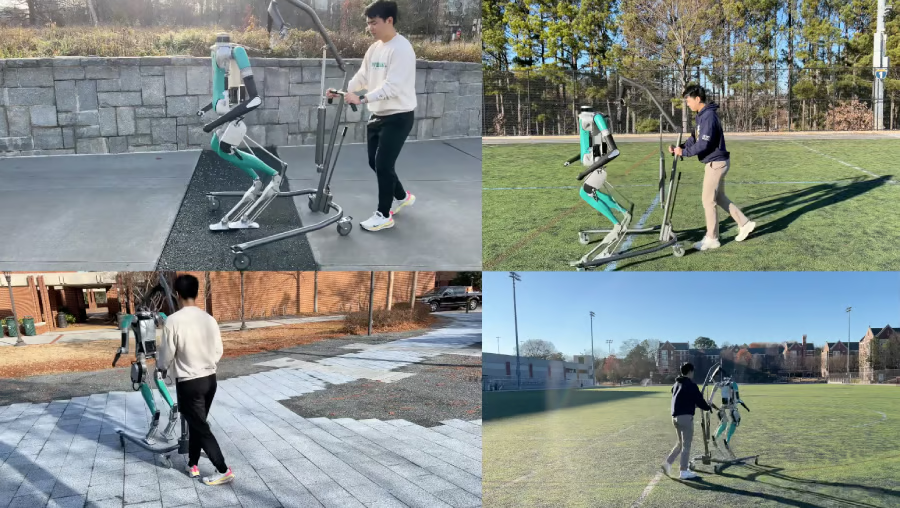
Georgia Institute of Technology researchers developed a machine learning framework called “Learn to Teach” that trained a bipedal robot to navigate varied outdoor terrain and slippery indoor surfaces using one controller. Presented at the IEEE International Conference on Robotics and Automation, the method trains two reinforcement learning models simultaneously rather than waiting for one to finish before the other begins.
The breakthrough optimizes a reinforcement learning method known as teacher-student learning. Normally, scientists train a simulated "teacher" agent with more complete environmental information, then use that mature model to train a "student" algorithm meant for the physical robot.
Feiyang Wu, a machine learning Ph.D. student who led the research, identified major inefficiencies in that tradition. “There are two problems with this approach,” Wu said. “It takes too much time to train them sequentially. Then, you’re wasting a lot of information that’s been gathered by the teacher.”
Because these simulations rely on expensive GPU chips, extended computation translates directly to high development costs. The Georgia Tech team bypassed this by training both the teacher and student models simultaneously.
“You don’t have to wait for the teacher to be an expert for it to begin teaching the student,” Wu said. “The teacher can gradually teach the student what they’ve learned along the way.”
Furthermore, the team let the teacher learn from the student's mistakes. This targeted the "teacher-student imitation gap," which occurs when the physical robot performs worse because it lacks the richer environmental data available to the simulated teacher.
Deployed on a physical humanoid in Associate Professor Ye Zhao’s lab, the controller exceeded expectations. It even allowed the robot to adjust its gait and remain upright when researchers physically pushed and pulled it. According to Zhao, the system outperformed the standard software provided by the robot’s manufacturer.
Democratizing the laboratory
This framework signals a shift away from brute-force computation toward algorithmic efficiency. Historically, the robotics industry has suffered from a high barrier to entry; only tech giants could afford the massive GPU clusters needed to train heavy machinery.
By demonstrating that concurrent training achieves superior balance on unmodeled terrain with a fraction of the compute, Georgia Tech is leveling the playing field for smaller startups and academic labs.
Furthermore, because the "Learn to Teach" framework is generic, its business implications stretch far beyond walking. It can be applied to robotic arms in manufacturing facilities or automated drones in warehouses, dramatically speeding up time-to-market for specialized automation.
Real-world blind spots
Despite the agility displayed on campus terrain, commercial adoption faces near-term bottlenecks. The researchers did not release exact benchmarks, meaning the actual dollar-and-cent compute savings remain directional rather than verified.
Additionally, while the robot handled uneven campus ground, real-world deployment contains high-liability risks. Industrial environments require safety certifications that statistical machine learning models struggle to guarantee. Because a neural network's decision-making can be unpredictable when encountering an obstacle it has truly never seen, companies may hesitate to deploy these fluid controllers around human workers until testing protocols are heavily standardized.
Related News: NVIDIA is teaming up with Japan's biggest robotics and manufacturing companies to bring AI-powered "physical AI" into factories.