






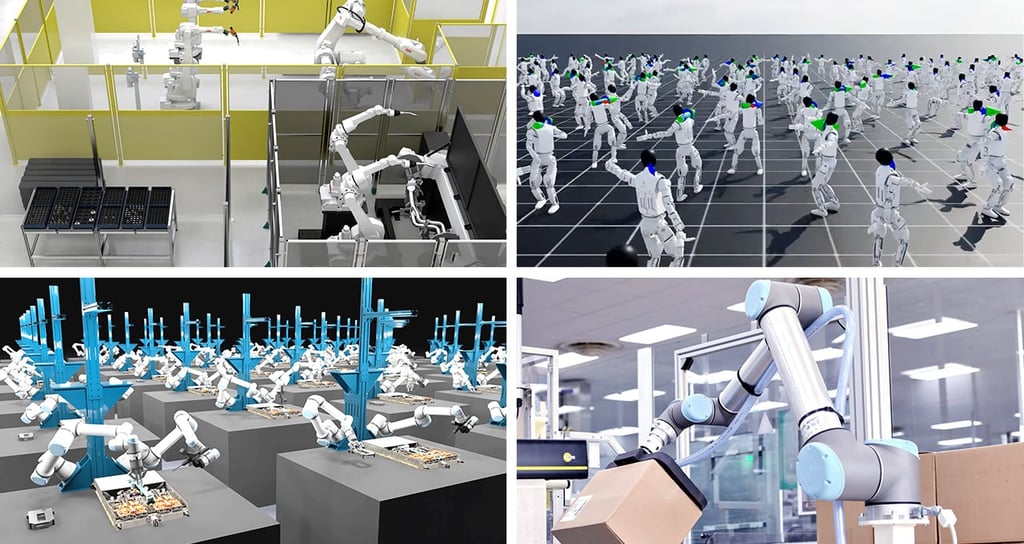


AI is no longer just living in data centers and chatbots. Nvidia says it is stepping into the physical world.
At its GTC conference, Nvidia announced a major push to accelerate “physical AI.” The company revealed new AI models, simulation frameworks, and partnerships with global robotics companies to help build the next generation of robots for factories, hospitals, and logistics systems.
Nvidia said it’s working with robotics companies across multiple sectors, from industrial manufacturing to humanoid robots, to deploy AI-powered machines at scale.
The collaborations aim to combine robotics hardware with Nvidia’s AI computing, software frameworks, and simulation tools so robots can be trained in virtual environments before operating in the real world.
“Physical AI has arrived — every industrial company will become a robotics company,” Jensen Huang, founder and CEO of Nvidia, said in a statement. “Nvidia’s full-stack platform — spanning computing, open models and software frameworks — is the foundation for the robotics industry, uniting a worldwide ecosystem to build the intelligent machines that will power the next generation of factories, logistics, transportation and infrastructure.”
New AI models and simulation tools
To support the robotics ecosystem, Nvidia introduced several new tools designed to help developers design and train intelligent machines faster.
Among them are new Cosmos world models, which can generate realistic virtual environments for training robots. The company also unveiled updates to its Nvidia Isaac robotics platform, including simulation frameworks that allow developers to test robot behavior before deploying it in real-world environments.
One of the biggest announcements was Cosmos 3, a world foundation model that combines synthetic world generation, vision reasoning, and action simulation to help developers build robots capable of operating in complex environments.
These tools allow robotics developers to create massive amounts of training data and test robot decisions without risking damage to real equipment.
As these tools move from simulation into real-world robotics and industrial environments, they reflect a broader shift toward physical AI in manufacturing and the AI-native factory.
Powering the next generation of humanoid robots
Humanoid robots remain one of the most ambitious goals in robotics, requiring machines to replicate human-like movement, dexterity, and reasoning.
Nvidia said robotics developers, including Boston Dynamics, Figure AI, and Agility Robotics, are using its simulation tools and AI models to accelerate development.
The company also introduced Isaac Lab 3.0, an early-access platform designed to enable large-scale robot learning on Nvidia’s NVIDIA DGX infrastructure. Another key announcement was GR00T N1.7, an early-access robot foundation model that gives machines generalized capabilities such as dexterous manipulation and autonomous task execution.
Huang also previewed GR00T N2, a next-generation model based on the company’s DreamZero research, which Nvidia says helps robots succeed at unfamiliar tasks in new environments more than twice as often as leading vision-language-action models.
Expanding AI into healthcare robotics
Beyond factories and warehouses, Nvidia is also pushing robotics into the healthcare sector.
Companies such as CMR Surgical, Johnson & Johnson, and Medtronic are using Nvidia’s platforms to train and validate robotic systems used in surgery and medical imaging. For example, CMR Surgical is training robotic intelligence for its Versius surgical system using Nvidia simulation technology before the systems are deployed in hospitals.
The goal is to ensure that healthcare robots meet strict safety and reliability requirements before they operate on real patients.
Nvidia’s strategy also extends beyond robotics manufacturers. The company is also partnering with cloud providers and software platforms to accelerate development.
Microsoft and Nebius are integrating Nvidia’s physical AI data tools into their cloud environments to help developers generate synthetic training data. Meanwhile, Alibaba Cloud is incorporating Nvidia’s robotics stack into its AI platform.
Through its Nvidia Inception Program, which supports more than 40,000 startups, the company also plans to help emerging robotics developers access computing resources, technical guidance, and industry partnerships.
Also read: As pharmacies face rising workloads and staffing shortages, AI and robotics are reshaping pharmacy workflows.