






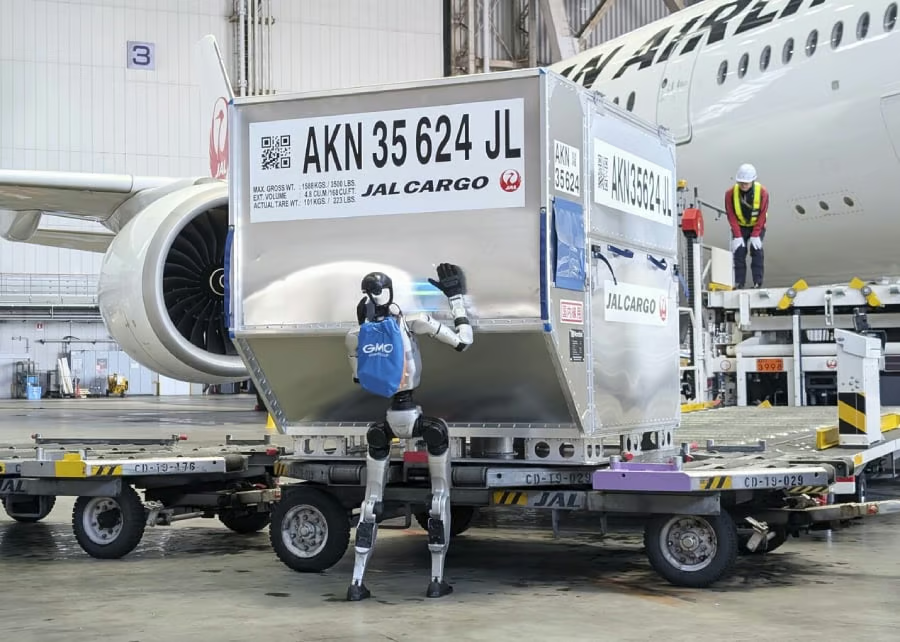


At Haneda Airport, the next ground crew assistant may look less like a cart and more like a person.
Japan Airlines plans to begin testing humanoid robots in May 2026 to help with airport ground operations, including physically demanding baggage and cargo tasks on the tarmac. The trial, led by JAL Ground Service and GMO AI & Robotics, comes during a growing labor crunch.
The country’s aviation sector is under pressure from a surge in international tourism combined with a shrinking working-age population. According to the Japan National Tourism Organization, more than 7 million visitors arrived in the country in just the first two months of 2026, following a record 42.7 million the previous year.
Airport ground handling remains labor-intensive, requiring workers to operate in tight spaces while lifting heavy loads. JAL Ground Service Co. President Yoshiteru Suzuki said using robots for such tasks would “inevitably reduce workers’ burden, providing significant benefits to employees,” according to Kyodo News.
His counterpart at GMO, Tomohiro Uchida, highlighted the gap between visible automation and reality, stating: “While airports appear highly automated and standardized, their back-end operations still rely heavily on human labor and face serious labor shortages.”
What the robots can do
The machines being tested include humanoid models developed by Unitree Robotics. In a recent demonstration, a compact robot, roughly 130 cm tall, was seen pushing cargo onto a conveyor belt beside an aircraft and gesturing to nearby staff.
Equipped with sensors such as 3D LiDAR and depth cameras, these robots are designed to navigate complex environments and interact with human workers. They can operate for about two to three hours before needing to recharge. The companies say humanoid design is key.
Unlike fixed automation systems, these robots can function within existing airport infrastructure without major modifications, making them more adaptable to real-world conditions.
A phased approach to deployment
The project will run through multiple stages, potentially lasting until 2028. It will begin with analyzing airport workflows to determine where robots can safely operate, followed by simulations and real-world testing that mirror daily operations.
Future roles could expand beyond cargo handling to include cleaning aircraft cabins and even operating ground support equipment. However, critical responsibilities, especially those related to safety, will remain under human control.
Related reading: For more on the race to commercialize humanoid robots, read about how UBTech Robotics is offering up to $18 million for a chief scientist to accelerate its embodied intelligence ambitions.