






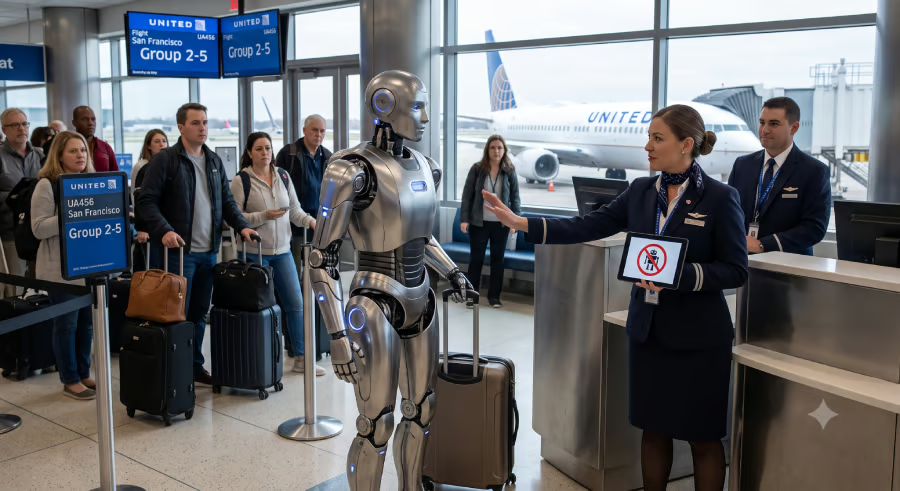


United Airlines and Delta Air Lines have become the latest US carriers to ban passengers from bringing humanoid robots on their flights, expanding a trend that began with Southwest Airlines earlier this year.
The restrictions apply to both carry-on bags and checked luggage, separating human-like and animal-like robots from ordinary consumer electronics.
Small robotic devices, including toy robots and robotic vacuum cleaners, can still travel if they meet existing baggage and lithium battery requirements.
United's policy took effect on July 23, while Delta introduced its restriction on June 18. United said the change is intended to improve flight safety rather than respond to a specific incident.
"We believe this change will help further ensure the safety of our customers and crews," a United spokesperson told CBS News.
Delta said it regularly updates its policies as new technologies emerge. "We continually review emerging technologies and update our policies to maintain the highest safety standards," a Delta spokesperson told CBS News.
"Delta has temporarily banned the transport of any robots designed to resemble or imitate a human or animal in appearance, size, movement or behavior, in the cabin or as checked baggage. These items are not considered assistive devices and do not fit the definition of a trained service animal (dog)," Delta wrote on its restricted items page.
Unlike United's permanent rule, Delta describes its ban as temporary.
A response to new technology
The latest restrictions follow Southwest Airlines' decision in May after a passenger flew with a humanoid robot companion, exposing uncertainty over how airlines should classify, screen, seat, and transport increasingly sophisticated robots.
Airlines say the concern is less about robots themselves and more about how they fit into existing aviation safety rules.
Humanoid robots often combine large lithium-ion batteries with articulated limbs, unusual shapes, and significant weight. Those characteristics can complicate baggage screening, storage, cargo handling, and emergency evacuation procedures compared with traditional luggage or consumer electronics.
Aviation rules are evolving with robotics
The airline industry has repeatedly updated baggage rules as new technologies — from smart luggage to hoverboards and large lithium batteries — have become more common. Humanoid robots represent another category that does not fit neatly into existing policies.
For travelers, bringing a life-sized humanoid robot onto a US commercial flight is becoming far less likely, even as investment in robotics accelerates.
For airlines, dedicated policies also reduce uncertainty for airport staff and flight crews, replacing case-by-case decisions with clear rules. If humanoid robots become more common in business, research, or personal use, carriers may eventually revisit these restrictions.
Until then, the tradeoff favors operational consistency and battery safety over accommodating a new class of high-tech passengers.
Check out our 12 APAC robots to watch, spanning humanoids, robot dogs, and other systems moving embodied AI into real-world use.