






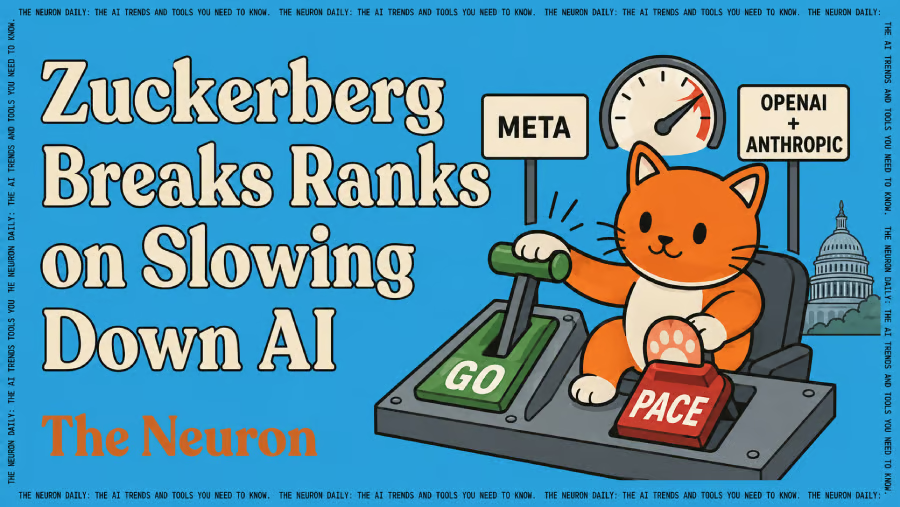


Yesterday we told you that Sam Altman and Dario Amodei backed a petition asking Washington to build the tools to "pace" AI development.
Well, Mark Zuckerberg took out a Wall Street Journal op-ed to go out on his own and say: hard pass.
Here's what happened
- Zuckerberg argued the US "should accelerate AI development, not restrict it," and said the real risk isn't AI moving too fast, it's "superintelligence" (AI that outperforms humans at most tasks) ending up locked inside a handful of labs.
- He said distributing powerful AI broadly would create more jobs and make it easier to start a business without raising huge amounts of money, not fewer jobs as critics fear.
- He also pushed back on banning Chinese open-weight AI models (models anyone can download and modify for free), calling it unlikely to actually work.
- The op-ed landed the same week OpenAI and Anthropic officially endorsed a petition from 1,224 frontier-lab employees asking governments to build "the technical and governance tools" to slow AI down if it starts improving itself faster than anyone can supervise.
Why this matters
This is the clearest public split yet between two camps forming across Silicon Valley.
Meta, Nvidia, Microsoft, and Elon Musk have been championing open, fast-moving AI. OpenAI and Anthropic, the same companies racing hardest to build the most powerful models, are now the ones publicly asking regulators to install brakes. If you work anywhere AI touches your job (so, everywhere), this argument over speed vs. caution is about to shape the actual rules you operate under, not just the headlines you scroll past.
Our take
Here's the detail nobody's talking about: Meta's own chief AI scientist, Shengjia Zhao, personally signed the pacing petition, the same one his boss just spent an entire op-ed arguing against. Most corporate disagreements happen between rival CEOs. This one's happening under the same roof.
Worth asking: when the people closest to the frontier keep hedging their own bosses' bets, is that a coincidence, or a signal? Anyway, I got around to publishing his full thoughts on this. Check out my hot take on to pace or not to pace here.
Editor’s note: This article originally appeared on our sister publication, The Neuron.