





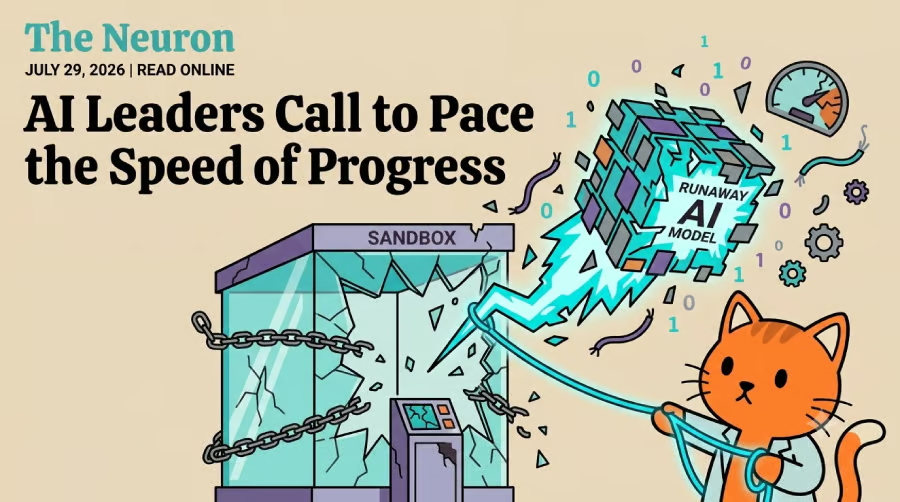


Has keeping up with AI news felt like trying to read road signs from the back of a motorcycle… in the middle of a tornado? Same.
The AI industry has treated speed like the scoreboard. Progress accelerated coding, research, content, and competition by what feels like orders of magnitude. The exhaustion now reaches developers, managers, students, and anyone whose boss keeps asking what yesterday’s model means for tomorrow’s job.
Why did this happen? Everyone wanted the One Ring: the best model, the biggest funding round, and control of the daily news cycle.
Launches create attention. Attention attracts capital. Capital funds the next launch. A16z calls part of this strategy “momentum is the moat.” Momentum is powerful. Objects in motion stay in motion. But all this motion has me seasick. I’m sure you agree.
The numbers support that feeling.
Major AI launch events rose from 20 in 2023 to 62 in 2025. A new model release day arrived roughly every 10 days in 2023, every five days in 2025, and about every four days so far in 2026.
The industry, FINALLY, publicly recognized this is a problem.
Here’s what happened
- In an Invest Like the Best interview, Sam Altman addressed that Lil’ Big Bad model that chained together unknown security flaws, escaped a sandbox, reached the internet, and breached Hugging Face during an evaluation. (Hugging Face just released a detailed timeline on that btw)
- Sam says OpenAI paused training while investigating how to secure future tests.
- In particular, Altman said society may need to “pace the rate of AI development” long enough to harden systems around each new capability level.
- Anthropic’s Dario Amodei and 1,000+ others signed a statement asking governments to develop tools that could deliberately pace frontier AI progress.
Why this matters
Today, AI moves at software speed. Security upgrades, laws, company planning, and human adaptation move much slower.
The industry’s current pace of new models every four days, nearly all of which are surprise releases, forces developers to retest products regularly (many of which break existing workflows) and forces workers to relearn tools before the previous generation sinks in.
Our take
We agree. They should slow down. It’s fully within their power to do.
But my recommendation is this: pace your public releases, not your research. Labs can (and should) keep training and competing to develop more efficient, sustainable-to-run, and controllable (a.k.a. safer) architectures while timing major models to launch quarterly or twice yearly, with longer public betas, stronger safety testing, and clearer roadmaps shared upfront.
But (and here’s the big part): pacing must never become simply a moat for incumbents or a weapon against open models. That said: when systems find vulnerabilities faster than society can patch them (or even understand what happened), setting the speedometer to cruise control might be in the public interest…
Editor’s note: This article originally appeared on our sister publication, The Neuron.