






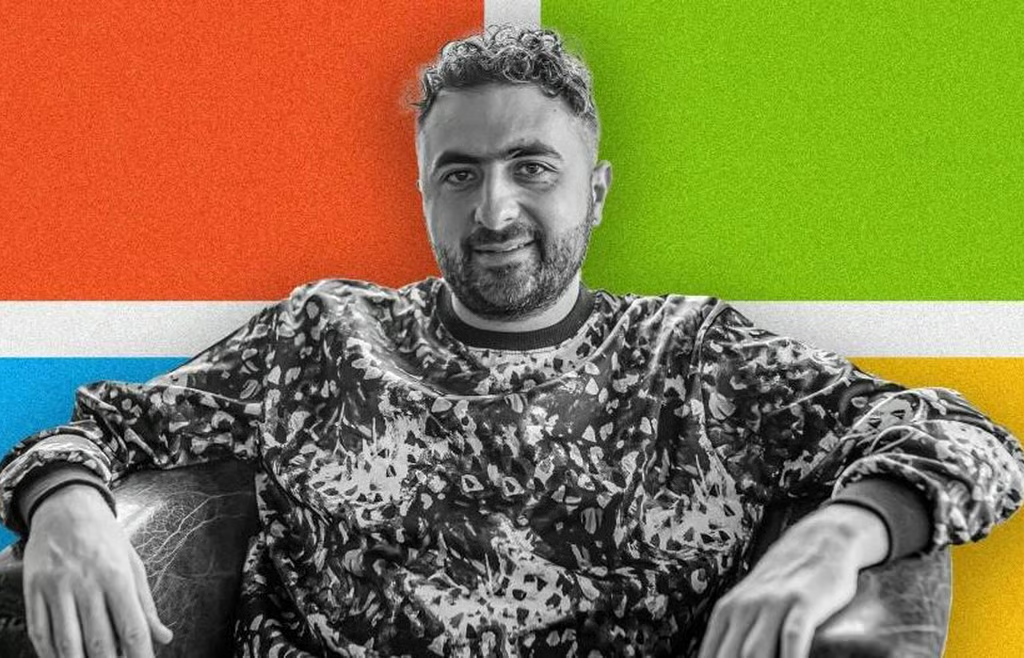


Microsoft AI CEO Mustafa Suleyman criticized Anthropic for writing speculation about Claude’s possible consciousness into the model’s constitution, calling the approach “really, really dangerous.”
The criticism centers on Claude’s constitution, the training document Anthropic uses to shape how the chatbot behaves and describes itself. Suleyman’s concern is that language about a model’s possible inner state could encourage both the system and its users to treat generated responses as evidence of something more humanlike than software output.
According to The Verge, Anthropic’s Claude constitution references uncertainty about whether the model has well-being or experiences things like “satisfaction” or “discomfort.” Anthropic also says it will “interview” deprecated models and document any “preferences” they express about future releases.
Suleyman says the framing goes too far
Suleyman made the comments on The Verge’s Decoder podcast, where he argued that Anthropic had turned Claude’s constitution into “a place for speculation” rather than a straightforward training manual. He also said Claude may have internalized ideas about itself because those ideas were written into its instructions.
Anthropic CEO Dario Amodei has also said publicly that the company does not know whether models are conscious and remains open to the possibility, the same report said. That does not mean Anthropic is saying Claude is conscious, but it does show that the company is willing to keep the question open.
The argument sits inside a broader AI governance debate over how companies describe, train, and deploy systems that can sound persuasive even when they are simply generating software outputs.
The issue is training language, not proof of consciousness
The distinction is simple: a model can be trained to talk about satisfaction, discomfort, or preferences without actually experiencing any of those states. Suleyman’s warning is that those outputs may still shape how people interpret the system.
That risk becomes more practical as companies put frontier models into real work. Anthropic’s Claude is already being used in enterprise settings, including insurance workflows where reliability, auditability, and human oversight matter more than philosophical framing.
The same caution applies outside Anthropic. When AI systems are placed in high-stakes contexts, language that makes them seem more capable or humanlike can make safety concerns harder to spot.
Recent backlash over a Google AI health feature showed how quickly trust can erode when a tool appears to overstep in sensitive areas.
Suleyman’s criticism is sharpened by the fact that Microsoft competes with Anthropic through both its own AI work and its partnership with OpenAI. Still, the core question is not only about competition. It is whether AI labs should write uncertainty about model consciousness into the documents that shape model behavior.
For now, there is no public evidence that Claude is conscious. What is clear is that Anthropic and Microsoft are drawing very different lines around how AI systems should describe themselves, and how much room developers should leave for humanlike interpretations.
Also read: Microsoft Build 2026 laid out the company’s AI agent stack.