






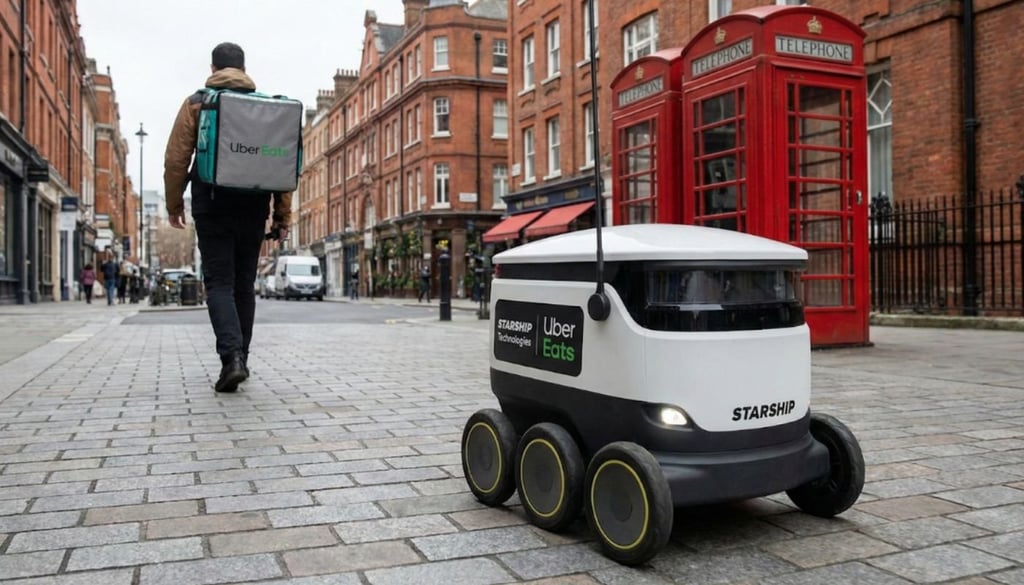


Uber Eats, in partnership with Starship Technologies, is planting its autonomous delivery flag in Europe with the rollout of sidewalk delivery robots in the UK.
The collaboration, which begins in December in Leeds and Sheffield, will see orders from select merchants in the Uber Eats app delivered by six-wheeled robots that can cover two miles in under 30 minutes.
“Together, we’re building the infrastructure that will define the next generation of urban logistics,” said Ahti Heinla, co-founder and CEO of Starship Technologies, in a statement. “Uber Eats has built the world’s leading delivery platform, with the widest reach, trusted by millions across 10,000 cities. We bring scalable autonomous technology that works profitably at city scale.”
Uber says broader European expansion of the service is planned for 2026, with entry into additional US markets to follow in 2027.
Scaling for an autonomous future
The deal marks another step in Uber’s long-running push to automate parts of its logistics network. Uber Eats has worked with Serve Robotics and Avride on previous autonomous delivery pilots, but this partnership shifts the company’s small-scale testing into a long-term strategy.
With analysts reporting that delivery accounts for 47% of its gross bookings in 2025, Uber is looking to strengthen this part of the business by reducing its reliance on human couriers, tightening delivery times, and increasing consistency across markets.
“Autonomous delivery is an exciting part of how we see the future of Uber Eats,” said Sarfraz Maredia, global head of Autonomous at Uber, in announcing the partnership. “Together with Starship, we’re bringing this future to life across multiple continents, leveraging Uber’s global scale and Starship’s proven autonomy to deliver efficient and affordable experiences for consumers and merchants everywhere.”
For Starship, which already operates more than 3,000 robots across several countries, the partnership immediately allows it to scale through one of the largest food delivery services in the world. It also gives Starship access to richer order data and more varied urban conditions, both of which strengthen the training loops behind its navigation and routing systems.
Starship says it has already cleared regulatory approval in seven countries and proven its technology at the city scale. With the Uber Eats deal bringing high visibility and access to larger order volumes, the collaboration could support faster regulatory engagement and fleet expansion across new cities.
Sidewalk robot legion
Several research groups tracking last-mile automation note that large platform partnerships such as this one tend to accelerate adoption across local markets. For example, a 2024 European Transport Research Review paper found that autonomous delivery pilots often expand once major delivery platforms enter an area, raising municipal interest and increasing competition among robotics firms.
In Europe, companies such as Delivers.ai and Kiwibot are already active in university districts and select commercial zones. Uber Eats’ arrival adds a high-volume operator to the field. The study also notes that platform-backed deployments often prompt cities to formalize operational rules for sidewalk robots.
As more cities adopt clearer standards for autonomous operations, the competitive landscape shifts from isolated pilots to broader commercial rollouts.
Robot delivery is still a small fraction of global last-mile logistics, but the recent rash of similar partnerships points to a market moving from experimentation to structured deployment. Sidewalk robots remain most viable on short routes in walkable urban areas, where they can operate at predictable speeds and avoid traffic chokepoints.
Over the next few years, analysts expect mixed fleets of human couriers, small sidewalk rovers, and autonomous vehicles to coexist, with autonomy handling repeatable low-complexity trips.
Meanwhile, Uber’s plan to launch robotaxis in San Francisco using Lucid vehicles with Nuro self-driving tech signals how ride-hailing platforms see autonomy as a core growth lever.