







The Cloud Native Computing Foundation announced on Jan. 29 that it is expanding its project roster, with the addition of the Rook project.
Rook is a container storage effort that works with the Kubernetes orchestration platform. Kubernetes was the founding project at the CNCF when the organization was created in July 2015 by the Linux Foundation. Rook becomes the 15th hosted project at the CNCF and is the first new project announced for 2018.
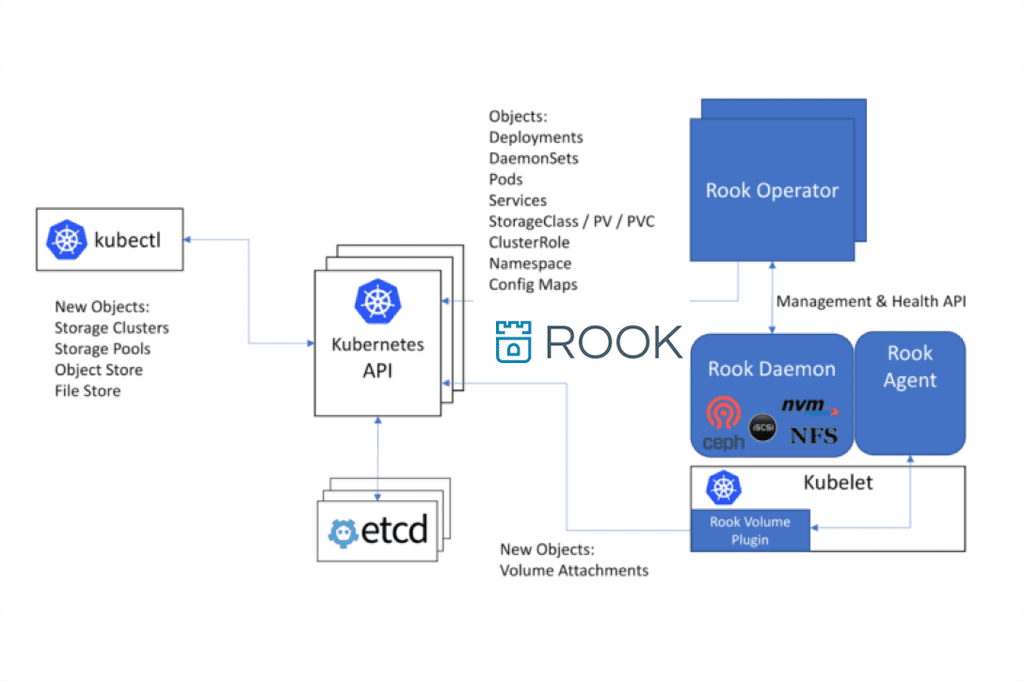
The Rook project defines itself as an open-source orchestrator for distributed storage systems running in cloud-native environments and is different from past efforts that enabled storage for container environments.
Among the earliest attempts at open-source container storage technology was the Flocker project, which provided a data volume manager for Docker containers. Kubernetes itself also natively includes an abstraction known as the Container Storage Interface (CSI), which enables storage technologies to plug into Kubernetes clusters.
“Flocker, CSI and other plug-in approaches focus on the consumption side of storage,” Bassam Tabbara, CEO of Upbound and creator of Rook, told eWEEK. “Rook focuses on the provider side of storage; it runs the actual storage cluster as a cloud-native application integrated into Kubernetes.”
Upbound is currently a stealth stage startup led by Tabbara that is working on Rook. Tabbara noted that storage vendor Quantum is the original sponsor of the Rook project and the maintainers of Rook are from both Quantum and Upbound.
Kubernetes deployments make use of many different types of storage back ends, with the open-source Ceph and Gluster storage technologies being among the most popular. Tabbara explained that organizations can make use of Ceph and Gluster through the CSI (Cloud Storage Interface). Rook sits at a higher level in the stack to enable stateful storage orchestration across a Kubernetes cluster.
“Rook is a storage orchestrator that enables running Ceph, and others in the future, like cloud-native applications,” Tabbara said. “It manages the deployment, bootstrapping, configuration, upgrade and scaling of storage systems like Ceph.”
There are multiple ways to install Rook into an existing Kubernetes deployment. As a cloud-native application, Tabbara said Rook can be installed through a Helm chart, which is an increasingly common DevOps approach to application deployment on Kubernetes. The open-source Helm project is a Kubernetes package manager that defines charts as packages of preconfigured Kubernetes resources.
“The Rook agent and all other components of Rook run in containers,” Tabbara said. “Nothing needs to be installed on the host.”
Rook is currently at the alpha release stage with a 0.6 milestone release. The project aims to have beta and production-ready releases later in 2018.
Sean Michael Kerner is a senior editor at eWEEK and InternetNews.com. Follow him on Twitter @TechJournalist.