






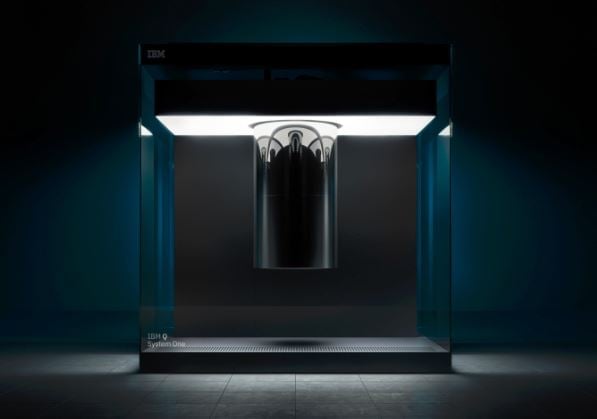

IBM said Jan. 9 that it has made a significant step forward in its quantum computing initiative with the development of the Q System One, a highly integrated, modular system the includes IBM-developed hardware, firmware and electronics that the company says is designed for both scientific and commercial use.
At the same time, company officials also said they plan to open the IBM Q Quantum Computation Center for commercial clients later this year in Poughkeepsie, N.Y.
IBM announced the new quantum system and plans for the center this week at the Consumer Electronics Show in Las Vegas, marking the company’s latest move in an emerging market that is being pursued by a broad range of major tech players, including Google, Microsoft and Intel. Quantum computing has been researched for decades, but the industry has seen the work accelerate in recent years, with IBM CEO Ginni Rometty saying she expects businesses to be running real applications on quantum systems and creating value within the next several years.
Quantum Can Go Far Beyond Conventional Computing
Quantum computing holds the promise of running workloads and solving problems that are beyond the reach of even the most powerful supercomputers today. Quantum computers are based on the laws of quantum mechanics in that they take advantage of the behavior of atoms and subatomic particles to address difficult computational challenges, such as those involved with exponential scaling.
While classic computers encode information in bits with a value of either 1 or 0, quantum computers use qubits that can be in both states at the same time, a quality that theoretically allows for significantly more computing power.
However, qubits also are extremely fragile and prone to error—they’re sensitive to outside forces, such as vibration, electromagnetic waves and temperature fluctuations. IBM’s Q System One has been designed with these issues in mind, the company said. The system comprises components that have been made to work together, including hardware designed for stability and reliability and being auto-calibrated to ensure repeatable and predictable high-quality qubits.
In addition, cryogenic engineering done by IBM researchers means a continuous cold and isolated environment for the qubits and high-precision, compact electronics were designed to tightly control large numbers of qubits. Firmware was designed to manage the system’s health and allow upgrades to be made with no downtime, and classical computation is enabled so quantum algorithms can be accessed via the cloud and executed in a hybrid fashion.
Qubits Must Be Protected From External Forces
All this is enclosed in an airtight case made of half-inch borosilicate glass that is nine feet tall and nine feet wide and designed to protect the qubits from external forces. It uses a motor-driven rotation system to open the enclosure for maintenance and upgrades while minimizing downtime. Independent aluminum and steel frames both unify and decouple the system’s cryostat, control electronics and outside casing to avoid the vibration that can affect the qubits.
IBM has a replica of the Q System One on display at CES.
The system is the latest step by IBM in its quantum-computing effort. The company in 2017 unveiled a 5-qubit system and also has made a 20-qubit system available via the IBM Cloud. Officials said the cloud-based IBM Q Experience, which has been operating since 2016, has more than 100,000 users who have run more than 6.7 million experiments.
The company’s Qiskit open-source quantum software development kit has been downloaded more than 140,000 times, and the IBM Q Network includes recent members such as Argonne and Lawrence Berkeley national labs, CERN and ExxonMobil.
Other companies also are in the quantum computing race. Both Google and Intel have developed multi-qubit processors, and Microsoft also has been doing research in the area, including developing a Quantum Development Kit. Startup Rigetti also is working on quantum computing, and officials with D-Wave have said they have quantum computers on the market–though some in the industry have said they aren’t true quantum systems.
‘Two- to Five-Year Time Frame’ Estimated for Widespread Use
All the work being done in the space means that businesses are not too far away from being able to run applications on quantum systems, according to IBM CEO Rometty.
“You’ll see real business clients doing real things that are really of value in a two- to five-year timeframe,” Rometty said in an interview on CNBC.
She said that quantum computing will be embraced by such industries as chemistry and materials, logistics and risk management, where calculations are so complicated that much of the work is done now based on approximations. Quantum systems will be able to better address those workloads.
“Quantum does not replace every kind of computer,” Rometty said. “It’s for certain kinds of problems.”
Gartner analysts, who put quantum computing on their list of top 10 strategic technology trends for 2019, said that while companies in such industries will see significant benefits from quantum computing, most enterprises will continue in the exploration phase through 2022.