







- Big Iron Mainframes Versus x86 Servers: What You Need to Know
- Five Advantages of Distributed Environments
- Acquisition Costs
- Operational Costs
- Infrastructure as a Supply Chain
- Expertise
- Data Center Convergence
- Five Advantages of a Mainframe Environment
- Security
- Resiliency
- Dynamic Capacity Management
- Server Consolidation
- Data Management
Big Iron Mainframes Versus x86 Servers: What You Need to Know
by Jeffrey Burt
Five Advantages of Distributed Environments
Acquisition Costs
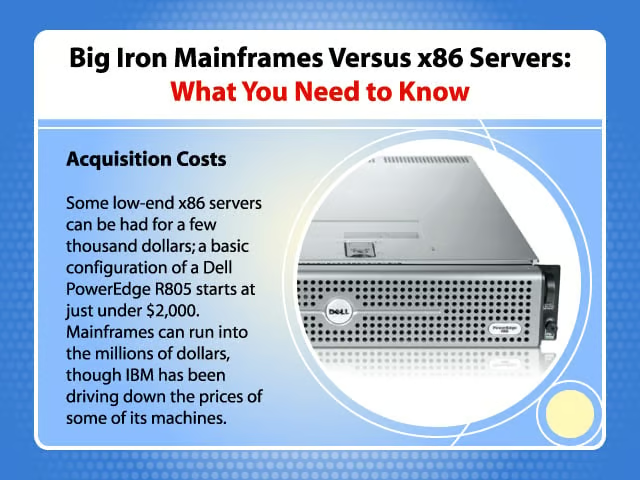
Some low-end x86 servers can be had for a few thousand dollars; a basic configuration of a Dell PowerEdge R805 starts at just under $2,000. Mainframes can run into the millions of dollars, though IBM has been driving down the prices of some of its machines.
Operational Costs
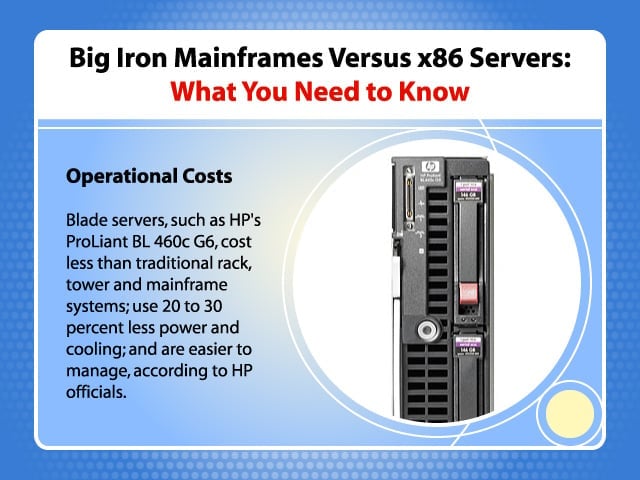
Blade servers, such as HP’s ProLiant BL 460c G6, cost less than traditional rack, tower and mainframe systems; use 20 to 30 percent less power and cooling; and are easier to manage, according to HP officials.
Infrastructure as a Supply Chain
A distributed model lets companies respond to business needs in a matter of minutes, rather than weeks or months. Services can quickly be requested by users, and the infrastructure can quickly provision them and make them available.
Expertise
While IBM, CA and others have been aggressive in recent years in attracting younger programmers to the mainframe platform, many mainframe professionals are older and nearing retirement age, and the bulk of students coming out of colleges have cut their teeth on new computing models.
Data Center Convergence
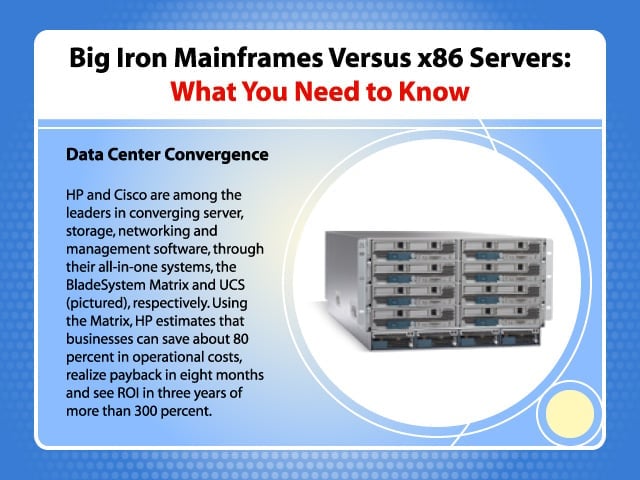
HP and Cisco are among the leaders in converging server, storage, networking and management software, through their all-in-one systems, the BladeSystem Matrix and UCS (pictured), respectively. Using the Matrix, HP estimates that businesses can save about 80 percent in operational costs, realize payback in eight months and see ROI in three years of more than 300 percent.
Five Advantages of a Mainframe Environment
Security
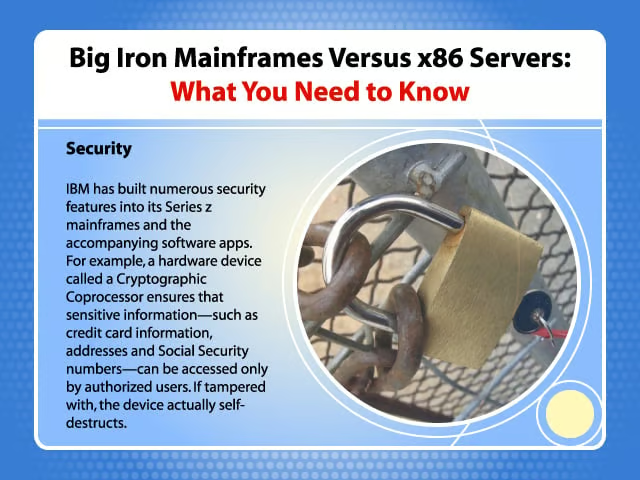
IBM has built numerous security features into its Series z mainframes and the accompanying software apps. For example, a hardware device called a Cryptographic Coprocessor ensures that sensitive information—such as credit card information, addresses and Social Security numbers—can be accessed only by authorized users. If tampered with, the device actually self-destructs.
Resiliency
Mainframes and IBM’s z/OS are built to stay up and running, even during planned and unplanned outages, firmware updates, and natural or man-made disasters.
Dynamic Capacity Management
IBM’s mainframes can add workloads to their systems—or remove workloads—at a moment’s notice.
Server Consolidation
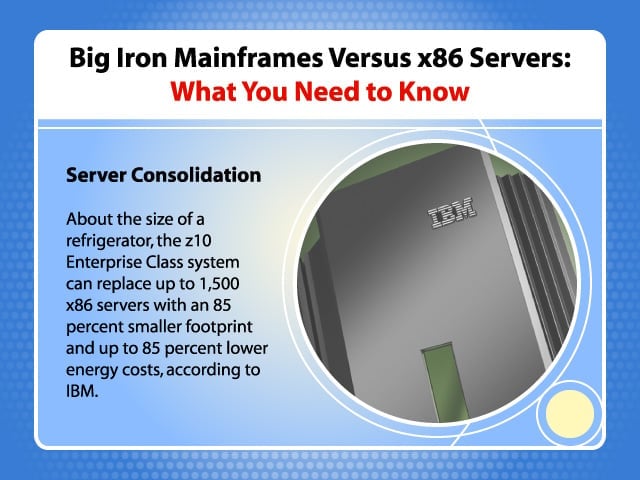
About the size of a refrigerator, the z10 Enterprise Class system can replace up to 1,500 x86 servers with an 85 percent smaller footprint and up to 85 percent lower energy costs, according to IBM.
Data Management
Businesses can use System z mainframes as centralized databases and avoid the data replication required with distributed systems, which create further data verification challenges.