






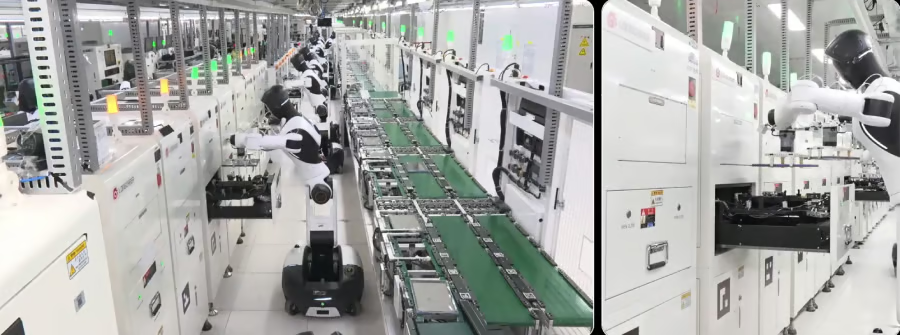


Chinese robotics company AGIBOT has completed a six-day livestream showing its humanoid robots operating inside a live production line at Longcheer Technology’s Nanchang factory.
The demonstration focused on tablet quality inspection, defect sorting, material transport, and other manufacturing activities. Unlike controlled demonstrations often held in laboratories, the robots worked alongside human employees, moving equipment and active factory processes.
According to AGIBOT, the robots operated for more than 64 hours, completed 64,828 production-line tasks, worked across more than four workflows, and achieved a reported task success rate of 99.99 percent. The company said the robots contributed to the production of 17,625 tablet units during the livestream.
The company presented the event as a test of whether humanoid robots can move beyond impressive demonstrations and become useful tools in commercial environments.
From robot demos to real deployment
AGIBOT said the livestream reflects a changing focus in the humanoid robotics industry.
Instead of measuring only what robots can do in isolated tasks, companies and manufacturers are increasingly looking at whether robots can operate reliably in complex workplaces.
“The key question for humanoid robotics is no longer only what a robot can demonstrate, but whether it can be deployed, integrated, and create value in real operating environments,” said Dr. Yao Maoqing, partner, senior vice president and president of Embodied AI Business Unit at AGIBOT.
The company said factories provide a tougher test than demonstrations because production lines keep moving, materials shift position, and robots must operate within existing processes rather than under controlled conditions.
This shift could influence how industrial customers evaluate humanoid robots. Future buyers may focus less on individual movements or hardware specifications and more on reliability, workflow integration, maintenance requirements, and the ability of robots to deliver measurable business value.
Scaling production alongside deployment
The livestream also came as AGIBOT announced that its 15,000th robot had rolled off its production line and was delivered to Longcheer.
The milestone robot was an AGIBOT G2, a wheeled mobile manipulator with a humanoid upper body designed for industrial tasks such as inspection, material handling, and production support.
The company said its manufacturing pace has accelerated, taking about one year to grow cumulative production from 1,000 to 5,000 robots, but only three months to increase output from 5,000 to 10,000 units. The production milestone highlights the company’s push to move humanoid robots from limited pilot programs toward broader industrial use.
Challenges remain before wider adoption
While the livestream showed progress, a successful factory demonstration does not automatically mean humanoid robots are ready for every workplace.
Industrial adoption will depend on long-term reliability, operating costs, safety around human workers, software improvements, and whether companies can achieve a return on investment compared with existing automation systems.
Traditional industrial robots remain highly effective for repetitive, fixed tasks. Humanoid robots are targeting more flexible environments where tasks change frequently and require greater adaptability. The bigger challenge for companies like AGIBOT is proving that robots can maintain performance over months and years, not just during a highly monitored six-day event.
A new test for the humanoid robot race
AGIBOT’s livestream marks a significant shift in the robotics industry: competition is moving from laboratory achievements toward real-world performance.
The next stage of humanoid robotics may depend less on which robot can walk, grab objects, or complete short demonstrations, and more on which companies can build reliable systems that fit into everyday industrial operations.
The six-day factory test does not prove that humanoid robots have solved manufacturing challenges. Still, it shows the industry is increasingly being judged by deployment results rather than promises alone.
Also read: Paris-based Enchanted Tools is positioning UMA as a humanoid robot built around approachability, emotional design, and service work.