






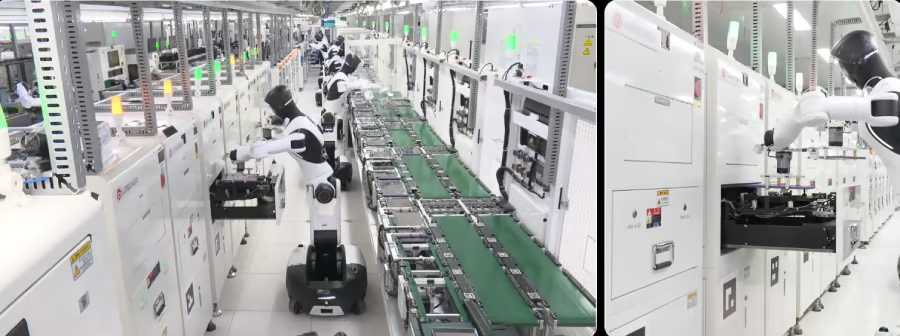


Chinese embodied AI company AGIBOT has kicked off a six-day global livestream showing its humanoid robots operating on an active tablet production line at Longcheer Technology’s factory in Nanchang, Jiangxi.
The broadcast runs from June 23 to June 28 and is streamed on AGIBOT’s official X and YouTube channels, giving viewers a direct look at robots working alongside human staff in a live industrial setting. Rather than a controlled demo, the robots are embedded into a real manufacturing workflow inside the quality inspection section of a mass-production line.
The robots, primarily AGIBOT’s G2 units, are tasked with inspecting, sorting, and handling tablets as they move through the production process.
They pick up devices from the line, run inspection steps using onboard sensors, and place them into trays for the next stage of processing. According to reports from the livestream, the robots processed more than 800 units in the first three hours without errors, later surpassing 3,000 items over extended continuous operation.
AGIBOT says the system is designed to work in sync with human workers and factory equipment, following the same production rhythm as the rest of the line.
Why this livestream matters
Unlike staged setups, real factory lines don’t pause for robotics experiments.
Instead of showcasing isolated movements or lab-based tasks, companies are now putting humanoid robots into real factories to test endurance, reliability, and consistency under production pressure.
Industry observers note that manufacturing environments are becoming the key proving ground for humanoid robots because they demand repetitive accuracy, long operating hours, and smooth coordination with humans and machines.
Inside AGIBOT’s approach
AGIBOT describes itself as an embodied AI company building both robotic systems and the intelligence behind them.
Its G2 robot is designed for industrial use, combining mobility, precision manipulation, and autonomous decision-making. The company highlights features such as dual-arm control, autonomous navigation, and continuous operation with hot-swappable batteries.
The robot is also built for long runtime performance, with reports of extended walking tests and validation under industrial conditions, including temperature extremes and collision safety checks. AGIBOT says its goal is to move embodied AI from research settings into real-world production environments where it can deliver measurable industrial value.
AGIBOT’s livestream follows similar public demonstrations from other robotics companies, including Figure AI, which has also streamed long-duration robot operations in logistics environments.
Across the sector, the focus is shifting from flashy demonstrations to sustained performance, especially in manufacturing and logistics, where robots can be evaluated on productivity rather than spectacle.
Factory deployment is now seen as one of the clearest ways to answer a central question in humanoid robotics: whether these systems can reliably replace or assist human labor at scale.
Why this matters to China
AGIBOT’s livestream also fits into China’s broader push to become a leader in embodied AI and advanced manufacturing.
By showing humanoid robots in a working factory, AGIBOT is not just promoting a single product. It is signaling that Chinese robotics companies want to move quickly from lab demos to industrial deployment, especially in sectors where repetitive tasks, labor costs, and production efficiency matter.
For China, that matters because humanoid robots could support factory automation, strengthen domestic robotics supply chains, and help the country compete in the next wave of AI-driven manufacturing. The livestream turns that ambition into something more concrete: robots doing real work, in public, under production pressure.
Also read: Our list of APAC robots to watch includes humanoids and robot dogs being tested for factory work, logistics, healthcare, retail, and public-space tasks as companies move beyond showroom demos.