






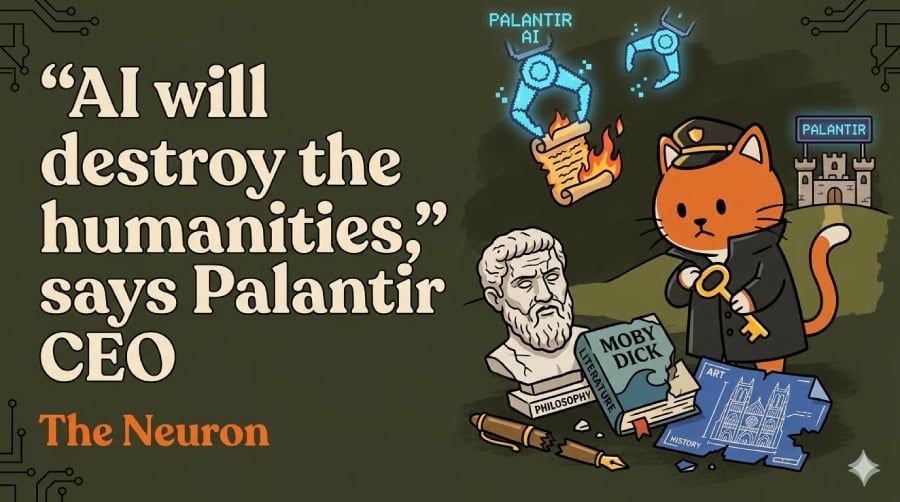


Alex Karp has a philosophy PhD from a German university, a law degree from Stanford, and a very specific warning for anyone who followed a similar path.
“You went to an elite school and studied philosophy. I’ll use myself as an example. Hopefully you have some other skill, because that one is going to be hard to market,” Karp told BlackRock CEO Larry Fink at Davos earlier this year.
The Palantir CEO wasn’t mincing words
AI, he said flatly, will destroy humanities jobs. The people who’ll be fine? The ones with specific technical and vocational skills. Not generalized knowledge from an elite degree.
It’s a provocative take, and not everyone agrees. McKinsey’s global managing partner recently said the firm is actively recruiting more liberal arts majors for their creativity. BlackRock’s own COO said they look for graduates who studied things with “nothing to do with finance or technology.” But Karp isn’t running a consulting firm. He’s running a defense tech company, and he’s betting on a different future.
His evidence isn’t just theoretical.
Palantir’s own Maven system, an AI tool that processes drone imagery for the US Army, is managed by a former police officer who attended a junior college. Karp’s point: the old signals of aptitude (elite schools, generalized degrees) are becoming less reliable. What matters now is what you can actually do.
Karp also launched a Meritocracy Fellowship last year, offering high school students a paid internship with a shot at a full-time role, explicitly bypassing the university pipeline entirely.
Why This Matters
This isn’t just one CEO being edgy at Davos.
Youth unemployment among 16-24-year-olds hit 10.4% in December. A new Lumina-Gallup survey found that 47% of college students have seriously considered switching majors due to AI concerns, and 16% have already done so. The anxiety is real, and it’s spreading faster than universities can respond.
Our Take: Karp is probably right that generalized knowledge alone won’t cut it, but the framing of “humanities vs. vocational” is too clean. The more interesting question is whether universities can actually teach students to work alongside AI, rather than just warning them it’s coming.
Most can’t yet, and that’s the real problem. And personally, I think that as AI gets more integrated into our lives, people will eventually crave something made by humans. Right now, most are still amazed at what AI can do. But as soon as we get bored or become accustomed to what AI can do, the humanities will re-emerge as people return to art, music, and literature made by humans.
Editor’s note: This content originally ran in the newsletter of our sister publication, The Neuron. To read more from The Neuron, sign up for its newsletter here.