






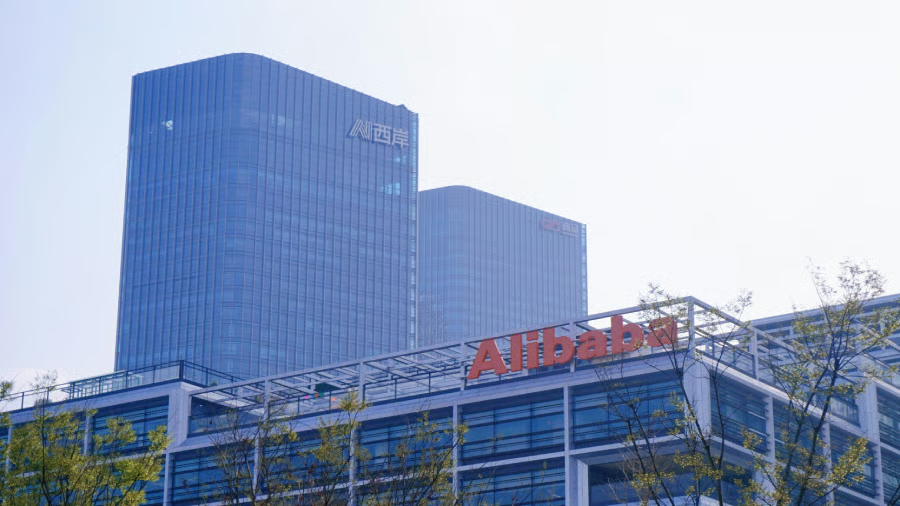


Alibaba’s AI business is growing fast enough to become a serious revenue engine. The bill for building it is growing fast, too.
The Chinese tech giant said AI-related product revenue reached RMB8.97 billion, or about $1.32 billion, in the quarter ended March 31, marking its 11th straight quarter of triple-digit growth. Cloud Intelligence Group revenue rose 38% year over year, even as Alibaba swung to an operating loss after heavy spending on AI infrastructure, quick commerce, and Qwen user growth.
For IT leaders, Alibaba’s results show the trade-off behind the AI infrastructure boom: demand is rising quickly, but turning that demand into durable profit remains a harder problem.
AI growth lifts Alibaba Cloud
Alibaba reported total quarterly revenue of RMB243.38 billion, or about $35.3 billion, up 3% from a year earlier. The result slightly missed analyst expectations cited by Reuters, but cloud and AI remained the company’s standout growth areas.
Cloud Intelligence Group revenue rose 38% year over year to RMB41.63 billion. External customer revenue for the unit grew 40%, with AI-related products accounting for 30% of that external revenue.
“Alibaba’s full-stack AI investments have progressed from incubation to commercialisation at scale,” CEO Eddie Wu said, according to the South China Morning Post. “This quarter, we achieved accelerated breakthroughs across models, cloud infrastructure, and applications.”
Alibaba pointed to demand for AI infrastructure, model training and inference, cloud operating systems, networking, storage, and Model-as-a-Service offerings.
The company is also bringing AI deeper into e-commerce. The Associated Press reported that Alibaba connected its Qwen AI app with Taobao, allowing users to browse, compare products, place orders, and manage deliveries through natural conversation.
Spending weighs on profitability
The growth came with a sharper profit hit. AP reported that Alibaba recorded an operating loss of RMB848 million, or about $125 million, compared with an operating income of RMB28.5 billion a year earlier.
Reuters reported that adjusted EBITA fell 84%, which Alibaba attributed to technology investments and quick-commerce spending. Excluding one-time items, net income for the quarter dropped 99.7%.
Alibaba previously pledged at least RMB380 billion, or roughly $56 billion, for AI and cloud infrastructure over three years. The company now expects to exceed that plan, though it did not provide a new target.
Wu told analysts that Alibaba is prioritizing market share over margins.
“We aim to maintain growth that is faster than the market average to gain a larger market share and firmly cement our absolute market leadership position. Those are the primary objectives, and margin is still secondary,” he said.
Agentic AI moves into commerce
Alibaba is also reorganizing around what it calls the “token economy,” a term tied to the computing units used to process AI inputs and outputs.
SCMP reported that Alibaba created the Alibaba Token Hub business group in March to centralize core AI operations around token creation, distribution, and application across much of its AI product stack. The move reflects Alibaba’s expectation that agentic AI tools, which can complete more tasks with less direct user input, will drive greater demand for cloud infrastructure.
According to AP, Alibaba launched Wukong, an agentic AI tool for commercial customers, in March and has raised prices for some AI services. Reuters also reported that the company is targeting more than $100 billion in combined external revenue from its AI and cloud divisions over the next five years.
For IT leaders, Alibaba’s results show both sides of the AI infrastructure race: demand is rising quickly, but the companies building these systems are still working out how to turn that growth into stronger operating returns.
China’s AI funding race is also lifting startups such as Moonshot AI, which raised roughly $2 billion at a valuation above $20 billion.