






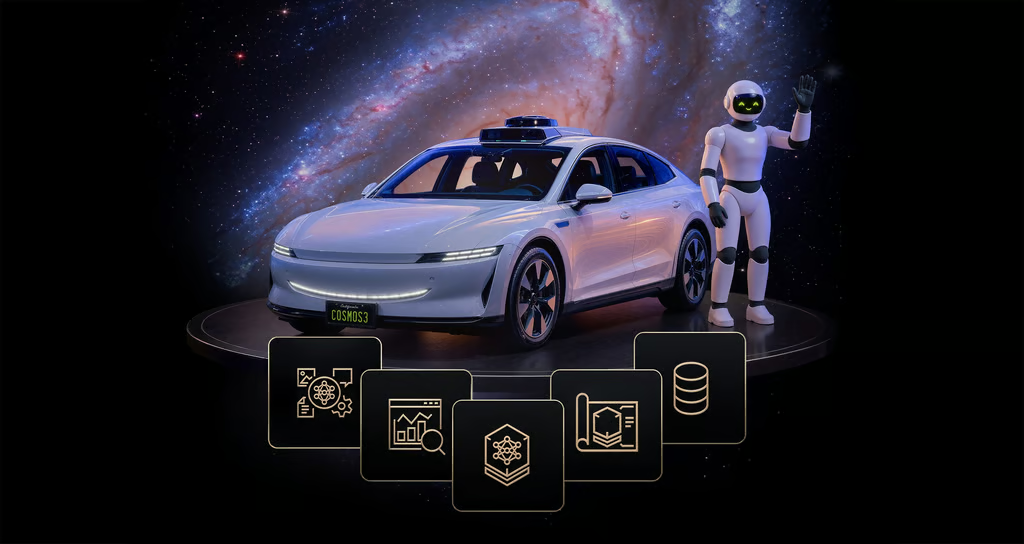


Nvidia’s latest AI model is not built to chat. It is built for systems that need to understand cameras, robots, movement, and the physical world.
Launched at GTC Taipei on May 31, 2026, Cosmos 3 is Nvidia’s new open-weight physical AI model family for robotics, autonomous vehicles, vision AI, and synthetic data workflows. For enterprise AI teams, the release could simplify some development pipelines, but it also raises familiar questions about Nvidia infrastructure dependency, production readiness, licensing, and benchmark validation.
What Nvidia Cosmos 3 gives robotics teams
Nvidia said Cosmos 3 combines vision reasoning, world generation, and action prediction in one architecture. The company describes it as an “omnimodel” that can process and generate text, images, video, ambient sound, and robotic action sequences.
Nvidia has also been pushing deeper into humanoid robotics research, where reference hardware, simulation tools, and training workflows are becoming part of the same platform conversation.
The release currently includes two model variants: Cosmos 3 Nano and Cosmos 3 Super. Nano is the smaller model aimed at faster inference, while Super is the larger model aimed at higher-accuracy generation, simulation, and physical reasoning workloads. A third variant, Cosmos 3 Edge, is expected later for real-time on-device inference.
Developers can access model checkpoints through the Hugging Face collection and use the Cosmos GitHub repository for code, recipes, deployment notes, and model documentation.
Cosmos 3 is broader than a video-generation model. The Cosmos 3 technical report describes a mixture-of-transformers architecture designed to support flexible input and output combinations across language, image, video, audio, and action data.
The company also says Cosmos 3 ranks first among open models across several physical AI benchmarks and leaderboards covering world generation, action policy, and vision understanding. Those claims should be treated as Nvidia-reported unless readers can verify the results through the linked leaderboards or independent evaluations.
The enterprise trade-off behind open weights
The open-model framing is important, but it comes with caveats. Cosmos 3 is being released with open weights, code, datasets, and post-training resources under the OpenMDW-1.1 license. The license grants broad permission to use and distribute the model materials, but it also requires notices to be retained and leaves rights-clearance responsibility with users.
Still, open weights do not automatically mean a cloud-neutral or hardware-neutral production path. Nvidia lists NIM microservices as a deployment option, including a Cosmos 3 Reasoner NIM, and the same hardware-software bundling pattern appears in Nvidia’s broader push into AI PCs with Microsoft Surface.
The launch also fits into Nvidia’s larger physical AI strategy, spanning simulation, synthetic data, NIM deployment, and DGX Cloud training infrastructure. Nvidia also announced the Cosmos Coalition, whose founding members include Agile Robots, Black Forest Labs, Generalist, LTX, Runway, and Skild AI.
For robotics developers, autonomous vehicle teams, and enterprise AI leaders, the trade-off is concrete: Cosmos 3 could reduce integration work, but only after teams validate performance for their own hardware, data, and safety requirements. The timing also comes as other AI labs, including OpenAI, are renewing their robotics ambitions.
That validation step is especially important because physical AI can affect safety, movement, and real-world operations.
The release gives enterprises a new open-weight foundation model option for physical AI, but not a shortcut around due diligence. Before adopting Cosmos 3 in production workflows, teams should review the license terms, test performance against their own robotics or simulation workloads, and confirm which Nvidia services they would need to run it at scale.
Also read: China’s Unitree cleared a key IPO review as investors place bigger bets on humanoid robots and embodied AI.