






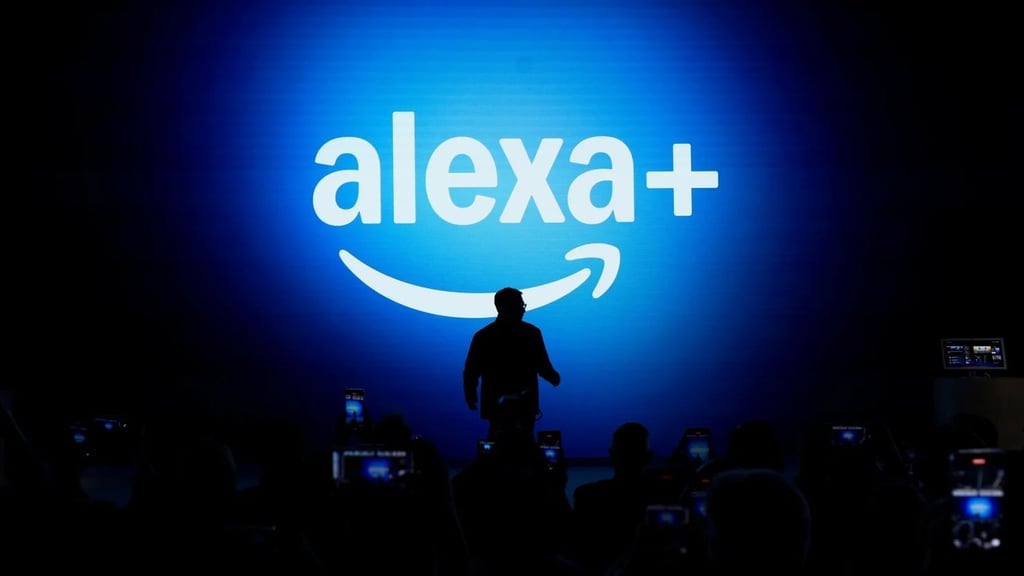


Amazon’s long-scheduled overhaul of its digital assistant, Alexa, has finally arrived on the web… sporting a look similar to rival ChatGPT.
While Amazon has one of the largest installed user bases for an AI product through the sale of hundreds of millions of Alexa smart home speakers, voice-activated virtual assistants have taken a back seat to text-based generative chatbots since the launch of ChatGPT three years ago.
Alexa+, which is available on the web at Alexa.com, is pitched as a tool to “get quick answers, explore complex topics, create content, plan trip itineraries, and get help with homework” — a familiar promise shared by most all-purpose generative chatbots. Users can carry over conversations and tasks across all Alexa-supported hardware, including connected smart home devices.
Even before ChatGPT’s launch, Amazon had been sinking billions into Alexa and its smart home device portfolio each year, without a clear route to profitability. While the devices were originally marketed as both the centre of the smart home and a way to order items, make reservations, and perform other high-value tasks, they have often functioned as little more than smart speakers for Spotify or Apple Music.
After the initial purchase, Amazon generated little additional revenue from its smart home devices. According to several surveys, only about 5% of Alexa owners said they had used the product to buy items.
Against that backdrop, Amazon began work on Alexa+ in 2024, with an initial integration into Alexa’s voice-activated assistant rolling out in March 2025. The service costs $19.99 a month for non-Prime users and is free for Prime subscribers. Amazon has not disclosed how many subscribers Alexa+ has, but has said it has scaled to tens of millions of customers.
Amazon putting AI in more places
Amazon has been steadily embedding AI across more of its product line, partly to counter claims that it is lagging in the AI race.
Recent launches include:
- An AI-powered “Help Me Decide” feature in its shopping app
- Conversational AI greetings on its Ring doorbells
- AI-generated recaps of popular shows on Prime Video
- Smart glasses with embedded AI for packers and delivery drivers
While this may appear to be a scattered approach, it mirrors how Microsoft and Google have integrated their AI systems over the past two years. Some integrations are so subtle that most users barely notice them, while others may unlock higher-value interactions that improve products over time.
Beyond software, Amazon has also been promoting its in-house AI accelerator chips as an alternative to Google’s TPUs and Nvidia’s GPUs. Amazon CEO Andy Jassy has said the chips are already a multi-billion-dollar business, with major AI developers using them to train models.
The old guard reasserts itself
Amazon is the latest member of the tech old guard to reassert its position, rolling out updates, integrations, and product launches to stay competitive. Of the four major players — Google, Microsoft, Amazon, and Apple — Google has arguably been the most successful so far, receiving strong praise for the launch of Gemini 3 and growing interest in its TPU accelerators.
Microsoft has aligned closely with OpenAI, even as the startup has sought to loosen ties forged through a series of agreements in 2023 and 2024. Microsoft holds an exclusive licence to the underlying API and has integrated its Copilot models across much of its software suite.
Apple remains the outlier and has struggled to generate momentum around its AI efforts, including Apple Intelligence. It reportedly plans a major Siri revamp similar to Amazon’s Alexa overhaul, potentially working with Google and OpenAI to support this revamp.
Also read: AWS’ re:Invent 2025 announcements underscore how Amazon’s AI push spans consumer assistants like Alexa+ and the infrastructure behind them.