









The AI race is beginning to look less like a contest for the smartest model and more like a fight over who can make advanced intelligence affordable.
With the launch of Claude Opus 5, Anthropic introduced a model that delivers performance that approaches Claude Fable 5 levels across several coding and knowledge-work benchmarks while costing roughly half as much to run. Instead of chasing another leap in benchmark scores, Anthropic is touting Opus 5 as a practical choice for businesses that want to deploy AI across coding, document analysis, office work, and long-running autonomous agents.
The release reflects a broader shift among leading AI developers, where reducing inference costs and improving efficiency are becoming just as important as pushing the limits of model intelligence. As enterprises expand AI deployments, operating costs, and not just raw intelligence, are increasingly shaping which models users get to use the most.
What’s special about Claude Opus 5?
Anthropic is positioning Claude Opus 5 as the sweet spot between raw capability and practical deployment. While Claude Fable 5 remains at the top, Opus 5 is designed to deliver performance close to Claude Fable 5's at roughly half the operating cost. That is exactly what Anthropic is betting will make it a more economical choice for enterprises.
Like its predecessor, Opus 4.8, Opus 5 is built to handle demanding workloads, particularly software engineering, professional writing, research, data analysis, and document-heavy tasks.
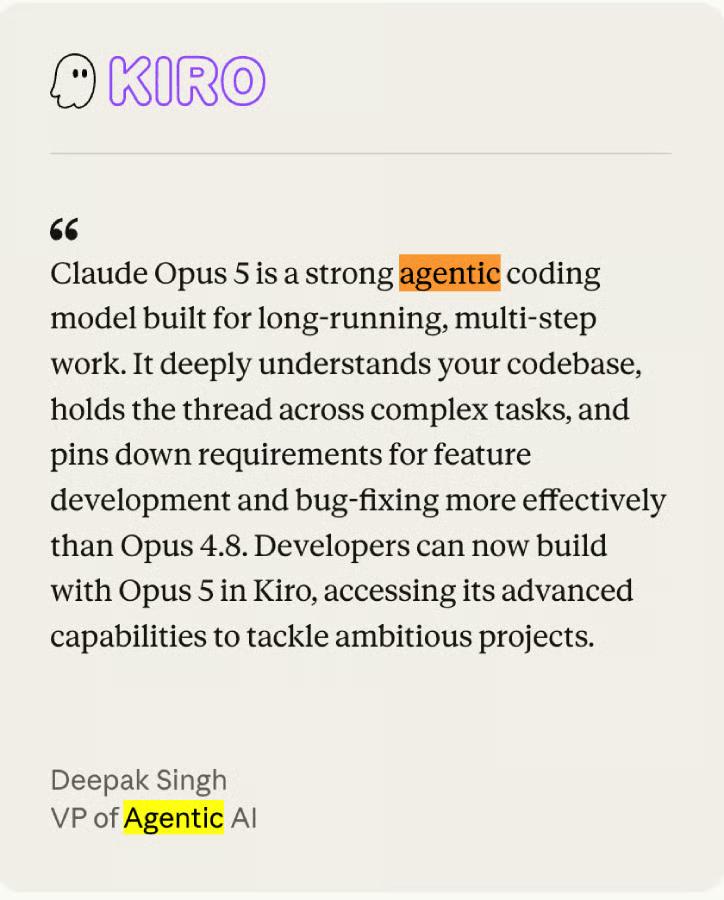
Early testers commended the model's agentic abilities, with Deepak Singh, VP of agentic AI at Kiro, praising the model’s ability to perform “long-running, multi-step” agentic work.
The model also introduces capabilities to improve real-world deployments. Anthropic says Opus 5 supports Fast Mode, “where it runs around 2.5 times the default speed” for twice its default price.
Why release it now?
For much of the AI industry's recent history, flagship releases have focused on outperforming rivals through advanced reasoning. With Opus 5, Anthropic is making a different argument: that for many enterprise workloads, a model delivering near-frontier intelligence at a significantly lower cost may be more valuable than squeezing out another incremental gain in capability.
The timing also reflects growing competitive pressure across the AI market.
Chinese AI labs have gained attention for high-performing open-weight models that combine strong capabilities with aggressive pricing, while US developers such as Anthropic, OpenAI, and Google are increasingly responding by driving down the cost of running proprietary frontier models without sacrificing much performance. In that sense, Opus 5 is as much a competitive strategy as it is a product launch.
The widespread gains from this trend
The immediate benefit is clear. Enterprises that cannot justify the cost of running Fable 5-level models at scale now have a lower-cost alternative with similar capabilities. Developers and other professionals handling complex workloads also stand to benefit, while making Opus 5 available through Pro alongside Max plans gives more users access to frontier-level AI.
The longer-term effects could extend beyond lower subscription costs. As AI companies increasingly prioritize efficiency alongside intelligence, newer models could require fewer GPUs, less electricity, less memory, less network bandwidth, and less compute time. That would not only reduce operating costs for AI providers and their customers but could also ease some of the infrastructure pressures fueling the industry's rapid data center expansion, potentially strengthening companies' case when seeking approval for new facilities.
There may also be downstream effects on the broader hardware market.
If more capable models can deliver similar results using fewer tokens or lower inference costs, enterprises could see reduced AI spending. While that alone is unlikely to lower consumer device prices, it could contribute to a better supply chain over time if paired with increased chip production and manufacturing capacity.
Also read: How OpenAI, Meta, and SpaceXAI are competing on AI cost and efficiency.