






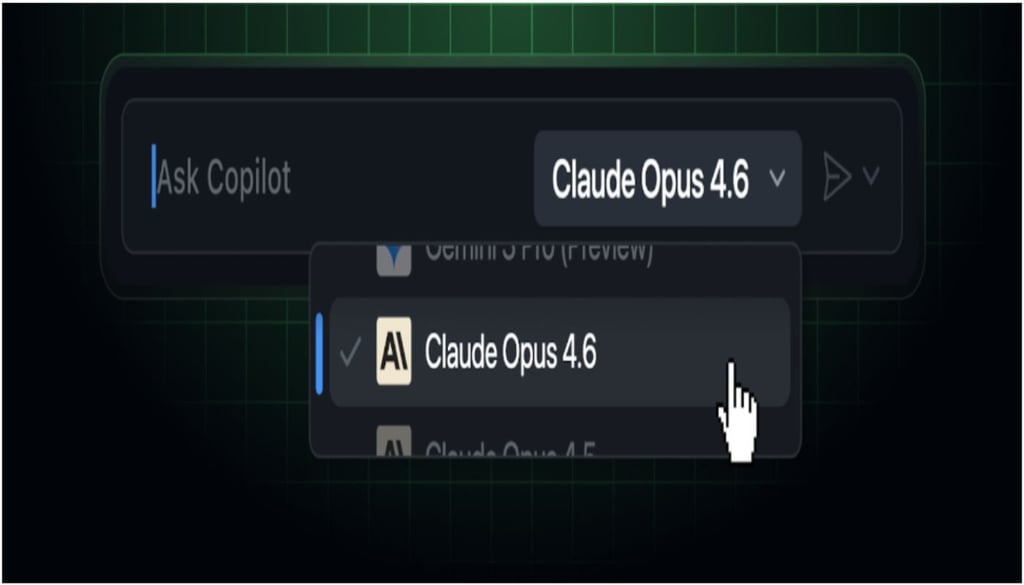


Anthropic’s most advanced AI model, Claude Opus 4.6, is now available within Microsoft’s AI ecosystem, marking a notable expansion for the fast-growing Claude platform and providing enterprises with new options beyond OpenAI-powered tools.
Microsoft confirmed that Claude Opus 4.6 is now live in Microsoft Foundry, its Azure-based platform for building and running enterprise AI systems. The model is also rolling out across GitHub Copilot, bringing Anthropic’s latest reasoning and coding capabilities directly to developers’ daily workflows.
According to Microsoft, the goal is to combine “intelligence and trust” by pairing Claude’s advanced reasoning with Foundry’s governance, security, and operational controls. Inside Foundry, Opus 4.6 can pull context from Microsoft 365 data, Fabric, and the web, making it suitable for complex coding tasks, research, and business workflows that require accuracy and auditability.
What makes Opus 4.6 different
Anthropic positions Opus 4.6 as a direct upgrade to Opus 4.5, with notable gains in long-running and complex tasks.
Opus 4.6 “improves on its predecessor’s coding skills. It plans more carefully, sustains agentic tasks for longer, can operate more reliably in larger codebases, and has better code review and debugging skills to catch its own mistakes,” the company wrote.
A major technical milestone is its 1 million-token context window, currently available in beta. This allows the model to reason across massive documents, long conversations, or entire codebases without losing track of earlier details.
The benchmark results Anthropic is leaning on
Anthropic says Opus 4.6 delivers state-of-the-art results across several well-known evaluations.
The company reports that the model achieves the top score (65.4%) on Terminal-Bench 2.0, an agentic coding benchmark, and leads all other frontier models on Humanity’s Last Exam, a multidisciplinary reasoning test.
On GDPval-AA, which measures performance on economically valuable knowledge-work tasks in areas like finance and law, Anthropic says Opus 4.6 outperforms OpenAI’s GPT-5.2 by about 144 Elo points, and beats Opus 4.5 by an even wider margin.
Anthropic also highlights strong results (84%) on BrowseComp, a benchmark focused on finding hard-to-locate information online.
From coding to office work
Anthropic is positioning Opus 4.6 as more than a developer tool. Within Microsoft environments, the model can generate documents, analyze spreadsheets, and assist in building presentations with professional formatting and structure.
Anthropic has also introduced agent teams, allowing multiple AI agents to work in parallel on large tasks. These capabilities are designed to support long-running projects, such as refactoring software, conducting deep financial analysis, or coordinating multi-step business processes.
Beyond Microsoft Foundry, Claude Opus 4.6 is also rolling out in GitHub Copilot, where it will be available to Pro, Pro+, Business, and Enterprise users. GitHub stated that the model excels at agentic coding tasks that require planning and tool use.
Developers can select Opus 4.6 across Visual Studio Code, Visual Studio, GitHub.com, GitHub Mobile, and the GitHub CLI, although the rollout is gradual and subject to admin controls for enterprise accounts.
Safety and pricing
With great power comes a lot of… internal monologue.
Anthropic admits that because Opus 4.6 thinks so deeply, it might actually overthink simple tasks, which can increase costs. To fix this, they’ve introduced an “Effort” parameter that allows users to dial the model’s intensity from “low” to “max.”
On the safety front, the company ran its most rigorous testing yet, including six new “cybersecurity probes” to ensure the model’s improved coding skills aren’t used for harm.
Despite the jump in intelligence, the price tag remains the same as the previous version: $5 per million input tokens and $25 per million output tokens.
For further context on how Anthropic’s AI reach is shaking up traditional industries, see eWeek’s coverage of the company’s new legal AI tool and its market impact.