






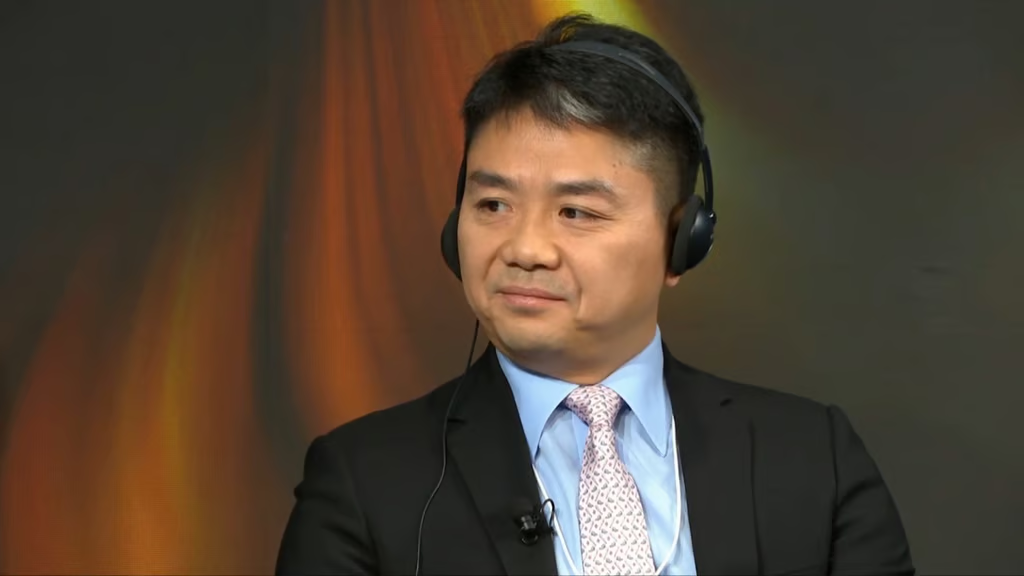


While tech executives around the globe are using artificial intelligence to trim their headcounts, one of China’s largest employers is taking a very different public stance.
Liu Qiangdong, the billionaire founder of e-commerce titan JD.com Inc., has promised to shield his massive workforce from displacement amid the company’s aggressive push into automation. Speaking during an internal address to corporate leadership, Liu sought to quiet anxiety about machines taking over human roles, according to a video that circulated widely on social media.
"JD.com will not fire a single front-line worker replaced by machines," Liu said in the video, according to Bloomberg.
He added that the e-commerce giant would "do everything possible to safeguard employment for hundreds of thousands of staff, including blue-collar workers," who keep the company's daily physical operations moving.
JD.com is among China’s largest private-sector employers, with roughly 900,000 workers spanning a wide range of roles, including delivery drivers, warehouse personnel, retail staff, AI trainers, and robotics technicians.
AI expansion continues
The pledge comes as JD.com continues investing heavily in automation and AI.
Company filings show JD.com has been developing and testing a variety of automated technologies, including unmanned warehouses, drone deliveries, autonomous vehicles, automated delivery stations, and cashier-free convenience stores.
The company has long positioned itself as a leader in logistics innovation. One of its most notable projects was a highly automated warehouse capable of processing large volumes of orders with only a handful of human workers overseeing robotic systems.
JD Logistics, the firm's logistics arm, has also expanded its use of AI-powered route planning and autonomous delivery technologies across parts of China.
Training instead of layoffs
Rather than reducing headcount, Liu said JD.com plans to prepare workers for new technology-driven roles.
According to his remarks, the company has established more than 80 training centers across China to help employees develop skills related to maintaining and operating automated systems.
The initiative reflects an effort to retrain workers as technology changes the nature of logistics and retail jobs. Supporters of the approach argue that automation can create new categories of employment, such as robot maintenance, AI operations, and technical support, even as traditional tasks become increasingly automated.
Growing policy pressure
Liu’s comments arrive at a sensitive moment for China’s labor market.
Chinese authorities have been encouraging companies to accelerate AI adoption as part of the country's push to become a global leader in advanced technologies. At the same time, policymakers remain focused on employment stability amid slower economic growth and persistent concerns over youth unemployment.
Recent legal developments have reinforced protections for workers affected by automation. Bloomberg reported that a Chinese court ruled in late April that companies cannot dismiss employees or reduce salaries solely to replace them with AI systems.
Authorities also introduced rules requiring businesses to retrain or reassign employees before termination in cases involving technological change.
Also read: Intuit is cutting 3,000 jobs as it restructures around AI agents, operational efficiency, and mid-market business services.