








Thousands of runners will hit the pavement in Beijing next week… but not all of them will be human.
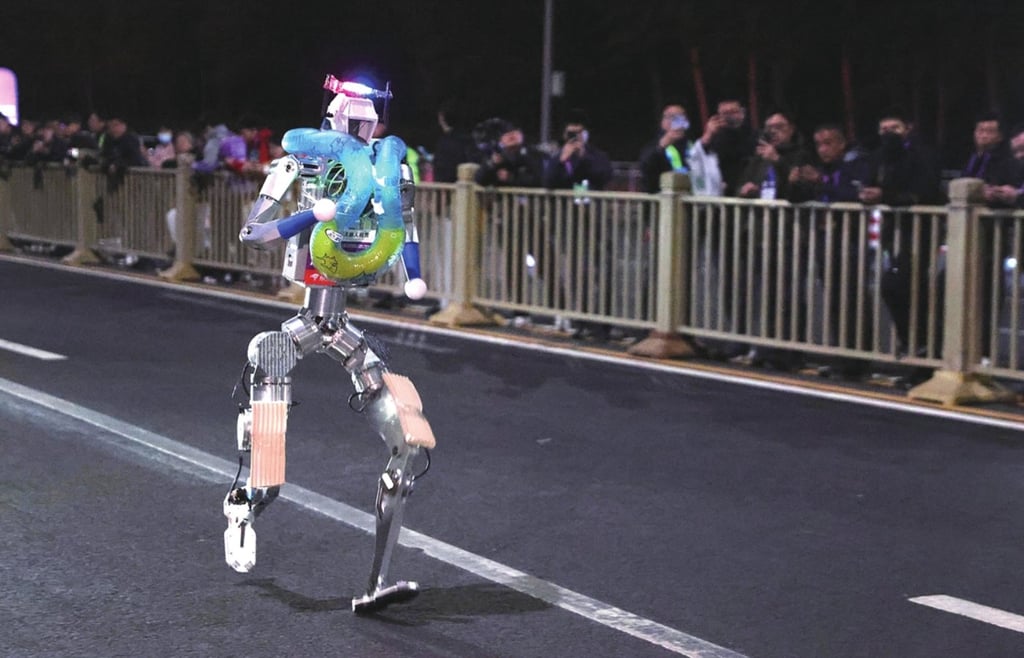
The city has completed a full-scale test of its humanoid robot half-marathon, with more than 70 teams participating ahead of the April 19 race and more than 100 expected to compete. The event, held in Beijing’s E-Town Economic and Technological area, pushes humanoid robots from controlled lab environments into real-world conditions.
The race will test autonomy, endurance, and real-time decision-making across a 21-kilometer course.
Full-scale rehearsal tests real-world conditions
Organizers said the overnight test from April 11 to 12 simulated the entire race route, including urban streets and terrain in the ecological park. The drill covered navigation, scheduling coordination, and emergency response systems to ensure race readiness.
According to CGTN, more than 70 teams, including four international entrants, took part in the test, using both autonomous and remotely controlled robots. The official race is expected to feature over 100 teams, nearly five times more than last year’s participation.
Teams are relying less on human control
Global Times reported that nearly 40% of teams will compete using autonomous navigation, part of the push to reduce human intervention in robotics.
Chen Jing, Vice President of the Technology and Strategy Research Institute, said the rule changes show a turning point for embodied AI.
“The scaling of autonomous navigation signals that the ‘brain’ of embodied AI is finally catching up with the ‘body,’” Chen said.
Organizers have updated competition rules to favor autonomy, including penalties for remote-controlled teams and stricter limits on human involvement. These updates aim to accelerate the development of robots capable of operating independently in complex environments.
Robots must handle several technical challenges during the race:
- Real-time perception and decision-making in dynamic environments
- Energy efficiency and battery management over long distances
- Balance, gait control, and millisecond-level posture adjustments
A proving ground for real-world robotics
The humanoid robot half-marathon is widely seen as more than a technical showcase. Industry observers emphasized it represents a practical test of how robots perform outside controlled settings.
Chen added that endurance races provide a dual benchmark for robotics systems.
“They provide a dual test of peak performance and sustained operation under complex conditions, evaluating both speed and robustness,” Chen told Global Times.
The broader robotics ecosystem in China is expanding rapidly. Government data cited by Global Times shows more than 140 humanoid robot manufacturers operating in the country by 2025, with over 330 models released.
Some of that momentum is shown in newer designs like Unitree’s R1 humanoid robot, which is built for agility. The robot can perform dynamic movements such as cartwheels and running downhill, enabled by its lightweight frame and flexible joints.
The April 19 race will serve as a high-profile proving ground for these advancements, as teams demonstrate how humanoid robots perform under real-world conditions at scale.
Also read: A Unitree robot stepped into the ring with a human reporter, and the footage shows just how far humanoid robotics has come.