






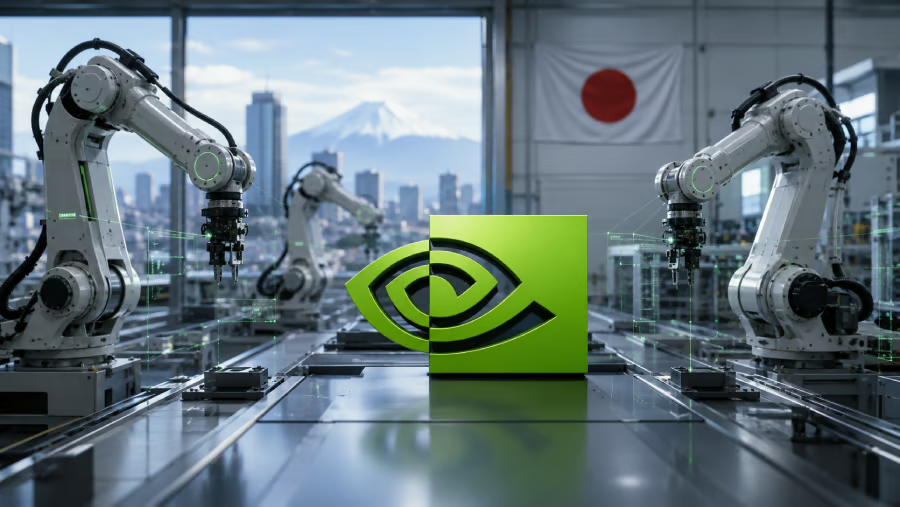


Japan is already a global leader in industrial robotics. Nvidia now wants to help those machines think as well as they move.
The chipmaker is partnering with major Japanese companies, including Fanuc, Yaskawa Electric, Fujitsu, Hitachi, and Kawasaki Heavy Industries, to develop physical AI systems for manufacturing and other industries. The effort combines Nvidia’s chips and AI models with Japan’s robotics expertise as the country faces workforce shortages and growing competition to build AI infrastructure across APAC.
The announcement also reflects a broader race to build the infrastructure needed for AI-powered manufacturing across the Asia-Pacific region.
Nvidia joins Japan’s industrial heavyweights
Nvidia announced the partnerships during CEO Jensen Huang’s visit to Tokyo, where executives from several Japanese robotics and manufacturing companies appeared alongside him.
“With AI, robots will become smart, easily adaptable and accessible,” Huang said during the event, per Reuters.
The companies plan to explore how AI can help industrial robots adjust to changing tasks and environments instead of relying only on fixed instructions. Nvidia also introduced Cosmos 3 Edge, a world model designed to help robots and vision AI systems understand and navigate physical surroundings in real time.
“The next frontier of AI is in the physical world, and this is a once-in-a-generation opportunity for Japan,” Huang said in a statement, according to CNBC.
Japan builds the computing layer
The robotics initiative is also tied to Japan's broader push to build domestic AI infrastructure. According to Reuters, government-supported company Noetra plans to buy 27,500 of Nvidia’s next-generation Rubin chips to develop computing capacity for physical AI.
Construction is scheduled to begin in April 2027, with operations expected to start in June 2028.
Local computing capacity could enable Japanese manufacturers to train and operate robotic systems without sending sensitive production data abroad. It may also help companies address data localization, security, and governance requirements as AI connects more closely with factory equipment and operational systems.
Nvidia described Japan as a full-stack AI ecosystem spanning robotics, manufacturing, research, infrastructure, and gaming.
What physical AI could change in factories
Physical AI could make industrial robots useful for a wider range of tasks. Traditional factory robots often work best in controlled settings, where movements and production steps remain predictable.
AI-enabled systems could respond to visual and sensor data, adjust to small variations, and switch between tasks with less reprogramming. For Japanese manufacturers, that could reduce downtime and make automation more practical for shorter production runs or frequently changing product lines.
Nvidia emphasized that Japan’s aging population also gives the technology a clear workforce angle. Smarter machines could help manufacturers, logistics companies, healthcare providers, and service businesses maintain output as the working-age population declines.
Hitachi is already developing systems that connect information technology with industrial operations, while avatarin is building Japanese-language AI agents and remote-presence robotics.
The barriers manufacturers still face
Access to chips and models does not guarantee fast adoption. Companies will still need secure networks, specialized training data, skilled workers, and safety controls for machines operating near people.
Legacy equipment could create another hurdle.
Smaller manufacturers may struggle to connect older production systems to newer AI platforms or to justify the costs of chips, sensors, integration, and maintenance.
Japan’s AI market is expected to reach $27.9 billion by 2029, according to an International Trade Administration estimate cited by CNBC.
Nvidia's partnerships position Japan at the center of the emerging physical AI market, but success will depend on more than advanced chips. Manufacturers must show that AI-powered robots deliver measurable gains in productivity, flexibility, and cost efficiency before large-scale adoption becomes the norm.
If they do, the next wave of industrial automation may be defined less by fixed programming and more by machines that can continuously adapt to the work around them.
Read Next: Japan wants 10 million AI-powered robots operating nationwide by 2040, making robotics one of Tokyo’s biggest AI bets.