








Picking a lipstick online has always involved a little guesswork. L’Oréal wants ChatGPT to take some of that guesswork out.
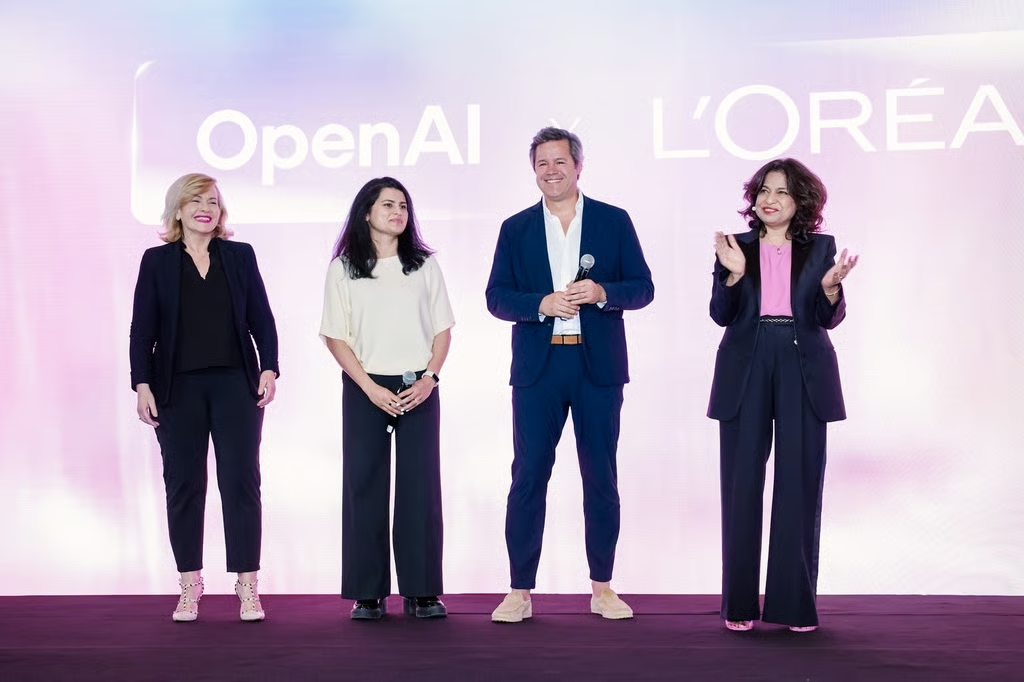
L’Oréal’s new partnership with OpenAI will bring Maybelline virtual try-on directly into ChatGPT. Announced at VivaTech 2026, the deal gives the beauty company a visible consumer feature inside one of the most recognizable AI platforms.
Beauty may be a surprisingly natural place for AI to meet the average shopper.
A familiar beauty habit enters the chat
The feature is designed to make makeup discovery more visual inside an AI conversation. Instead of relying on product photos or swatches alone, shoppers could use ChatGPT to test how a makeup look appears on them.
L’Oréal said the Maybelline experience will be powered by ModiFace, its augmented reality beauty technology. The company described the tool as a way for consumers to discover and try makeup looks in real time through AI-powered conversation.
During a France 24 interview at VivaTech, Asmita Dubey, L’Oréal’s chief digital and marketing officer, said: “Maybelline makeup virtual try on is now inside ChatGPT.”
L’Oréal wants a place in AI answers
The beauty company is betting that shopping may start before someone reaches a search result or product page. Instead of browsing first, a shopper might ask an AI assistant for help choosing a lipstick shade, finding a cleanser, or narrowing down a product for a specific skin concern.
Dubey called large language models such as ChatGPT and Gemini the “front door to beauty discovery.” L’Oréal, she added, wants to be “the definitive source of beauty truth in the answer layer.”
ChatGPT’s reach explains why that space is attractive to a major beauty company. The platform has more than 900 million weekly users, and the company plans to improve how its products are discovered in ChatGPT in the US, including brands from Lancôme to Kérastase.
Advertising is part of the plan, too. SkinCeuticals, CeraVe, and Garnier are included in a global ChatGPT ad pilot, bringing L’Oréal brands into the kinds of beauty questions shoppers might once have turned to search for.
OpenAI’s work goes past the shopping aisle
The OpenAI deal is not limited to makeup try-ons and product recommendations. It also reaches skincare research and brand content, two areas that shape what consumers eventually see on shelves and screens.
L’Oréal says OpenAI’s GPT-Rosalind model will help with skin microbiome research tied to future skincare development, starting with La Roche-Posay. OpenAI’s technology will also support CreAItech, the company’s internal platform for creating brand imagery and video.
The old beauty counter worked because it combined advice, testing, and product discovery in one place. L’Oréal’s OpenAI partnership points toward a digital version of that model, where an AI assistant can answer a question, show a look, surface a product, and influence the buying path.
OpenAI’s latest hire brings a major Google AI veteran into its ranks after a short-lived return tied to Character.AI.