






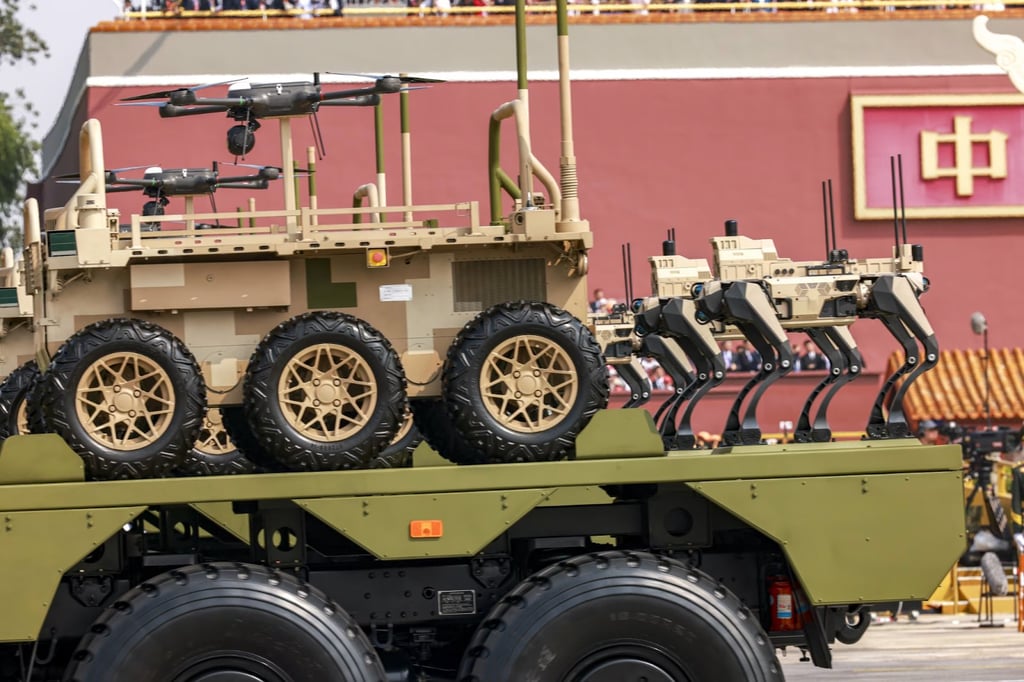


China’s leading military labs are developing autonomous weapons designed to hunt and operate like apex predators, with the capability to deploy and operate with minimal human input.
At one of China’s leading military-linked universities, researchers have studied the behaviour of hawks, wolves, and coyotes to simulate how drones and quadrupedal robots should act when encountering enemy units. In some scenarios, the systems are programmed to behave like apex predators, identifying and targeting weaker adversaries. In other cases, they adopt survival strategies observed in coyotes, prioritising evasion and avoiding detection by more serious threats.
The drone systems, known as Swarm I and Swarm II, can launch hundreds of drones under a single mission objective. These swarms are designed to continue operating autonomously even when communications are jammed. Their behaviour can shift depending on the mission, allowing them to identify vulnerable targets in one scenario and remain concealed or evasive in another.
Quadrupedal robots are also designed to operate as coordinated teams, fanning out across wide areas to intercept targets, inspired by wolf-pack hunting tactics. China has increasingly showcased these robots during military exercises.
Seven universities linked to military projects backed by China’s Communist Party, which make up the Seven Sons of National Defense, are thought to be responsible for the surge in military patent activity in recent years, according to a report by The Wall Street Journal. China’s patent filings have reportedly far outpaced those of the US in fields such as drone swarming and swarm intelligence.
Researchers are also working on “information warfare” systems that use artificial intelligence to generate multimedia propaganda and deepfakes. This is expected to be a high-growth market over the next decade, with global forecasts indicating it could reach $35 billion by 2035.
Drone warfare is a high-value market
The war in Ukraine has highlighted the growing importance of drones on the modern battlefield, with both sides deploying unmanned systems deep into enemy territory.
Defence against these drones has become a high-value market, with companies such as OpenAI and Palmer Luckey’s Anduril working with the US military on detection and interception technologies. On the ground in Ukraine, front lines are reportedly covered with fish wire and other low-tech measures designed to physically block incoming drones.
Many militaries are now increasing spending on both offensive and defensive drone capabilities. North Korea’s state-run media recently reported investment in “AI suicide drones,” similar to systems deployed in Ukraine but designed to operate without direct human involvement.
China’s civilian robotics edge finds way to battlefield
It is not just drones that China’s People’s Liberation Army is keen to demonstrate. The military has recently released a video of a motion-controlled combat robot, which researchers and officials claim could be used in real-world combat scenarios rather than purely for demonstrations or entertainment.
China’s military research and development spending has increased rapidly over the past two decades. By leveraging its dominance in hardware manufacturing and civilian robotics, the country has quickly adapted and repurposed technologies for military use.
Also read: In a separate push to test robotics in high-stakes environments, Airbus will trial UBTech’s Walker S2 humanoid robots in aircraft manufacturing.