








When land runs out, China is looking to the sea.
The country is turning to underwater data centers powered by offshore wind to fuel its fast-growing AI ambitions. A newly operational subsea facility near Shanghai shows how far that idea has come. By placing compute infrastructure beneath the ocean and pairing it with renewable energy, China aims to ease pressure on crowded cities while cutting energy use.
Offshore wind meets underwater compute
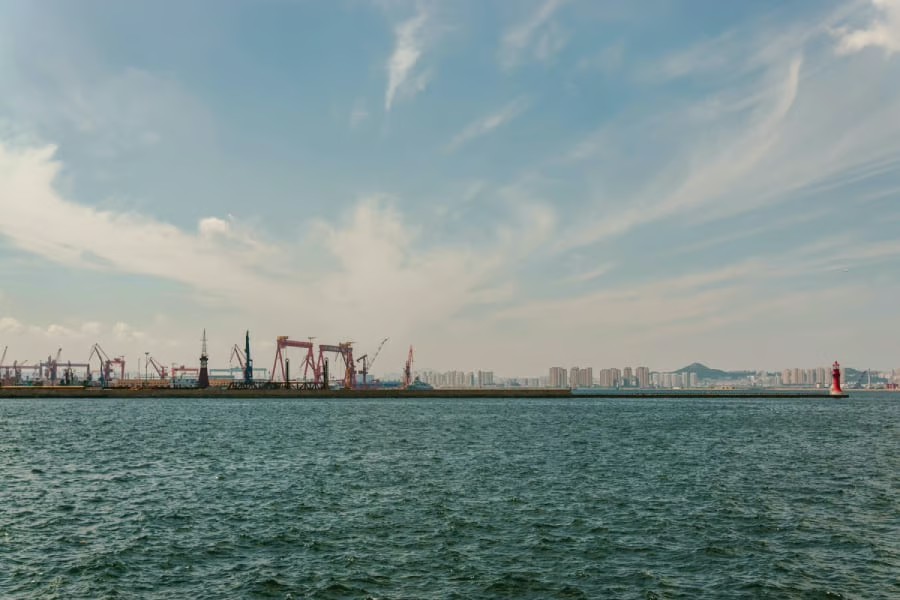
The South China Morning Post reported that China recently started operating what is believed to be the world’s first subsea data center. The facility is directly connected to an offshore wind farm in Shanghai’s Lingang Special Area.
The facility, built by Shanghai HiCloud Technology, is situated about 10 meters underwater and roughly 10 kilometers off the coast. It has a planned capacity of 24 megawatts and represents an investment of approximately 1.6 billion yuan, or $232.4 million. The system links to onshore cloud and telecom infrastructure and is designed to handle AI workloads, including autonomous driving and embodied intelligence applications.
The project is also connected to offshore wind farms, enabling renewable energy to power the site while seawater cools the systems.
Efficiency gains drive early momentum
According to Tech in Asia, China’s subsea push builds on earlier deployments in Hainan, where HiCloud tested underwater data center systems in commercial settings.
Initial results pointed to measurable efficiency improvements over land-based facilities. SCMP noted that the Hainan project reduced water use by 26,000 tons annually, cut electricity consumption by 3.4 million kilowatt-hours, and lowered carbon emissions by about 2,720 tons.
“HiCloud has demonstrated the comparative advantages of submarine data centers through commercial operation in Hainan,” analysts from a Shanghai government-backed think tank told SCMP.
Cooling plays a major role in those gains. Subsea systems use surrounding seawater, reducing the need for energy-intensive cooling that can account for a large share of electricity use in traditional data centers.
Early-stage model still faces hurdles
Despite growing interest, subsea data centers remain in the early stages of development. Analysts pointed to challenges, including a lack of industry standards, maintenance complexity, and uncertain long-term economics, as noted in CXO Digital Pulse reporting.
China’s efforts follow earlier experimentation in Microsoft’s Project Natick, which deployed underwater data centers off Scotland. Tech in Asia explained that the project demonstrated improved reliability but was discontinued in 2024 due to concerns about scalability and operational costs.
China’s approach focuses on shallow-water deployments, which developers say could reduce costs and simplify maintenance. Still, scaling the model will require addressing technical and operational risks.
For now, subsea data centers are expected to complement rather than replace traditional infrastructure as demand for AI computing continues to rise.
Also read: China’s new humanoid robot training schools show how robotics companies are using repetition and real-world simulation to prepare machines for practical work.