






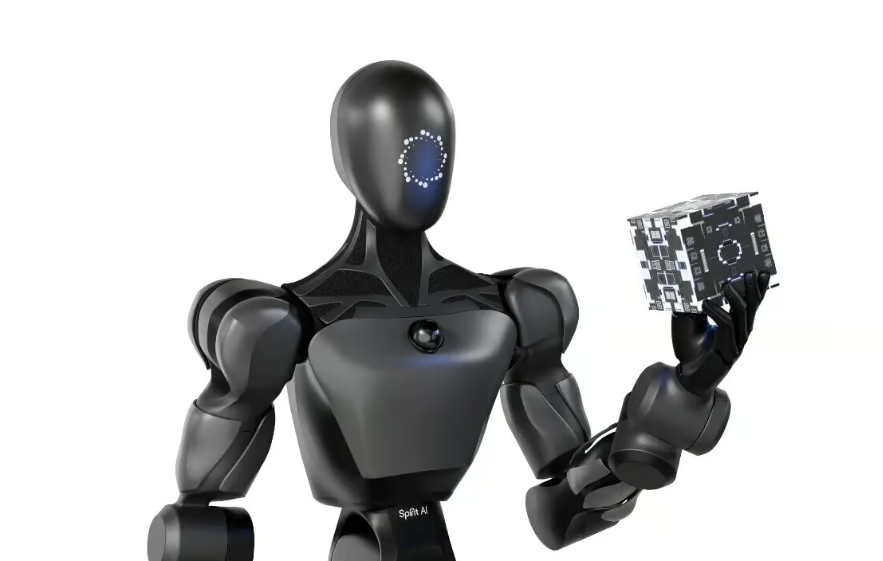


A Chinese robotics startup has claimed the top spot on a global robotics leaderboard, edging out Nvidia in a closely watched test for physical AI models.
Spirit AI’s Spirit v1.6 embodied intelligence model ranked first on the RoboArena leaderboard, ahead of Nvidia’s Cosmos3-Nano-Policy. The result does not settle who leads in robotics, but it gives Spirit AI a high-profile benchmark win in a field that could shape factory robots, logistics automation, autonomous machines, and humanoids.
Spirit AI climbs RoboArena
The South China Morning Post (SCMP) reported that Spirit v1.6 scored 1,924 on RoboArena, ahead of Nvidia’s Cosmos3-Nano-Policy, which scored 1,881. Another Nvidia project, DreamZero, ranked third with a score of 1,763.
Spirit AI, based in Hangzhou, Zhejiang province, was the first model from China to top the RoboArena global leaderboard, according to SCMP. The benchmark evaluates how well generalist robot policies translate into real-world actions.
The ranking came shortly after Nvidia launched Cosmos 3, a model SCMP described as designed to help physical AI “think before it acts.”
Physical AI differs from large language models because it focuses on machines that must perceive, understand, and interact with the real world. Instead of generating text or code, these systems help robots, autonomous vehicles, and other machines decide what to do next.
Funding adds momentum
Gasgoo noted that Spirit AI completed a 1.5 billion yuan (about $222 million) A+ funding round on June 3. The round was backed by top-tier US-dollar funds, major industrial capital, state-owned national funds, and existing shareholders.
The financing marked the largest funding round and most diverse capital structure in China’s embodied intelligence sector to date.
Spirit AI is positioning its technology for use in automotive manufacturing and smart logistics. Those markets could give embodied AI a commercial path beyond benchmark rankings, especially in environments where robots need to perform physical work under changing conditions.
SCMP also highlighted that Spirit AI has completed four funding rounds in three months. Other Chinese embodied AI startups have also drawn major funding, including XYZ Embodied AI and Manifold AI.
Robotics becomes a new AI battleground
According to SCMP, Nvidia CEO Jensen Huang framed data as a central challenge for the field. “For robotic systems and physical AI, data is the hardest problem,” Huang said.
That challenge may shape global competition. “China was fundamentally very well positioned on data,” Alexandr Wang, founder of Scale AI and now with Meta Platforms, told SCMP.
The publication also noted that Beijing and Shenzhen have supported state-backed “data factories” to collect robotics data.
For businesses, the leaderboard result should not be read as a final verdict on physical AI leadership. Benchmarks can change, and real-world robotics performance depends on more than one score.
Still, Spirit AI’s rise shows that physical AI is becoming more competitive. As robotics models improve, enterprises may see new automation options for manufacturing, logistics, autonomous machines, and other settings where AI has to act, not just answer.
For more on physical AI research, read about how Nvidia, Unitree, and Sharpa launched a new humanoid robot for robotics development.