






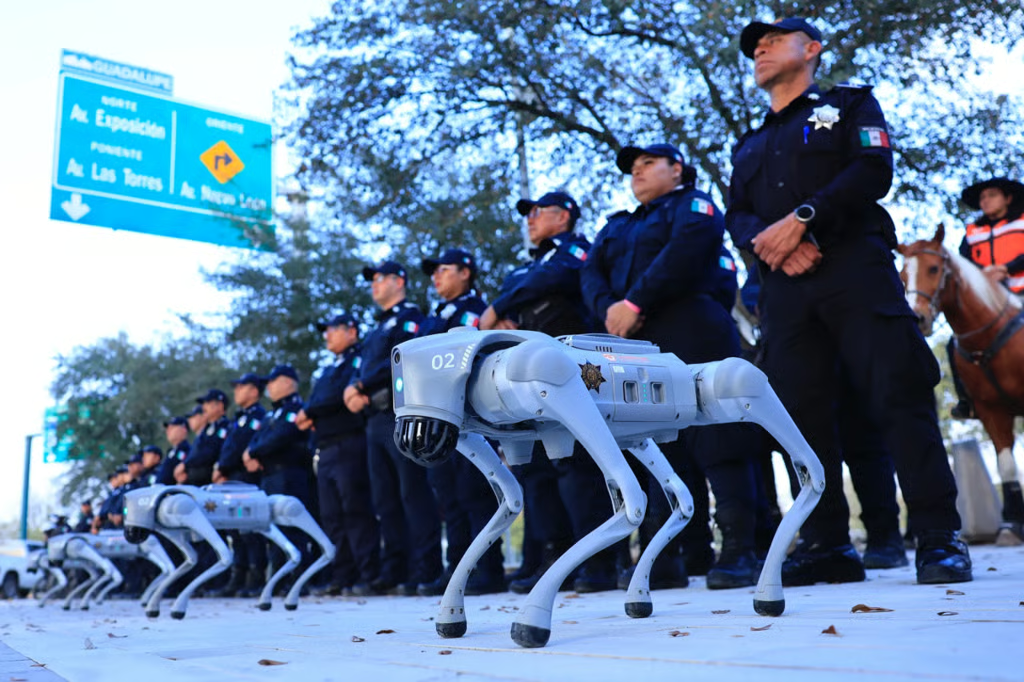


As millions of football fans flood into stadiums across North America, they are being greeted by a new kind of security personnel: autonomous, four-legged robot dogs.
The deployment turns one of the world’s biggest sporting events into a live test of robotics in crowded public spaces. The machines, known as Spot robots and built by Boston Dynamics, are being deployed at selected World Cup venues in the United States as Hyundai Motor Group expands its largest-ever robotics and mobility program for a global sporting event.
Hyundai said it has rolled out more than 1,500 vehicles and robots across host cities in the United States, Canada, and Mexico. The company, which owns Boston Dynamics and serves as FIFA's official robotics partner, is using the tournament to showcase how autonomous machines can assist with large-scale events.
Four customized Spot robots are operating at the International Broadcast Center in Dallas as well as at venues in New York and New Jersey. Their job is not to replace human guards. Instead, they patrol designated areas, conduct inspections, and help security teams keep watch over busy locations expected to attract huge crowds.
Built for crowded and unpredictable venues
Unlike factory floors, stadiums and broadcast centers are constantly changing environments. Thousands of fans, media workers, and staff move through these spaces every day, creating a setting where robots must navigate around people, obstacles, and ongoing activity while continuing to perform their tasks.
Hyundai says the tournament provides an opportunity to test robotics in real-world environments where reliability and safety are critical. The company believes the experience could help shape future uses of autonomous systems at public events.
The robots are equipped with cameras that stream footage back to command centers and are designed to access areas that may be difficult or unsafe for humans to inspect.
Not what social media claims
Despite viral posts online suggesting the robots are equipped with facial scanning technology, that claim has been directly denied by officials and the robot’s maker.
Reuters reported that FIFA and Boston Dynamics confirmed the robots are not capable of facial recognition. A Boston Dynamics spokesperson said the Spot units are deployed for perimeter checks and to “assist security personnel with investigating suspicious packages or other potentially hazardous materials.”
FIFA also clarified that the robots are being used for asset protection and risk detection, with any findings escalated to human security teams for action. The viral claims were traced to misleading social media posts, including edited videos shared on platforms like TikTok and X.
A bigger test for robotics in public spaces
The World Cup marks one of the largest real-world tests yet for autonomous robots in public venues. Traditionally used in controlled industrial environments, robots like Spot are now being pushed into unpredictable spaces filled with fans, media crews, and live operations.
Experts say this shift is important because stadiums and public events require constant monitoring, quick response, and safe navigation through dense crowds.
These conditions are far more complex than factory floors. If the machines prove useful in crowded venues and complex environments, they could become a more familiar sight at future sporting events, concerts, and other major public gatherings.
Also read: A California fire department is testing a robot dog for inspections, hazardous areas, and emergency response work.