






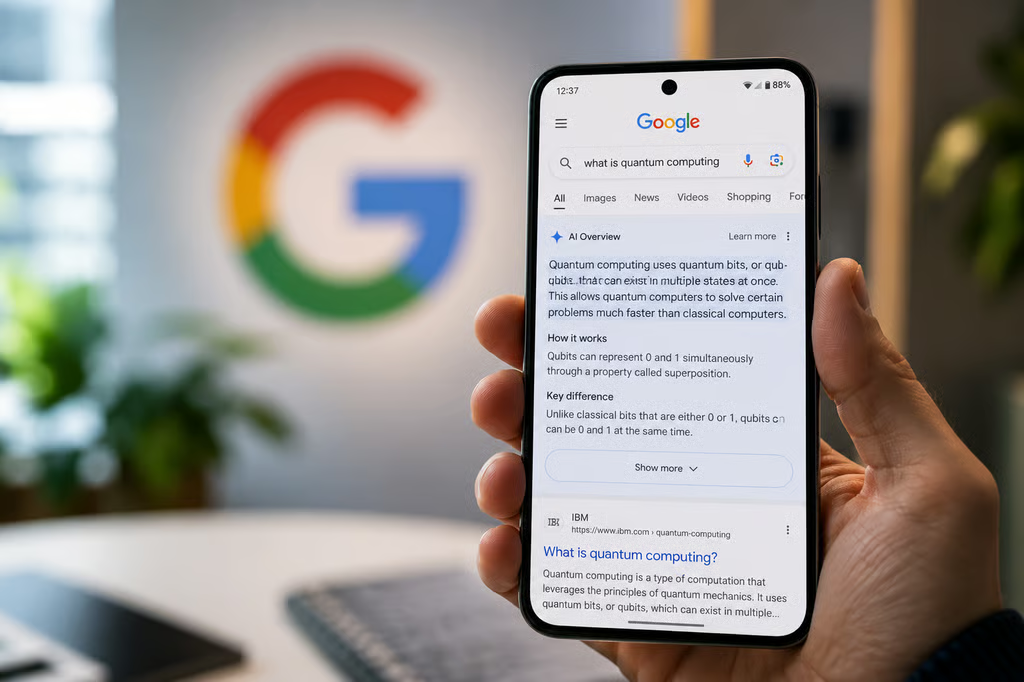


Google's push to make Search more AI-driven is drawing fresh scrutiny over how well those tools protect younger users.
Common Sense Media's Youth AI Safety Institute rated AI Overviews and AI Mode as posing an "Unacceptable Risk" to minors after testing the features with child accounts using Google's default protections. Google disputed the findings, arguing that the tests did not reflect typical user behavior.
The disagreement highlights a broader challenge as AI-generated answers become a primary source of information for children and teenagers.
What the organization says it found
Google's AI Search features did not receive their "Unacceptable Risk" rating because of a single flawed response. Instead, Common Sense Media said the designation followed a broader evaluation of how AI Overviews and AI Mode responded to hundreds of test prompts across multiple safety categories.
The organization said it used Google accounts for children aged 11 and 15, with the company's built-in protections enabled, and completed more than 2,600 searches and assessed over 2,100 AI-generated responses. In a report detailing the research process, Common Sense Media noted that both Google Search AI and AI mode repeatedly revealed shortcomings across several areas.
Highlighted in the reports were cases where the tools helped complete homework instead of helping the user learn, failed to detect "signs of suicidal ideation," and presented inaccurate information.
According to separate research from the organization, 75% of U.S. tweens and teens already use AI-generated answers in search results, while Google remains the dominant search engine. Against that backdrop, Common Sense Media argues that shortcomings in Google's AI Search are more significant because the feature is deeply integrated into Search and difficult for parents and schools to disable.
Google says the claims hold no weight
Google has rejected the report's conclusions, arguing that the testing does not accurately represent how people interact with its AI-powered Search features. In a statement to Android Authority, the company said many of the prompts used during the assessment were "ambiguous and contrived," making the results unrepresentative of real-world use.
In a separate response to PBS News, the technology giant noted that these AI tools “are an incredibly useful way for kids and teens to learn, explore and make sense of information and the world.” In the same statement, Google also clarified that parents could turn off the AI tools.
The company also challenged the legitimacy of the tests, noting that several examples highlighted in the report could not be reproduced internally, according to reporting from The New York Times. Google argued that the reported issues could not be reliably reproduced, a key factor in verifying and addressing potential flaws.
Broader implications
According to Android Authority, Common Sense Media also tested other AI tools and found them to pose unacceptable risks, suggesting the concerns extend beyond Google Search.
For Google, however, the findings carry particular weight because AI Overviews and AI Mode are deeply integrated into the world's most widely used search engine. As AI-generated answers increasingly become the default way people, including children, access information online, questions about safety, accuracy, and age-appropriate responses are likely to face greater scrutiny from parents, educators, and regulators.
While the report does not carry legal force, it could influence how AI search platforms design safety guardrails and demonstrate that their protections work consistently for younger users. As AI becomes the front door to the web, child safety may become as important a measure of these tools as answer quality or speed.
More News: Google is facing a new copyright lawsuit from major publishers and author Scott Turow, escalating the legal battle over whether Gemini was trained on copyrighted books without permission.