






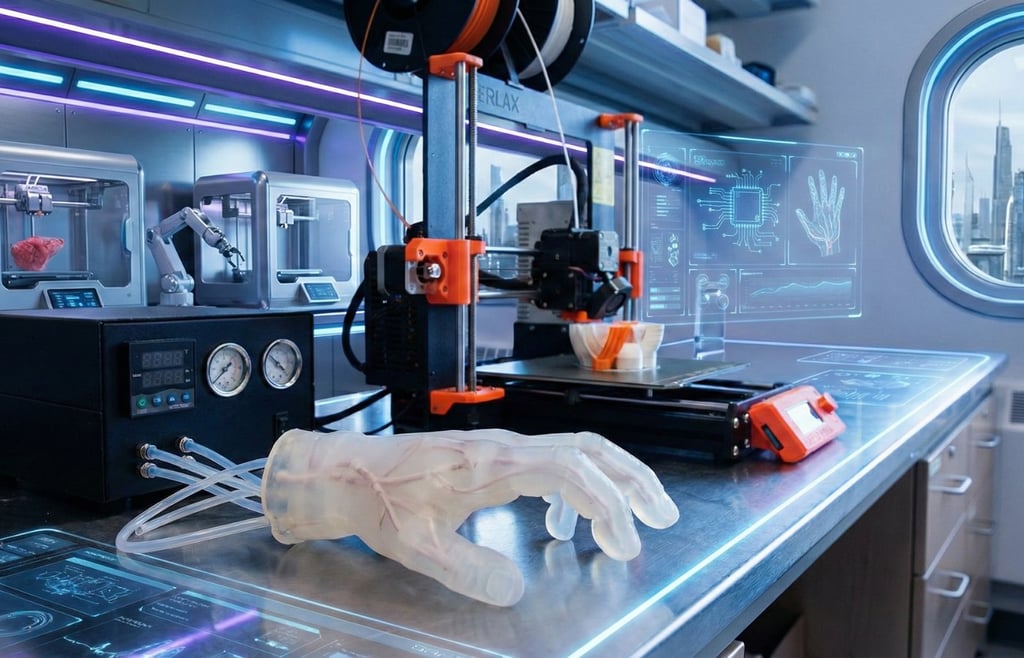


Soft robots just got a lot more lifelike.
Harvard engineers have developed a 3D printing method that produces flexible machines capable of bending and moving on command, much like real muscle. In a study published in Advanced Materials, the team describes a fabrication approach that embeds motion directly into soft structures during printing.
Where rotation becomes instruction
The breakthrough centers on the printer head. Instead of depositing a single material, a rotating dual-material nozzle extrudes a flexible outer shell around a temporary inner gel in one continuous sweep.
As the nozzle turns, it determines where the internal channel sits within each filament. Once the outer layer sets, the gel is removed, leaving hollow pathways that can be pressurized with air. Those channels drive the bend, with direction and intensity decided during fabrication rather than after assembly.
The result is a soft device produced in a single pass, without the molds or multi-step layering that have traditionally defined soft robotics manufacturing.
Designing how it moves, not just how it looks
Control is built into the layout itself. By adjusting the geometry of each filament, researchers can influence how a structure will curve, twist, or flex once inflated.
The printed strands can run straight, arc across a surface, or stack into raised patterns, allowing flat sheets to curl and segmented forms to bend at defined points. In lab demonstrations, the team produced a spiral flower actuator and a five-digit, hand-inspired gripper with bending knuckles.
To create more intricate builds like the gripper, the researchers relied on a connected spiral pathing strategy that lets the printer generate complex shapes in one uninterrupted motion.
Instead of attaching separate mechanisms later, the structure’s behavior is determined by its printed architecture.
A faster path from concept to testing
The approach also streamlines development. Traditional soft robotics often requires designing and fabricating molds before testing even begins, slowing iteration and locking designs in early.
Here, a digital adjustment can be followed by a reprint and a new test cycle without additional tooling. That shorter loop makes it easier to experiment with new geometries and refine performance.
Built for precision tasks inside tight spaces
Soft robotic systems are increasingly sought after in environments where rigid machines fall short, especially in healthcare. Devices that flex and compress are better suited for navigating confined or delicate spaces, including inside the human body.
The Harvard team highlights potential uses in surgical robotics and assistive technologies, where controlled motion and material compliance are essential. The researchers have also filed a patent on the printing method, showing ambitions beyond the laboratory.
After shipping around 5,500 units last year, Unitree now has its sights set on 20,000 humanoid robots in 2026.