






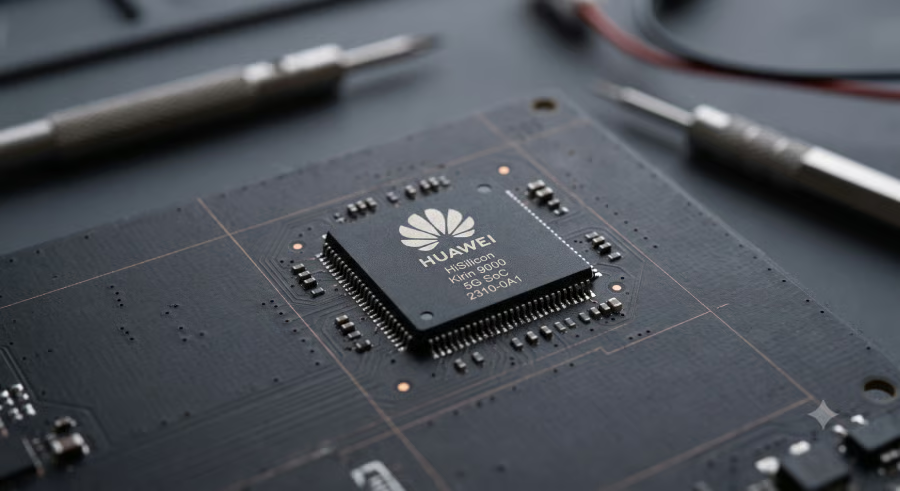


Huawei says its next phone chip can pack in far more computing power without newer chipmaking tools.
The company claims its upcoming Kirin smartphone processor can deliver a 55% increase in transistor density over last year’s Kirin 9030 Pro without moving to a newer manufacturing process. The reported gains stem from a LogicFolding design that rearranges logic circuits rather than relying on more advanced lithography tools, the light-based process used to print smaller features onto chips.
For China’s semiconductor industry, the claim matters because it suggests a design-first workaround amid ongoing US export controls that restrict access to the most advanced chipmaking equipment. The hard part is proving that the gains can survive real-world production, where heat, yield, cost, and reliability still decide whether a chip design can scale.
Huawei points to chip design over lithography
The South China Morning Post reported that Huawei’s Kirin 2026 uses the company’s LogicFolding architecture, which reorganizes the physical layout of logic circuits rather than relying on a smaller fabrication process.
“The gains were obtained not through a new lithography step but through a topological reorganisation of the spatial distribution of logic,” He Tingbo, chairwoman of the Huawei Scientist Committee and president of the company’s semiconductor business department, wrote in the updated paper, according to SCMP.
Huawei said the Kirin 2026 also cut power consumption by 41% while achieving the same performance as the Kirin 9030 Pro baseline. The chip also recorded a 5.6% drop in power density at 25 degrees Celsius and 0.9V.
Interesting Engineering said that the double-layer LogicFolding design shortens wire length by 30%, lowers the clock-buffer count by more than 50%, and cuts clock skew by 25%. Those changes can help signals move more efficiently across the processor.
Put simply, Huawei is trying to squeeze more performance out of chip architecture rather than waiting for access to more advanced manufacturing equipment.
A design-first path for China’s chips
Huawei introduced Tau Scaling Law as an alternative to Moore’s Law, which has traditionally focused on shrinking transistors to fit more of them onto a chip. Tau Scaling focuses instead on how quickly data moves through a processor.
The stakes go beyond one Huawei handset.
China’s chip industry is under pressure to keep advancing without the same access to advanced foreign tools used by leading global foundries. If Huawei can commercialize the design at scale, it could support domestic smartphone and AI hardware makers while adding another variable to Asia’s already crowded semiconductor market.
He also outlined a longer-term plan for LogicFolding to move from today’s two-layer approach to three, four, or more active tiers per package.
“Over the next decade, LogicFolding is expected to evolve from local critical-path folding to full-scale, multi-layer folding,” He wrote, according to Interesting Engineering.
Heat and yields remain the hard part
The research was published on ChinaXiv, a platform for scientific papers that have not yet undergone peer review, so Huawei’s figures still need broader technical scrutiny.
The biggest tradeoffs are also familiar in chip manufacturing: heat dissipation, production yield, standards, tooling, and cost. A denser chip can look strong on paper, but commercial devices need consistent manufacturing results and thermal performance under real-world use.
For smartphone buyers, the immediate impact could be faster Huawei Mate devices with better power efficiency, if the claims hold up in commercial hardware.
For the regional chip market, the bigger takeaway is that design innovation may become a more important lever as export controls reshape hardware supply chains and domestic technology strategies.
Huawei’s claim is not just about one phone chip. It is a test of whether architecture can help close part of the gap created by limited access to advanced lithography.
Also read: DeepSeek’s reported AI chip push could reduce its reliance on Nvidia and Huawei as China’s AI hardware race grows more crowded.