








Your next fitness tracker may not just monitor your body—it could try to read your emotions.
A recently published Meta patent describes an AI-powered wearable capable of estimating a user’s emotional state by combining speech patterns, laughter, sighs, daily activities, and times when user’s take their medication.
The patent was filed on Dec. 16, 2025, and published on July 2, 2026. The system is designed to build emotional profiles over time while adapting coaching recommendations based on those observations.
The proposal highlights how AI wearables could expand beyond monitoring physical health into interpreting human behavior and emotions, a direction that has already prompted privacy concerns. Meta, however, maintains that patent filings should not be viewed as evidence that a product is being developed or will reach the market.
How the tool tracks your mood
Current fitness platforms typically tailor recommendations using physical health data, workout history, and user-entered information. Meta’s patent expands that approach by introducing an AI assistant that continuously builds an emotional profile from signals gathered throughout a user’s day.
As Patentlyze observed in a review of the filing, the system is designed to operate across different contexts rather than only during exercise sessions.
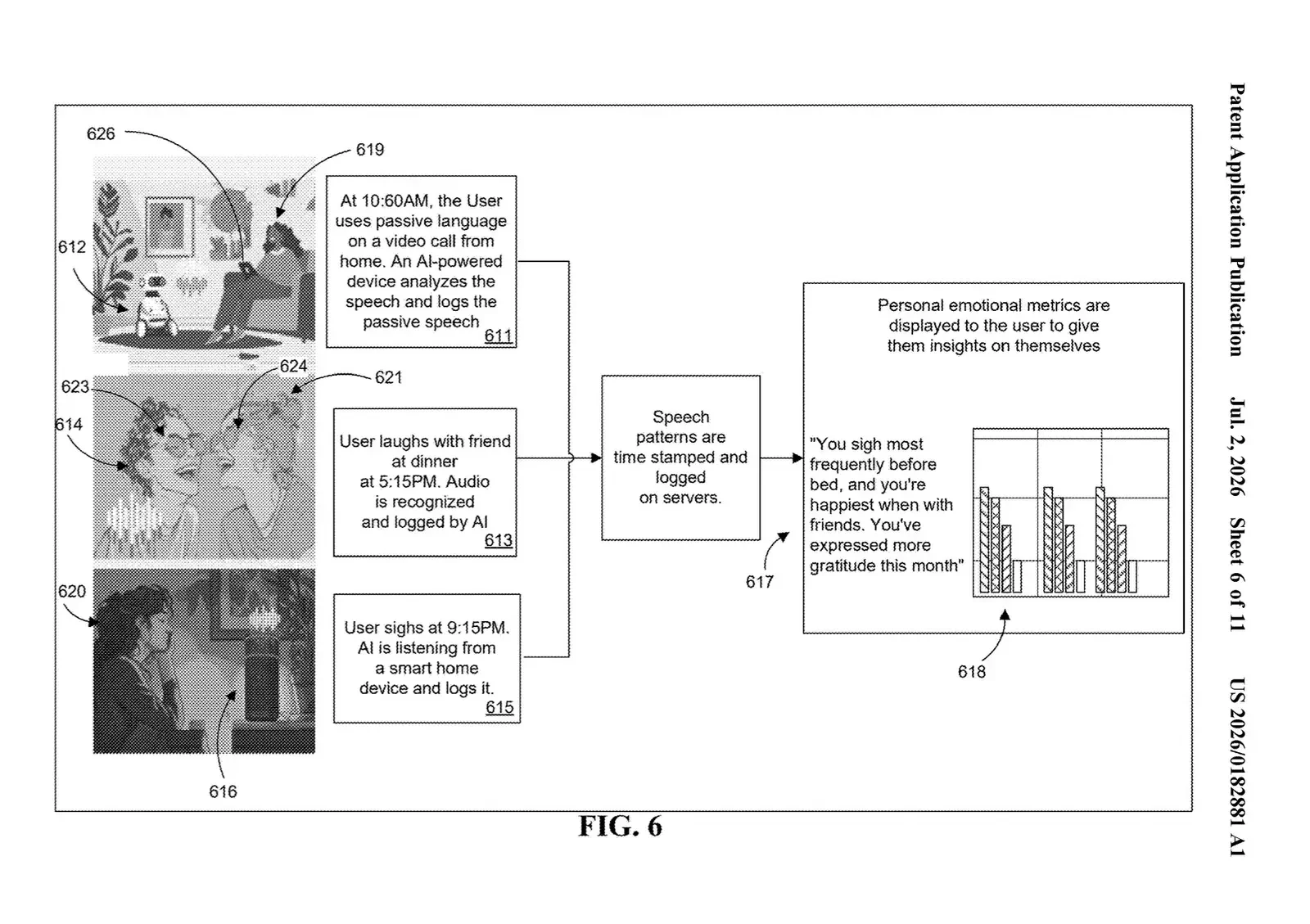
Based on the patent, the AI first records and transcribes spoken audio. An emotion-state machine-learning model then evaluates both verbal and nonverbal characteristics such as tone, pitch, and speaking pace. The patent says those findings are then linked to factors such as location, current activities, time of day, and digital interactions.
The patent says the resulting profile could feed into the wearable’s coaching functions, allowing it to recommend routines, determine when a user is most prepared for exercise, and provide corrective guidance during workouts. Rather than responding to a single conversation or event, the system is designed to refine its recommendations as additional behavioral data accumulates.
Another tool joins Meta's queue
Meta’s new patent will be the company’s latest move to building products that draw on user-generated behavior and activities. In a statement to 404 Media, Tracy Clayton, a spokesperson at Meta, noted that the company may not pursue development of the product, even if the patent is granted.
The patent follows several other AI-related concepts Meta has explored publicly and through patent filings. Separately, reports last month suggested the company was developing Arena, a prediction market app to rival dominant platforms like Polymarket and Kalshi.
Privacy advocates view the tech from a different angle
Privacy advocates argue the bigger issue is not the wearable itself, but the kind of data the technology will generate. Josh Golin, executive director of Fairplay, warned that technology capable of interpreting users’ emotions could become another tool for profiling people, calling it part of Meta’s broader effort to “monitor every aspect of our lives” to profit from ads targeted at users’ emotional vulnerabilities.
The criticism lands differently because it targets Meta’s business model rather than the patent’s technical design or the AI’s potential accuracy.
For consumers, the filing raises a broader question as AI assistants become more capable: should emotional inferences be treated as just another data point, or too personal to fuel personalized recommendations or targeted advertising?
Related News: Meta's Muse Image sparked backlash after allowing public Instagram photos to be used for AI-generated images by default.