






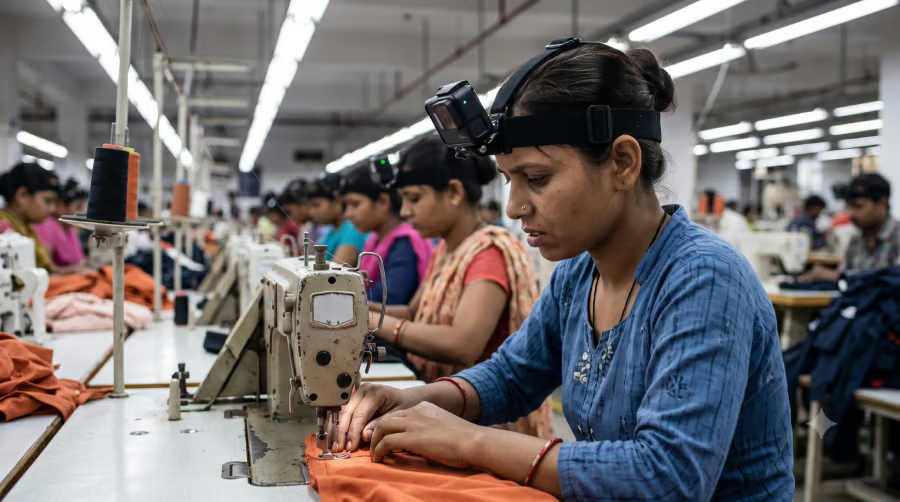


Manufacturers in India are asking factory workers to wear head-mounted cameras to capture footage for training AI-powered robots. While the practice has yet to emerge in Singapore, it raises governance questions for one of Asia’s most automated manufacturing sectors around employee consent, surveillance, and ownership of worker-generated training data.
Singapore’s manufacturers have spent years building one of the region’s most automated production bases. That progress now places them closer than many of their regional peers to a workplace governance challenge emerging alongside industrial AI: how organizations should manage the knowledge and data generated by skilled employees as robots become more capable.
The questions are being sharpened by reporting from The Guardian, which found factories using wearable cameras to collect first-person footage from assembly-line workers for AI robot training. Although the practice has yet to surface locally, it offers an early look at the policy decisions Singapore manufacturers may soon face as industrial AI moves from software pilots onto production floors.
A workplace and AI trend
A report from The Guardian has emerged about manufacturing sites across the Global South, particularly in India, where assembly-line staff are asked to wear forehead-mounted cameras and smart glasses during shifts. The footage is "egocentric," first-person video capturing how experienced workers handle tools and materials.
That kind of physical demonstration data is scarce and expensive to collect in wealthier markets. It has become essential fuel for vision-language-action models, the systems behind next-generation humanoid and industrial robots.
Data-aggregation firms, including Egolab.AI, Humyn Labs, and Scale AI, have positioned India as a primary source, supplying robotics developers whose product roadmaps depend on large volumes of human demonstration footage. Collecting equivalent footage in the US and similar regions can run upward of $30 an hour, the report said.
Separate reporting on the same trend has put individual worker pay in India as low as $1 an hour, well below what a simple fraction of the US figure would suggest, with data resold to robotics labs at a markup.
Permissions are typically negotiated with factory management, not individual workers. The Guardian reported that attempts to introduce direct payments to workers have met resistance from factory owners concerned about margins. The same footage collected for robot training can also be repurposed for productivity monitoring — tracking idle time or flagging when employees pause to talk.
For Singapore, this is less a story about wearable hardware and more about a shift already underway: enterprises building proprietary AI capability from the accumulated skill of their own workforce. In advanced manufacturing, that skill is becoming a strategic input rather than just a labor cost.
Why it lands differently in Singapore
Manufacturing accounts for a substantial portion of Singapore's GDP, and the sector sits squarely inside the government's AI ambitions. In February, Prime Minister Lawrence Wong announced a new National AI Council to run "AI missions" across four sectors, one of which is manufacturing.
That gives local manufacturers more exposure than most to exactly this dynamic. As robotics and industrial AI move from pilots to production lines, enterprises will need policies on how worker-generated data is collected, used, stored and eventually deleted. In the cases reported so far, those decisions appear to have been made informally, or not at all.
The consent structure described in the report is also where surveillance and AI training can quietly converge. A camera system justified as a robotics initiative can, without clear governance, double as a behavioral monitoring tool. Singapore's Personal Data Protection Act already requires organizations to obtain consent and limit the use of personal data to a stated purpose. That standard sits uneasily with data collected under one label and repurposed under another.
Workplace expectations are shifting too. Singapore's Workplace Fairness Act, passed in 2025 and expected to take effect in 2027, doesn't directly regulate AI-enabled surveillance. But it signals a broader move toward employers having to justify practices that materially affect staff. That translates into a bar that worker-monitoring and data-capture systems will increasingly need to clear, even without a dedicated AI surveillance law.
Who should be at the table?
The reporting frames this as a factory-floor issue. The governance questions extend well past operations teams:
- HR needs policies on employee consent and communication before any recording system goes live.
- Legal and compliance need clarity on retention periods and, where footage or models cross borders to overseas developers, on transfer obligations under Singapore's data protection framework.
- Security needs to treat worker-generated training data as a sensitive asset, with the same access controls as other proprietary IP.
There's also an unresolved ownership question. If a worker's accumulated expertise — reflexes, sequencing, problem-solving under real conditions — is captured, cleaned, and turned into a licensable dataset or model, it isn't obvious, under current frameworks, who benefits from that value beyond the employer. That question hasn't been tested in Singapore, but it sits close enough to existing employment and IP law to warrant attention before large-scale collection becomes routine.
A cautionary preview from outside the factory
The risk isn't confined to lower-wage manufacturing markets. Meta ran a comparable experiment within its own US workforce, capturing employees' keystrokes, mouse movements, and on-screen activity to teach its AI agents how people navigate software. The company said the data was for model training only, not performance reviews.
Weeks later, Meta paused the program after a security lapse exposed some of the records it had collected. For Singapore enterprises watching both the factory-floor and white-collar versions of this trend, the lesson is consistent: governance needs to be designed in before collection starts, not assembled after a leak or a labor complaint.
Industrial AI is moving out of software and onto physical shop floors faster than governance frameworks are catching up. Because Singapore's manufacturers rank among the highest globally for automation, they have an opening to set worker-data policy proactively rather than reactively.
Enterprises that treat data provenance, consent, and retention as governance requirements now, rather than as an afterthought once robots are already trained on their workers' movements, are likely to find that responsible data handling becomes a competitive differentiator as much as a compliance line item.