








Nvidia wants humanoid robots to become more than keynote theater.
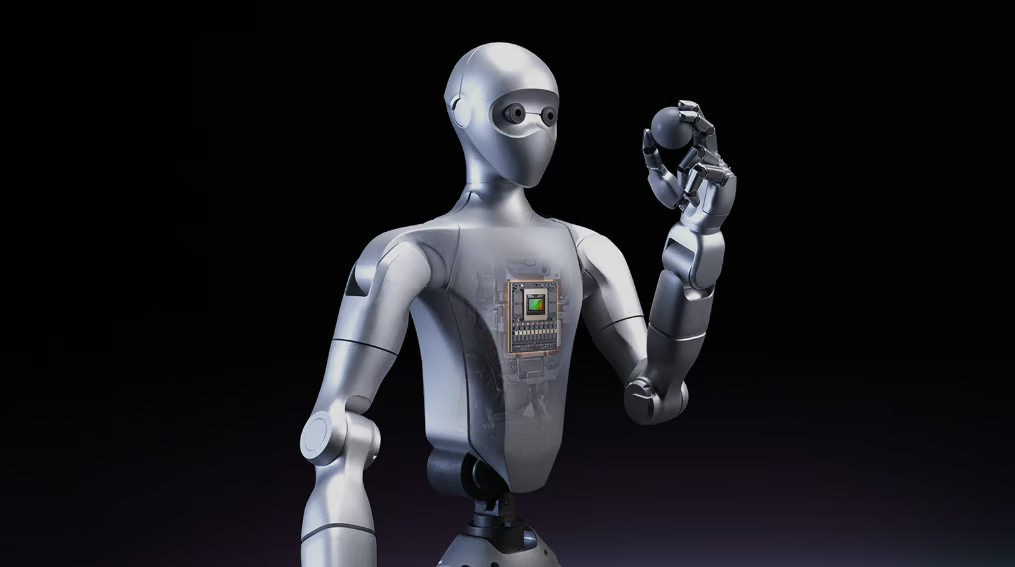
The company introduced the NVIDIA Isaac GR00T Reference Humanoid Robot during CEO Jensen Huang’s GTC Taipei keynote, providing academic robotics teams with a standardized platform for collecting data, training robot policies, testing behaviors in simulation, and deploying skills on real hardware.
Built with China’s Unitree and Singapore-based Sharpa, the system signals Nvidia’s broader ambition in physical AI: to provide not just the chips but also the software, workflow, and reference hardware that researchers use to build general-purpose humanoid robots.
A reference design for academic robots
Nvidia announced the open reference design as part of its Isaac GR00T development platform. The system brings together Unitree’s H2 Plus humanoid robot, Sharpa’s Wave tactile five-finger hands, Nvidia Jetson AGX Thor T5000 onboard compute, and Nvidia Isaac GR00T open software and models.
“Humanoid robots will bring physical AI to the world’s largest industries, opening a multitrillion-dollar economic opportunity,” Jensen Huang, founder and CEO of Nvidia, said in the announcement.
“The NVIDIA Isaac GR00T Reference Humanoid Robot gives researchers a single, open platform to make breakthrough discoveries toward general-purpose physical intelligence,” Huang emphasized.
The robot stands nearly 6 feet tall and weighs about 150 pounds, according to Nvidia. It has 31 degrees of freedom across the body, and the Sharpa hands add 22 degrees of freedom each, bringing the total to 75 degrees of freedom across the body and hands.
The reference design also includes multi-view sensing, including a head-mounted stereo camera, wrist cameras, and an inertial measurement unit for motion tracking. Nvidia stated that the Jetson AGX Thor T5000 module offers 2,070 FP4 teraflops of AI performance, 128GB of shared memory, and uses a Blackwell GPU to process and control the robot.
From simulation to real-world testing
The Isaac GR00T platform is designed to provide researchers with a more unified workflow for humanoid development. Nvidia said the stack includes Isaac Teleop for collecting robot demonstration data, Isaac Sim and Isaac Lab for simulation and policy training, Isaac ROS for deployment, and Jetson Thor for real-time robot inference.
“For agentic systems, robotic systems and physical AI, data is the hardest problem,” Huang said during his keynote, according to the South China Morning Post.
The company said researchers will retain control of robot data, training data, telemetry, and logs. That detail is important for academic labs and enterprise research teams that need to manage sensitive data while testing robots in physical environments.
Nvidia said Ai2, ETH Zurich, Stanford Robotics Center, and UC San Diego’s Advanced Robotics and Controls Laboratory are among the institutions expected to use the reference design.
SCMP noted that Sharpa founder David Li Yifan called the partnership “a meaningful step towards deploying robots that can perform real work in real settings."
Nvidia looks beyond Unitree
Nvidia executives told Reuters the company also plans to work with humanoid makers in the United States, Europe, and South Korea, in addition to Unitree. The company has not yet named those future partners.
Nvidia is also adding security features to the robot architecture. Nvidia chips will facilitate the flow of software updates for robot subsystems, allowing for code authenticity checks.
The company’s secure boot and confidential computing technologies are intended to help prevent robots from running malicious code and protect sensitive data from leaving the robot without permission.
The NVIDIA Isaac GR00T Reference Humanoid Robot will be available from Unitree in late 2026, while the Isaac GR00T reference workflow for Unitree G1 is expected to become available soon on GitHub and Hugging Face.
Read more about Unitree Robotics’ plan to scale humanoid robot shipments from roughly 5,500 units last year to as many as 20,000 in 2026.