







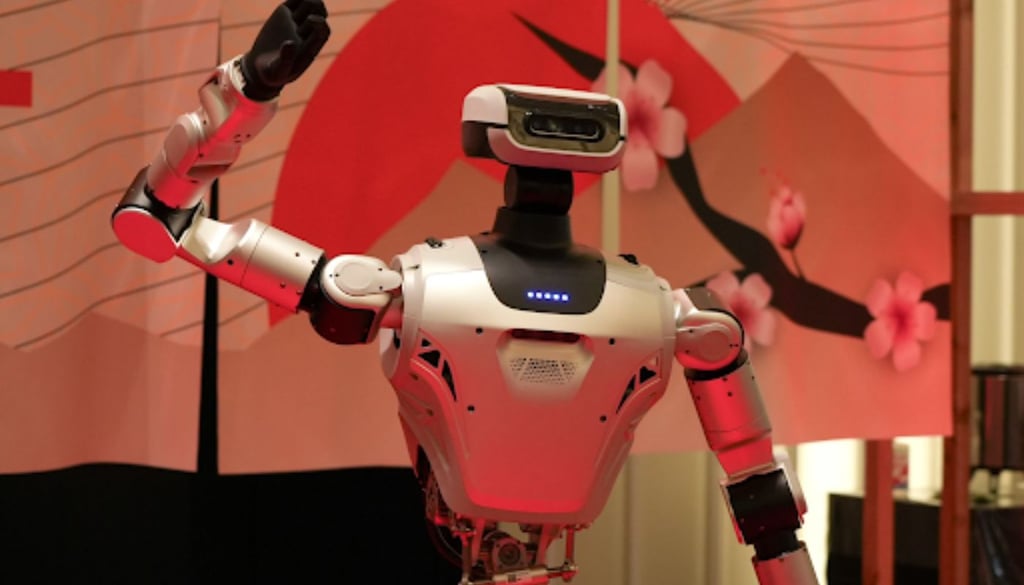
Humanoid robots danced, threaded needles, tightened tiny bolts, and pitched a future of airport delivery at a Tokyo robotics summit this week.
At the Humanoids Summit Tokyo, Chinese robotics companies were among the most visible exhibitors, with demos that highlighted lower-cost humanoid machines and faster commercialization. Japanese developers, including Honda, emphasized fine-motor control, durability, and manufacturing quality, while researchers pointed to Japan’s public openness to robots as a potential advantage.
For Japan, the stakes are especially sharp. The country helped define the modern robotics imagination, but China is now pushing hard on price, speed, and scale.
Chinese developers take the spotlight
The Associated Press reported that dozens of companies took part in the Tokyo event, including Boston Dynamics and Toyota Motor Corp., but Chinese companies emerged as some of the most visible competitors.
Chinese robotics developers, including Booster Robotics, LimX Dynamics, Unitree, and High Torque, are building on technologies first advanced in Japan and the US. The difference now is speed, cost, and commercialization.
Tim Hornyak, author of “Loving the Machine: The Art and Science of Japanese Robots,” told AP that Japan risks falling behind in humanoids because Chinese companies are moving faster.
“I really hope that Japan can come up with a Ford Model T-version of humanoid robots. But I think China has already stolen their lunch,” Hornyak said.
High Torque’s Mini Pi Plus robot clearly showed market tension. The small robot danced and wiggled for attendees, but it is not ready to work on an assembly line or wash dishes at home.
Its starting price of $5,500, however, points to a wider effort by Chinese companies to make humanoid systems more affordable and easier to scale.
Japan leans on precision and trust
Japan still has major strengths in humanoid robotics. Honda, known for its Asimo humanoid first shown in 2000, demonstrated a motorized four-fingered robotic hand that could screw and unscrew tiny bolts and thread a needle.
One example at the summit was GMO, a Tokyo-based AI and robotics company developing a humanoid with camera eyes for Japan Airlines cargo and other airport tasks. AP reported that the robot’s internal systems came from Unitree, a Chinese company also developing a four-legged robot.
Osaka University Professor Hiroshi Ishiguro, who has worked on humanoids for decades, said Japan remains well-positioned because its public is more receptive to robots.
“What’s significant is that Japan has a culture that’s receptive to robotics. If we’re going to really start using robots in society, Japan is the ideal place,” Ishiguro said.
From demos to real-world cities
The summit comes as Japan looks for ways to move humanoids beyond demonstrations. According to Nikkei Asia, the Institute of Science Tokyo is planning a district in Tokyo’s Meguro Ward where humanoid robots, automated transport, and AI-powered services would operate around residents and visitors.
The project would turn part of the city into a live testbed for physical AI, or AI systems that interact with the real world through robots, sensors, and automated infrastructure. A planned 39-story complex would serve as the first physical test site, with initial sections targeted to open in fiscal year 2031.
For Japan and China, the next test is whether humanoids can move from spectacle to utility. The winner may not be the robot that dances best, but the one that can do useful work without breaking the budget.
For more on where humanoid robotics is headed next, read about China’s XPENG plans for humanoid robot mass production by 2026.